

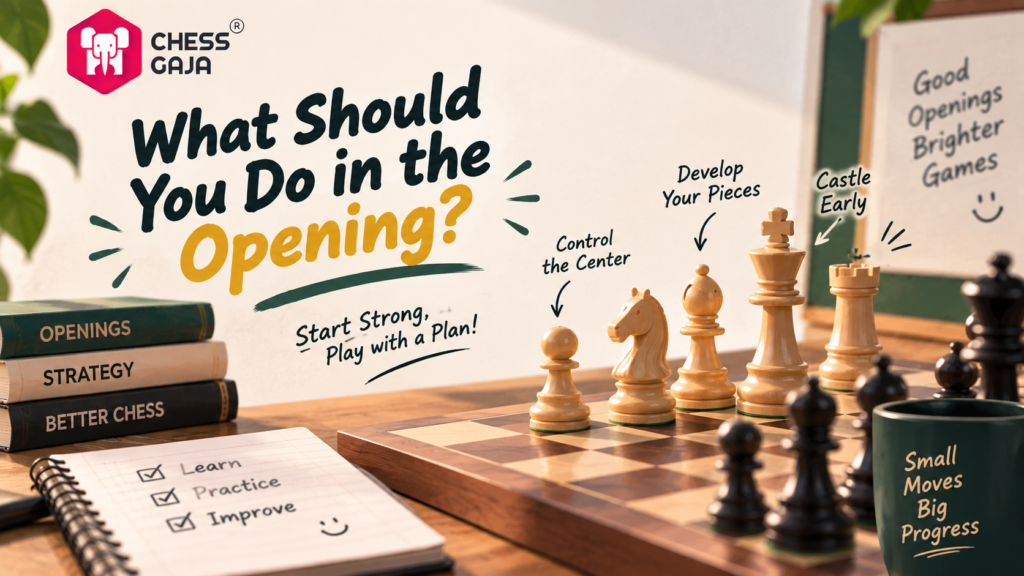
Your opening moves shape everything that follows in a chess game. Many beginners rush through this phase without a clear plan, leading to weak positions by move ten.
At Chess Gaja, we’ve seen how principled opening play transforms a player’s results. When you understand the core principles and build a consistent strategy, you move into the middlegame with real advantages.
Three Moves That Win Games
The first three moves of your game matter far more than most beginners realize. A USA-based student spent months memorizing opening lines but lost consistently because she had no framework for choosing between them. Once she understood the three core principles, her results shifted immediately. Within six weeks, her rating climbed 120 points.
Control the Center Before Your Opponent Does
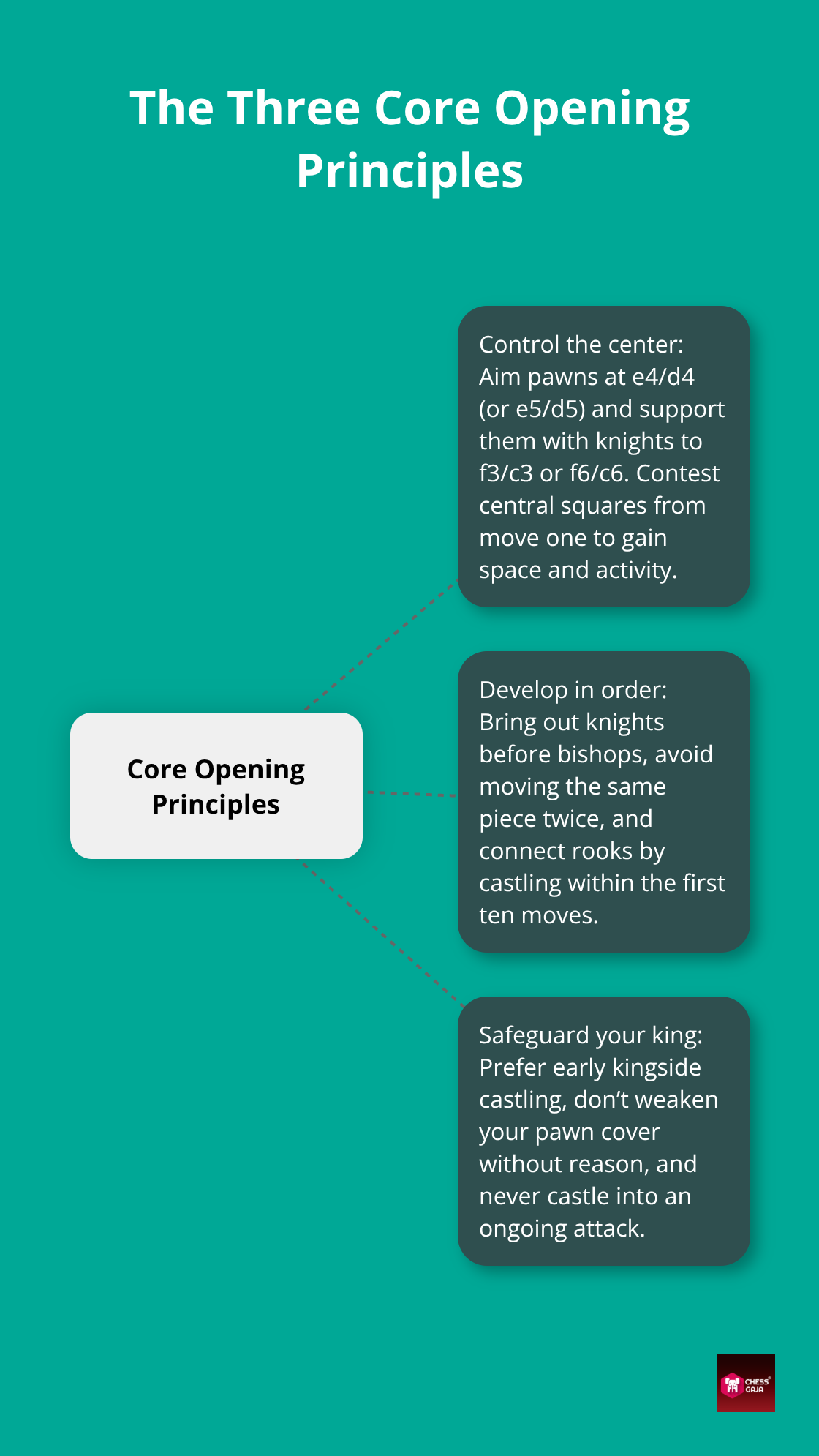
The four central squares-d4, d5, e4, e5-are the battleground where opening advantage is won or lost. White who plays 1.e4 or 1.d4 gains immediate space. Black must respond with equal force, not passivity. A pawn on d5 or e5 (for Black) directly contests White’s control. This is not theory; it is mathematics. Your first five moves should advance this single goal: place pawns on central squares and support them with pieces. If your opponent plays 1.e4, do not respond with 1…a6 or other rim moves. Play 1…c5, 1…c6, 1…e5, or 1…d5. Each contests the center immediately. Your second and third moves should develop knights toward the center, not toward the edges. A knight on f3 or c3 (for White) or f6 or c6 (for Black) supports center control and opens lines for your other pieces. A knight on h3 or a3 wastes a move.
Develop Pieces in the Right Order, Fast
Rapid piece development is essential to get out of the gates quickly. But speed alone is not enough; order matters. Move your knights and bishops first. Avoid moving the same piece twice in the first ten moves. A beginner in Singapore had developed his queen to f3 on move three, thinking he was attacking. Within three moves, his queen was repeatedly attacked by developing minor pieces and forced back to an inactive square, wasting precious moves. Meanwhile, his opponent had developed four pieces with purpose.
Develop knights before bishops. Because knights are short-range pieces, they need to reach central squares early to exert influence, whereas long-range bishops can control diagonals from behind. Once your knights stand on f3 and c3 (for White) or f6 and c6 (for Black), then develop your bishops. Place them on active diagonals where they control central squares or open lines. Do not place a bishop on a square where it blocks your own pawns. After developing both knights and both bishops, connect your rooks through castling. Castling serves three purposes: it protects your king from the center, it places a rook on an open or semi-open file, and it signals that development is maturing. Castle within the first ten moves in most positions. The entire process-knights, bishops, castling-should take roughly eight to ten moves. If you are still moving pieces aimlessly after move twelve, you have failed this principle.
Safeguard Your King Before You Attack
King safety is not optional. A student from Dubai ignored this principle in a tournament and was checkmated on move 18. His opponent sacrificed material to open lines around an uncastled king. Castling kingside (O-O) is generally safer than castling queenside (O-O-O). Kingside castling places your king closer to the corner, away from where most attacks originate. Queenside castling exposes your king to attacks along the c-file and can be risky if your opponent controls that file.
In most positions, castle kingside within the first ten moves. Only castle queenside if you have a specific reason-for example, your opponent has committed pieces to attacking the kingside. Never delay castling to chase material. A pawn or the exchange is not worth an exposed king. Never castle into an attack. If your opponent has pieces aimed at your castled king, find another way to secure it or avoid castling in that direction entirely.
After castling, your king is safer, but the game is not won. You must still avoid unnecessary weaknesses around your king. Do not push pawns in front of your castled king without a concrete reason. Each pawn move weakens the squares around your king permanently.
In the opening, your job is to complete these three tasks: control the center, develop your pieces in order, and castle your king to safety. Everything else-tactics, attacks, sacrifices-flows from this foundation. Once you master these three principles, you are ready to build a consistent opening repertoire that matches your playing style and competitive goals.
Your Opening Repertoire Matters More Than You Think
The Cost of Learning Too Many Openings at Once
Most beginners make one critical mistake: they try to learn too many openings at once. A student in the USA spent weeks memorizing 12 different openings, hoping to be prepared for anything. In her first tournament, she faced an unfamiliar move on turn four and panicked. She had no framework for responding because she had spread her study across too many lines. Within three games, her confidence collapsed. The problem was not her intelligence-it was her strategy.
We recommend beginners choose exactly two openings as White and two solid defenses as Black, then study them deeply for six to twelve months. This focused approach builds genuine understanding instead of fragile memorization.
Building Your Four-Opening Core
Choose one White opening that starts with 1.e4 and one with 1.d4. For 1.e4, the Italian Game offers straightforward tactical play with clear middlegame plans. For 1.d4, the London System provides a solid positional framework that requires minimal theoretical overhead—allowing you to focus on middlegame plans rather than pure move memorization.
As Black, select one reliable defense against 1.e4—such as the solid Caro-Kann (1…c6) or the dynamic Sicilian (1…c5)—and one defense against 1.d4, like the solid Slav Defense (1…d5) or the aggressive King’s Indian Defense (1.d4 Nf6 2.c4 g6). This four-opening core covers the vast majority of real tournament positions you will face.
Study Model Games From Active Players
Study model games from active players, not historical games from the 1950s. The Sicilian Defense is one of the most popular responses at club level and above. When you search opening databases, filter by rating-study games from players rated 2200 to 2400, not 2700+. Elite players often rely on deep computer preparation and niche theoretical novelties, whereas 2200–2400 rated players demonstrate clear, practical, and repeatable plans.
Watch how they handle the middlegame transition from your chosen opening. A student in Dubai studied ten games where White played the Italian Game and reached move 15 with a clear plan: activate the bishop pair, control the e-file, and launch a kingside attack. Once she recognized this pattern, she stopped memorizing moves and started understanding purpose.
Practice Your Lines Against Real Opposition
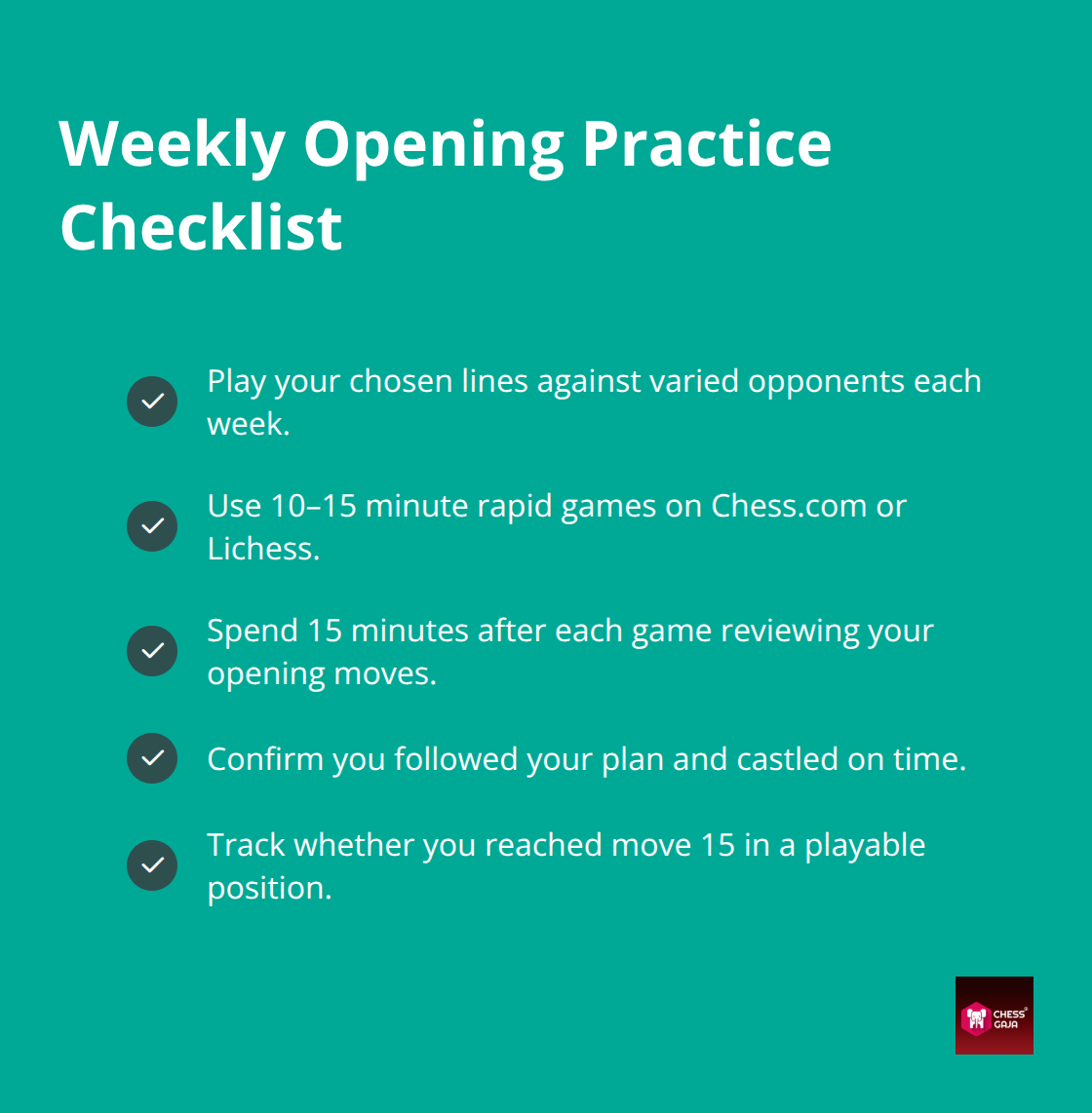
Practice your chosen lines against different opponents every week. Use Chess.com or Lichess to play rapid games with increments (such as 10+5 or 15+10) where you can apply your opening knowledge without rushing critical early middlegame decisions. After each game, spend fifteen minutes reviewing your moves from the opening phase.
Did you follow your plan and complete development on schedule? Most importantly, was your king safely castled before launching any action? Track whether you reached move 15 in a playable position.
If you lost games in the opening, the problem was not bad luck-it was a gap in your understanding. Record these gaps and study them specifically. A student in Singapore lost three games in a row because his opponent kept playing an offbeat third move that disrupted his memorized line. Instead of learning ten new variations, he studied one principle: how to respond when your opponent deviates. Once he understood the underlying principle, he handled all deviations confidently.
Moving From Memorization to Mastery
The transition from memorized lines to principled play happens when you stop asking “What move did the grandmaster play?” and start asking “What plan does this position demand?” Your four-opening core becomes a vehicle for learning how strong players think, not a script to follow blindly. As you build this foundation over the next several months, you will notice something shift: positions that once felt foreign become familiar, and your instincts sharpen. This is when you are ready to test your opening knowledge in real tournament conditions and discover where your preparation meets the pressure of competitive play.
Where Your Opening Strategy Falls Apart
Spreading Your Study Across Too Many Openings
Most beginners sabotage their own progress through three specific habits that destroy the foundation you have built. The first habit is spreading your study across too many openings simultaneously. A student in the UAE spent six weeks learning the Sicilian, the French, the Caro-Kann, and the Scandinavian all at once. When she faced the Sicilian in her first tournament, she froze because her study was fragmented across four different structures and middlegame plans. She knew isolated lines but not the connecting principles. Her rating actually dropped eight points after that tournament, not because she lacked talent but because she had diluted her preparation across openings that demanded different strategic thinking.
The solution is brutal honesty: choose your single main defense against 1.e4 and your main defense against 1.d4, and stop learning new openings for six months. This constraint forces deep study instead of shallow breadth. When you play the same opening repeatedly against different opponents, patterns emerge that memorization never reveals. You discover which middlegame structures you handle well and which expose gaps in your calculation. A student in Singapore played the King’s Indian for three months straight in rapid games online. Within three months, he recognized that his opponent’s most common reply on move seven created a closed center structure that demanded a systematic kingside pawn storm. He stopped asking what the engine preferred and started asking what the position demanded. His rating jumped 45 points because his preparation had shifted from memorization to pattern recognition.
Abandoning King Safety for Material Gain
The second sabotage is abandoning king safety to grab material in the opening. This is where ego and greed collide. A student in the USA saw a free central pawn on move seven and captured it without completing development. Two moves later, his opponent opened the e-file with a piece sacrifice against the uncastled king, leading to an unavoidable checkmate. He won material and lost the game. This happens constantly at beginner level because young players see the tactical gain and miss the strategic consequence.
Never take material if it delays your castling or weakens your king’s position. A simple rule: castle within the first ten moves unless your position demands otherwise. If your opponent has not castled and you have, you hold a significant advantage in most positions. That advantage is worth more than an extra pawn. The cost of an exposed king far exceeds the value of any piece you capture in the opening.
Attacking Before Development Is Complete
The third sabotage is attacking before development is complete. A student in Dubai developed his queen to f3 on move three, his bishop to c4 on move four, and then launched a premature pawn push with g4 on move five. He felt aggressive and in control. His opponent simply developed with purpose: knights to f6 and c6, bishop to e7, and castled kingside within eight moves. The student had three pieces aimed at the black king, but they were uncoordinated and easily defended. Within twelve moves, the student had no plan beyond his initial attack. His opponent had completed development and struck back in the center with a …d5 pawn break, gaining a crucial tempo by attacking White’s undefended c4-bishop. The student’s attack fizzled, and he faced a lost position within eighteen moves.
The lesson is mechanical: develop all your pieces first, then attack. This means both knights, both bishops, and castling complete before you commit to an aggressive plan. If you attack prematurely, your opponent develops while you waste moves on tactics that lead nowhere. A student in Singapore learned this the hard way after losing three games in a row where he had attacked before castling. Once he committed to completing development in every game for two weeks, his results stabilized and then improved. His wins came from positions where he had four pieces deployed actively and his king was safe, while his opponent still had a piece on its starting square.
Final Thoughts
Principled opening play transforms how you approach the first fifteen moves of every game. The students we work with at Chess Gaja who improved fastest were not the ones who memorized the most lines-they were the ones who committed to a four-opening core, played it repeatedly against different opponents, and studied the patterns that emerged. A student in Dubai went from 1200 to 1380 in four months by doing exactly this, while a student in Singapore improved 65 points in six weeks by focusing on one opening as Black and understanding its middlegame structure instead of learning five openings poorly.
Your opening strategy should not rest on guesswork or memorized moves from 1985. You control the center, develop in order, and castle safely to reach move fifteen with a real advantage-this framework works across hundreds of games because it rests on sound principles, not luck. Within two months of playing your four chosen openings in rapid games online and reviewing each game for fifteen minutes, you will see patterns that no opening book can teach you.
If you want professional guidance to accelerate this process, Chess Gaja offers personalized starter classes where a FIDE-rated coach evaluates your current level, identifies gaps in your opening understanding, and builds a study plan tailored to your goals. Our coaches work with students across the USA, UAE, and Singapore, and every student receives a personalized study schedule with recommended resources calibrated to their rating.