

Most adult chess players hit a wall between 1200 and 1600 rating. They practice sporadically, lack clear direction, and wonder why improvement stalls.
We at Chess Gaja have worked with thousands of adult players who faced this exact problem. This guide shows you the structured adult chess improvement plan that breaks through plateaus and gets you to 1800+.
Why Adult Chess Players Hit a Wall
The Tactical Ceiling Around 1400–1500
Adult players rated 1200 to 1600 face a distinct hurdle. The basic tactics that brought success earlier no longer yield results, as opponents stop falling for simple pins and forks. Around 1400 to 1500, opponents quickly punish simple oversight blunders. Tactical opportunities now require two- to three-move calculation sequences instead of obvious one-move tricks. Research shows players at this level spend 3 to 5 hours weekly on chess. Yet, they see minimal rating gains month after month. The issue isn’t effort—it lacks direction.
The Fragmentation Problem
Many adults jump between tactics training, openings study, and endgame drills without a coherent system connecting these areas. A player might solve 50 daily puzzles on Chess.com. However, without analyzing their own games, they will miss the tactical patterns showing up in actual play. Without game analysis feeding back into study, improvement plateaus hard. Time constraints make this worse. Adults juggling work and family rarely have 10+ weekly study hours. Consequently, an efficient 3.5 to 5-hour weekly plan becomes essential for steady growth. When practice happens in scattered 20-minute sessions, the brain doesn’t retain patterns deeply enough to recognize them in tournament games. Inconsistency kills progression more than lack of talent ever will.
The Study-to-Play Gap
Most adults study chess in isolation from their actual games. After completing a tactics course or watching an opening video, many jump straight into blitz without connecting what they learned to what went wrong. This creates a false sense of progress—you feel productive during study but see no rating improvement. The gap exists because adults lack personalized feedback on their specific weaknesses.
A player might struggle with rook endgames but spend weeks on queen tactics instead. Self-analysis alone rarely uncovers these hidden blind spots, causing you to repeat the same errors game after game. Those rated between 1400 and 1600 need someone to identify whether their rating stall comes from calculation blunders, weak opening preparation, or poor endgame technique.
Generic chess advice won’t fix this. Effective instruction must target your specific bottlenecks. Once you redirect study toward calculation accuracy rather than theory, ratings jump 50 to 100 points in two months. Lacking this precision, adults waste months studying the wrong areas. Consequently, their plateau deepens.
Ultimately, real progress comes from targeted study systems rather than simply adding more hours-it’s the right study system matched to your actual game weaknesses. The next section reveals the four pillars that break through this wall.
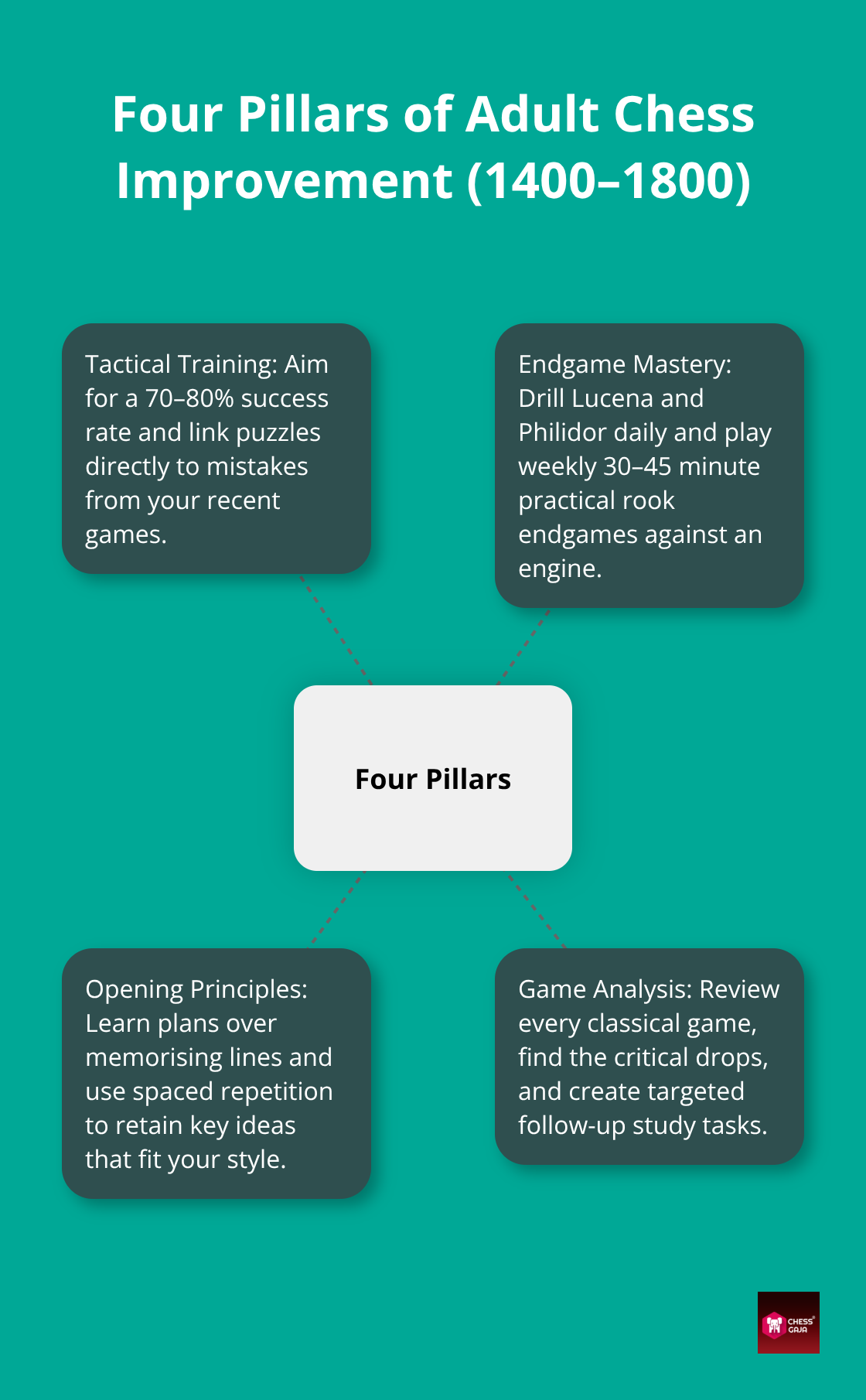
Four Pillars That Break Rating Plateaus
Tactical Training That Connects to Your Games
Tactics win games, but only if you solve the right puzzles at the right difficulty. Most adults waste time on puzzles far below their rating, creating a false sense of progress. Research shows that players improve fastest with a balanced puzzle success rate. Aim for challenges that test your calculation without causing total frustration. At 1400–1500 rating, this means moving beyond simple one-move forks and pins into two- and three-move tactical sequences.
Timed puzzle runs train speed, but miss deeper issues. Improvers at your level miss blunders despite solving dozens of daily puzzles. Tactical disconnects occur when untimed calculation training and game analysis never connect. Spend 10–15 minutes daily on standard rating-based puzzles. Immediately after, review one of your recent losses to identify which tactical patterns you missed in actual play. Document the specific error—such as an overlooked hanging piece, an unseen back-rank weakness, or an unprevented double attack.
Connecting puzzle practice to game analysis turns raw training into rating points. Track these recurring mistakes in a simple spreadsheet. When you notice a pattern like missing back-rank tactics, dedicate the following week exclusively to that topic. Targeted training like this compresses improvement timelines dramatically. Adults who build this feedback loop typically gain 40–60 rating points within 6 weeks.
Endgame Mastery Wins Positions
Endgames separate players who stagnate from players who break through. Most adults ignore endgames entirely until they reach 1600+, which is precisely why they plateau. Rook endgames appear in a vast majority of all endgames, yet most players at 1400–1500 cannot hold a drawn position or convert a winning one.
Mastering both the Lucena position and Philidor position provides a non-negotiable foundation for your game-these two technical setups appear constantly in real games. Spend 15 minutes daily drilling these positions using Silman’s Complete Endgame Course (focusing on the 1400–1600 sections) or 100 Endgames You Must Know. Do not memorize them passively; solve them from different board positions until you recognize the pattern instantly. Once weekly, dedicate 30–45 minutes to a deeper endgame session where you set up theoretical positions (like the Lucena or Philidor) and play them out against a maximum-strength engine to test your technique against perfect defense. This trains practical technique under pressure, not just theoretical knowledge. Adults who master rook endgames convert significantly more winning positions and regularly hold difficult positions for draws.
Opening Principles Over Theory
Openings matter far less than adults think, but structure matters immensely. You do not need 30 moves of theory to reach 1800. Build a compact repertoire with one solid response to 1.e4 and 1.d4. Focus on key middlegame plans over endless theoretical branches. If you play 1.e4, understand why you’re playing it-is it to control the center and develop quickly, or to launch a kingside attack? Connect each move to this underlying idea.
Spend 15 minutes daily reviewing your opening moves using spaced repetition on Chessable rather than grinding theory endlessly. This approach trains intuition and memory retention far better than passive study. Align your openings with your middlegame strengths. If you love tactical attacks, choose sharp openings; if you prefer positional play, select solid, strategic lines. Adults who do this see immediate rating gains because they understand the underlying plan, not just the move order.
Game Analysis Closes the Learning Loop
After every classical game, spend 15–20 minutes reviewing it on your own first to write down where you felt uncomfortable or unsure. Then, use an engine to check major evaluation swings (drops of 1.5+ points) where the dynamic advantage shifted or key calculations failed. Was a tactical blow missed during the opening phase? Perhaps a key strategic transition went off course, or a technically winning endgame slipped into a blunder. Identify the root cause: calculation error, pattern blindness, or conceptual misunderstanding. Then, create a follow-up study task.
If you lost a rook endgame due to poor technique, spend your next endgame session drilling that specific type. If you missed a middlegame tactic, add similar patterns to your next week’s puzzle training. This closed feedback loop ensures every game teaches you something concrete. Adults who analyze games systematically improve 60–80 rating points faster than those who play without analysis.
These four pillars form the foundation of your improvement system. The next section shows you how to build a realistic weekly schedule that weaves all four together without overwhelming your life.
How to Structure Your Weekly Training Without Burning Out
The biggest mistake adults make is treating chess improvement like a part-time job. They commit to eight hours weekly, hit a rough week at work, skip training entirely, then wonder why they plateau. A sustainable improvement plan for 1400–1800 players needs to fit into real life, not replace it. Research on adult learning shows that consistency matters far more than volume. Training four hours weekly for 12 months yields 80–120 rating points. In contrast, training 10 hours weekly for three months and then quitting yields nothing. Adults who break through to 1800+ share one trait: they build a schedule they actually follow.
Five Core Elements That Drive Real Progress
Your weekly structure should contain five core elements, each serving a specific purpose in your improvement. Tactical training occupies 10–15 minutes daily using standard rating-based puzzle sets on Chess.com or Lichess, targeting that sweet spot of difficulty where you calculate lines thoroughly rather than guessing. Opening review takes 15 minutes daily using spaced repetition on Chessable, not grinding theory endlessly.
Calculation practice demands 10–15 minutes per complex exercise, three times weekly. Always write down concrete variations starting with Checks, Captures, and Threats (CCT) before checking solutions. Afterwards, log recurring calculation errors in a spreadsheet.
Endgame drills require 15 minutes daily with a focus on rook positions, plus one deeper 30–45 minute session weekly where you play theoretical endgames against a maximum-strength engine to practice against perfect defense.
Game analysis happens after every classical game you play, spending 20–30 minutes identifying the critical moments where your evaluation dropped significantly.
Expect to spend roughly 30–45 minutes on weekdays. Save longer 60-minute blocks for weekend game analysis. A realistic schedule focuses on one core pillar per day instead of crowding every topic into a single session: morning tactics and openings, midday calculation work, evening endgame drills. Anchor these sessions to existing habits—try solving tactics while your coffee brews, reviewing openings during your lunch break, or practicing endgames after dinner. Treat chess like brushing your teeth, not like preparing for medical school.
Choosing Tools That Match Your Rating Exactly
The wrong software wastes months of your life. An adult at 1500 rating solving beginner puzzles on Lichess feels productive but learns nothing new. Meanwhile, jumping into advanced calculation courses designed for 2000+ players leads to frustration and quitting within two weeks. The software you choose must match your exact rating and serve a specific function.
For tactical training, standard rating-based puzzle sets on Chess.com or Lichess work better than timed speed runs like Puzzle Rush. Unrated, untimed calculation exercises train deep accuracy. This directly translates to fewer blunders in classical games. Chessable’s spaced repetition system easily outperforms free opening resources. Its scientific review intervals lock in variations without wasting time on mastered material.
For calculation, use structured books or Chessable courses aimed at 1400–1800. Writing candidate moves and CCT variations builds deeper discipline than mental calculation alone. Jeremy Silman’s How to Reassess Your Chess addresses the specific imbalance and planning problems adults face around 1500 rating, teaching you how to evaluate positions systematically.
For endgames, Silman’s Complete Endgame Course and Johan Hellsten’s Mastering Endgame Strategy are ideal. Avoid free YouTube endgame content due to its lack of systematic progression. Game analysis happens on Chess.com’s built-in engine or Lichess, both free, but adults at 1500+ benefit enormously from coaching review. Coaching review helps identify patterns in your games that self-analysis alone cannot reveal.
Monthly Progress Tracking Reveals True Improvement
Adults obsess over rating swings that mean nothing. You gain 10 points one week, lose 15 the next, and assume your training isn’t working. This thinking kills motivation. Rating volatility at 1400–1600 is normal because your skill is inconsistent. What matters is the three-month trend. Track your official FIDE rating monthly on a simple spreadsheet, plotting the data point on the first of each month only. This removes noise and shows genuine progress. Most adults who follow the four-pillar framework gain 40–60 rating points within six weeks, 80–120 points within three months. If you haven’t gained 30 points within two months, your training plan needs adjustment.
The issue usually stems from two root causes. Either your puzzle success rate is too low from tackling overly hard material, or your game analysis isn’t driving your study. Fix puzzle difficulty first by checking your accuracy on Chess.com; aim for a steady majority of correct solves without guessing. Assuming your accuracy is on target, spend the next two weeks analyzing every loss and creating follow-up study tasks. A player who loses a game because of a hanging rook in the endgame should immediately schedule extra endgame drills that week. Similarly, anyone who misses a middlegame tactic ought to add those specific patterns to their next puzzle session. This feedback loop closes the gap between study and play faster than any other adjustment.
Secondary Metrics That Predict Rating Gains
Beyond rating, track secondary metrics: how many classical or 15+10 rapid games you play monthly (aim for 4 to 8 quality games), your puzzle accuracy, and hours of self-analysis completed. Aim to play 4 to 6 long-control games monthly, supplemented by controlled 10+0 games. This balance builds strong calculation depth while sharpening practical pattern recognition. Conversely, someone training 180 minutes daily while playing zero classical games will stagnate because tournament play exposes weaknesses that training never reveals.
If your rating hasn’t moved in two months despite consistent training, the problem lies in one of these areas: your puzzle difficulty is mismatched, your game analysis lacks specificity, or you’re not playing enough classical games to apply what you’ve learned. Adjust one variable at a time and measure the result over the next month. This systematic approach to self-correction accelerates improvement far more than simply training harder.
Final Thoughts
Breaking through to 1800+ requires three things: a structured adult chess improvement plan, consistency over intensity, and honest feedback on your actual weaknesses. The framework in this guide works because it connects your daily training directly to your games-you solve puzzles that match your rating, analyze losses to identify patterns, and adjust your study the following week. This feedback loop compresses improvement timelines dramatically, and most adults who follow this system gain 80–120 rating points within three months, not because they train longer, but because they train smarter.
Start with one element from the four pillars this week rather than attempting to overhaul everything at once. Should tactics feel like your weakest area, commit to 15 minutes daily on standard rating-based puzzles. If endgames terrify you, spend that time drilling rook positions instead. Lastly, when openings lack direction, focus your daily 15 minutes on spaced repetition. Adults who attempt all four pillars simultaneously burn out within two weeks, so build one habit first, then layer in the others.
Structured coaching accelerates progress faster than solo study. At Chess Gaja, grandmaster-led, FIDE-rated coaches work with adult improvers worldwide to pinpoint specific calculation and strategic bottlenecks. Book a 1-on-1 evaluation session with Chess Gaja today to receive a personalized roadmap to 1800+.