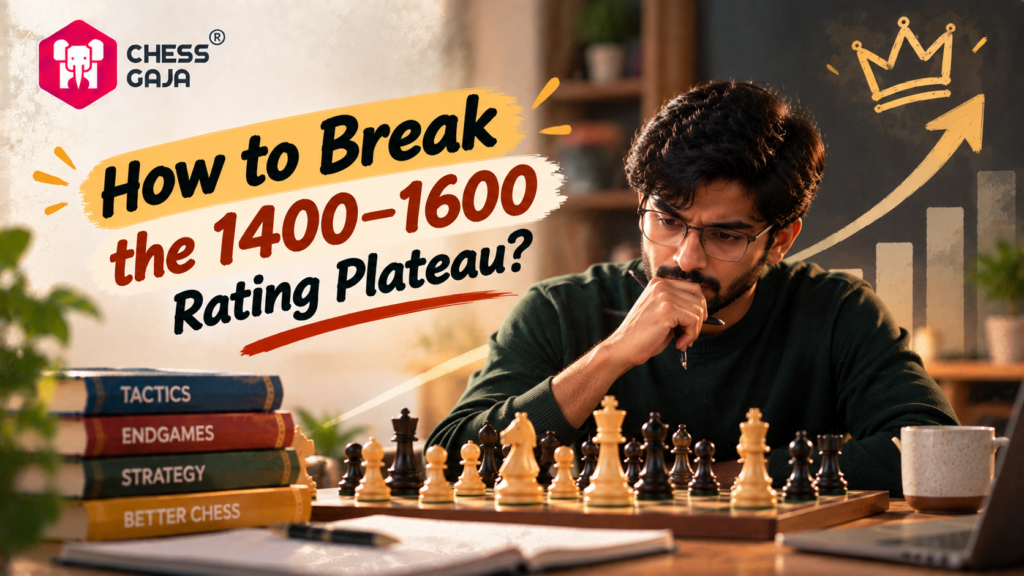
Most adult chess players hit a wall around 1400-1600 rating and stop improving. The problem isn’t talent-it’s that they lack a structured adult chess improvement plan.
At Chess Gaja, we’ve worked with thousands of adult learners across the USA, UAE, and Singapore who felt stuck. The difference between those who break through and those who plateau comes down to one thing: having a clear framework to follow.
Why Adult Players Stop Improving
The Plateau Pattern That Stops Most Adults
Adult chess players plateau because they treat improvement like a hobby instead of a skill that demands structure. Most adults start playing again after years away or begin learning for the first time. They often practice sporadically—a game here, a puzzle session there—without a framework connecting their efforts. The typical pattern shows improvement from 800 to 1400 rating within a few months of casual play, then a hard stop. At this point, players blame talent or lack of time. The real culprit is that they have no systematic approach to identifying and fixing specific weaknesses.
Why Skipping Fundamentals Kills Progress
Rating stagnation happens when players skip the fundamentals phase entirely. Jumping straight to complex openings or advanced tactics without mastering basic endgames leads to lost positions that should be easily won or drawn. A 1500-rated adult might spend 30 minutes daily on random puzzle apps. Yet, they spend zero time on king-and-pawn or rook endings—the positions that decide most real games. Inconsistent practice schedules make this worse.
Playing one tournament game per month, then studying sporadically for two weeks, then disappearing for a month creates no momentum. Spaced repetition is a powerful learning tool, but you need to be careful what you apply to it. A player who solves 20 tactics puzzles three times weekly learns faster than someone who solves 100 puzzles once per month.
How Adults Waste Time on the Wrong Activities
Without guidance, adults gravitate toward whatever feels productive in the moment—usually flashy tactical puzzles—rather than what actually builds rating strength. Another common pitfall is misusing engines. Post-game analysis with software can accelerate learning. However, most adults use engines as a crutch, letting the computer spot errors before analyzing positions themselves. This outsources their thinking and prevents them from developing independent calculation skills. The adults who break through the 1400-1600 wall are those who get external accountability through a coach who understands your playing style and challenges, not those with more free time or natural talent.
What Separates Breakthroughs From Stagnation
The difference between players who improve and those who stall comes down to structure. A coach or formal program provides three things casual players lack: accountability, a clear roadmap, and feedback on what actually matters. When you have someone reviewing your games, identifying your specific weaknesses, and assigning targeted work (not random puzzle apps), your rating moves. The players stuck at 1400-1600 need to stop treating chess like entertainment and start treating it like a skill worth systematic investment. This shift in mindset, combined with a real plan, is what opens the door to genuine improvement.
How to Build Your Personal Rating Roadmap
Your first step is knowing exactly where you stand. Pull up your rating from USCF if you play in the US, or check your FIDE rating if you compete internationally. If you’re in the UAE or Singapore and haven’t played rated games yet, play three to five games on Chess.com or Lichess with time controls matching real tournament play-typically Game 30 (30 minutes per side) or Game 60.
This gives you a baseline. Adults often underestimate their actual strength because they confuse puzzle ratings with game ratings. A player with a 2000 puzzle rating might play at 1400 in real games, which is completely normal due to the difference between isolated pattern recognition and full-game management. Your game rating is what matters for planning.
Once you have this number, set a specific target six months out. Not vague improvement-actual numbers. An adult at 1500 should target 1650 to 1750 within six months with structured work. This target becomes your anchor for everything that follows.
The Schedule That Actually Sticks
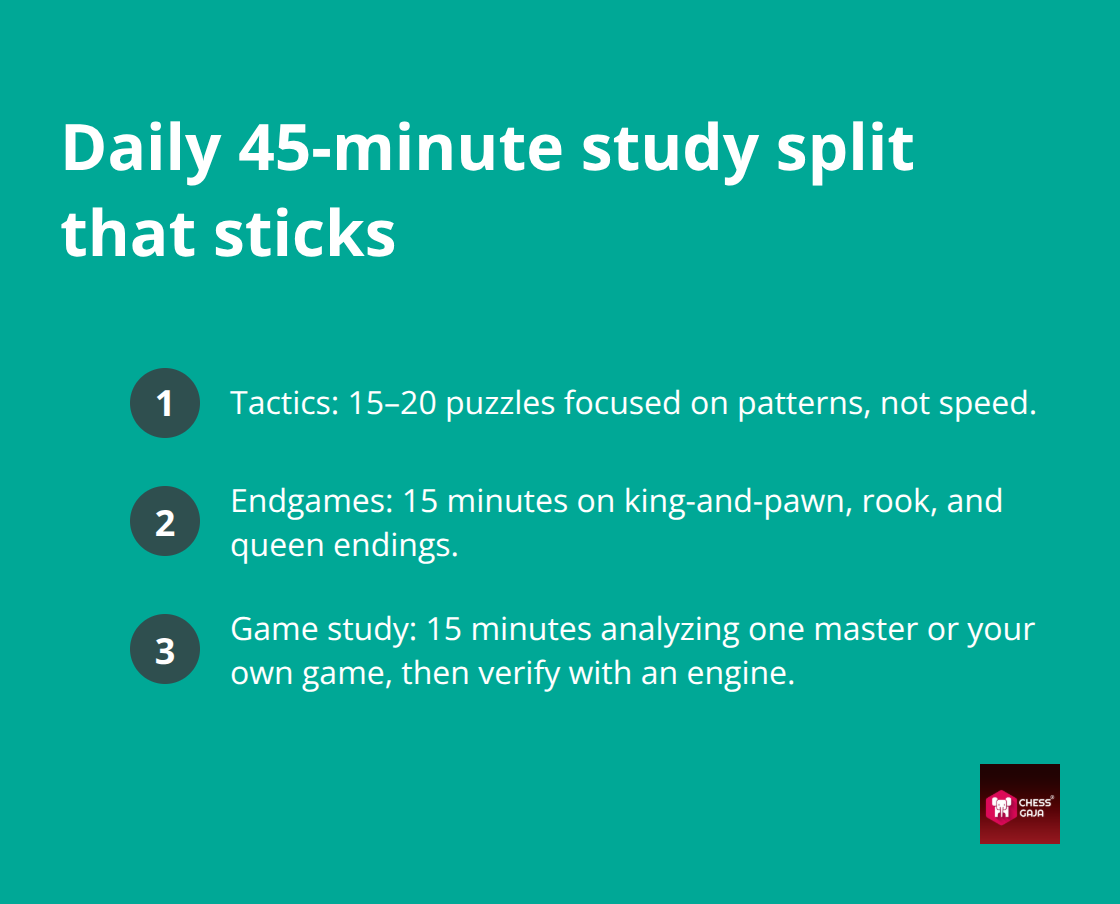
Most adults fail because they plan 90 minutes daily, miss three days, then abandon the plan entirely. Instead, commit to what you’ll actually do. If you have 45 minutes most days, build around 45 minutes. The structure matters far more than the volume. Dedicate 15 minutes to tactics training-solve 15 to 20 puzzles on Chess.com Tactics Trainer, focusing on pattern recognition rather than speed.
Spend 15 minutes on endgame positions. King-and-pawn endings, rook endings, and queen endgames are non-negotiable. Most adults lose games they should draw or win because they fumble endgames.
The final 15 minutes goes to studying one master game with commentary or reviewing one of your own games without an engine first, then verifying with one. This three-part split-tactics, endgames, game analysis-covers the domains that actually move your rating.
Play one rated game per week minimum, two if possible. One tournament game monthly is insufficient. The players who break through 1600 play consistently every week because repeated competitive experience under time pressure accelerates your learning far faster than study alone.
Why Fundamentals Come Before Flashy Openings
Adults want to learn the Sicilian Defense or the Ruy Lopez because strong players use them. This is backwards. Before you study any opening beyond the most basic principles, master the fundamentals that decide almost all amateur games: basic endgames, tactical patterns, and how to recognize weak squares and pawn structures.
A 1500-rated player studying advanced opening theory wastes time. Your games are decided in the middlegame and endgame where you lack knowledge, not in the opening where you’re already decent enough to reach playable positions. Choose one opening for White and one for Black that fit your playing style-not what you think you should play.
If you like quiet, positional chess, the English Opening and the French Defense work. If you like sharp tactics, the Italian Game and the Sicilian Najdorf are better. Study these openings primarily to understand central control, piece placement, and typical middlegame plans, rather than trying to memorize move sequences beyond moves 6 to 8.
A coach who understands your rating and goals can accelerate this process significantly. Your study plan should include specific chess books, puzzle sets, and software calibrated to your current rating, not generic resources.
How Personalized Plans Accelerate Your Progress
Generic resources fail because they don’t match your actual level. A book written for 1800-rated players teaches concepts you haven’t yet mastered. A puzzle app that mixes tactics from 1200 to 2000 rating wastes your time on positions too easy or too hard. Personalized study schedules tailored to your current rating, goals, and available time create the conditions for real improvement.
Training with tactics puzzles set to your exact skill level sharpens pattern recognition faster. Matching your endgame study directly to realistic board positions leads to higher win conversions. Furthermore, focusing game analysis on individual weaknesses—rather than generic advice—prevents recurring mistakes. This targeted approach separates players who break through from those who plateau indefinitely.
How to Train Like a Player Who Actually Improves
Solving 100 random puzzles weekly will not move your rating. Playing tournament games without analyzing them will not move your rating. Studying openings while your endgames crumble will not move your rating. The adults who break through the 1600 barrier do three things consistently: they solve puzzles at their exact skill level, they analyze their own games before consulting an engine, and they work with someone who holds them accountable. These three practices separate players who stagnate from players who gain 200+ rating points in a year.
Puzzles Must Match Your Skill Level, Not Your Ambition
Chess.com Tactics Trainer and Lichess both rate their puzzles, and this matters far more than you think. Set your tactics difficulty so puzzles sit within 50 to 100 points of your current tactics rating. You want tasks where you succeed most of the time through clear calculation, rather than guessing high-rated puzzles or breeze-solving trivial ones.
This success rate activates learning. Research shows optimal learning happens when tasks sit at the edge of your ability. Puzzles should be hard enough to challenge you, yet easy enough to solve consistently.
Adults who solve 15 to 20 puzzles daily at their exact level for three months report measurable rating gains of 50 to 100 points. The reason is pattern recognition. Tactical themes repeat: forks, pins, discovered attacks, back-rank threats. Solving puzzles at your level hammers these patterns into recognition so deeply that you spot them in real games without conscious effort.
Most adults waste this time by either racing through puzzles for speed or grinding through puzzles that are too hard. Slow down. Solve puzzles where you have to think for 30 to 60 seconds. This builds the calculation depth that matters in actual games.
Analyze Your Games First, Then Verify With an Engine
Adults make a critical mistake after losing a game: they immediately fire up an engine to see what went wrong. This outsources their thinking. Instead, analyze your loss or draw first without any engine. Sit with the position where you made your worst move.
Ask yourself three questions: What was my plan? What did my opponent threaten that I missed? What did I overlook in my own position? Write down your answer. Only then open an engine and check. This practice trains your independent calculation.
The adults improving fastest spend 45 to 60 minutes deeply analyzing a single key game each week—working through critical decision points on a physical or digital board without assistance—before running an engine check. They don’t analyze five games in 20 minutes with engine assistance. One deep game per week teaches more than five shallow games.
After three months of this habit, players report that their in-game calculation improves because they’ve trained their brain to think critically rather than rely on a computer. An engine is a verification tool, not a thinking tool. Use it that way.
Work With a Coach for Targeted Accountability
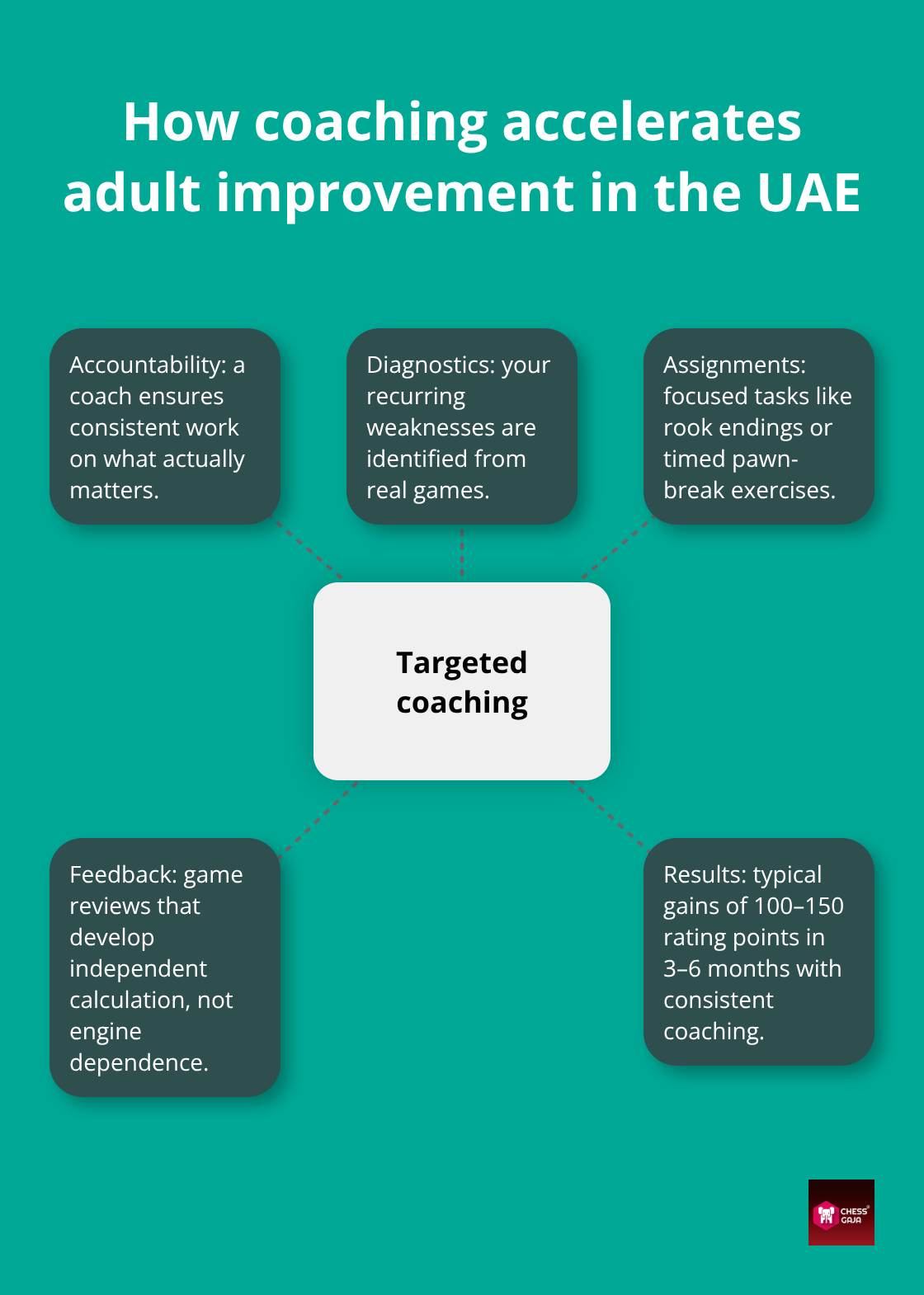
The single biggest differentiator between adults stuck at 1400 and adults climbing past 1700 is external accountability. A coach reviews your games, identifies your specific weaknesses-not generic advice, your actual patterns-and assigns targeted work.
One adult might frequently mismanage open files and back-rank tactical threats, so the coach assigns major piece activity and king safety drills. Another struggles in equal rook endgames, so the coach focuses on passive vs. active rook placement.
A coach tailors your improvement plan to your actual problems. Without coaching, adults drift. They study whatever feels interesting that week. They avoid the uncomfortable work of fixing their real weaknesses. Within three to six months of consistent coaching, most adults gain 100 to 150 rating points because their study time stops being random and becomes surgical.
The adults who work with a coach gain rating faster than those grinding alone because someone is watching and ensuring they’re working on what actually matters.
Final Thoughts
The adults who break through the 1400-1600 plateau share one trait: they stopped treating chess improvement as something that happens by accident and started treating it as a skill that demands structure.
Your adult chess improvement plan works only when you commit to three non-negotiables: solving puzzles at your exact skill level, analyzing your own games before consulting engines, and working with someone who holds you accountable to what actually matters. The difference between stagnation and breakthrough is not talent or time-it is clarity.
Structured coaching accelerates this process dramatically. A coach identifies your specific weaknesses, not generic ones, and assigns targeted work that stops wasted effort. Within three to six months of consistent coaching, most adults report measurable rating gains because their study time becomes surgical rather than random.
At Chess Gaja, we work with 1,000+ students across 20+ countries, including the USA, UAE, and Singapore, with coaches delivering personalized study plans calibrated to your rating and goals.
Your next step is booking a Paid Starter Class with Chess Gaja. A professional coach will evaluate your current level, identify your specific weaknesses, and design a personalized plan tailored to your goals and available time.