

You’ve just won your first youth tournament game, but your opponent’s unexpected third move threw you off completely. By the time you reached move 15, you’d already burned through half your clock and lost your strategic direction.
At Chess Gaja, we believe an opening plan for tournaments changes everything. Players who prepare systematically win more games and climb ratings faster than those who wing it.
Why Opening Preparation Wins Tournaments
The Pattern That Separates Top Tournament Players
A structured opening plan separates advancing players from those who plateau. Systematic preparation drives consistent rating progress far better than memorizing random lines.
The difference comes down to structure. Entering a tournament with a balanced repertoire—one main line as White plus dedicated responses to 1.e4 and 1.d4 as Black—preserves mental energy for critical middlegame decisions. Conversely, players without a clear plan waste clock time early. By the time they reach move 15, fatigue sets in, leading to avoidable errors.
Tournament results across the USA, UAE, and Singapore show that top young players maintain a consistent opening repertoire. In contrast, lower-performing players tend to treat each game as an improvisation. The psychological advantage alone is substantial: confidence in your opening choices translates directly to faster decision-making and clearer strategic vision once you transition into the middlegame.
How Preparation Predicts Results
Research from competitive chess environments confirms that players who dedicate 30-45 minutes weekly to opening review achieve measurable rating gains within 3-4 months. Conversely, players without structured preparation repeat the same opening mistakes across multiple tournaments, cycling through the same weak positions repeatedly. Learning brand-new openings right before a tournament often causes panic and forces reliance on memory over true understanding.
Successful players focus on refining familiar openings, refreshing their understanding of key setups, and strengthening their execution through repetition. Furthermore, selecting openings based on what a stronger player uses—rather than what fits your personal style and calculation depth—remains a common trap to avoid.
The Missing Link: Opening to Middlegame Transition
A critical error we observe is skipping the transition phase from opening to middlegame. Players memorize moves 1-10 but have no plan for moves 11-15, leaving them adrift precisely when they should execute concrete strategy. A genuine opening plan includes not just the opening moves but a clear strategic goal for the position you’ll reach after your opponent’s expected responses.
This transition phase (moves 11-15) determines whether your opening preparation actually translates into tournament wins. Without it, you’ve only solved half the problem. The next chapter shows you exactly how to build this complete opening plan-one that carries you smoothly from move one through the critical middlegame decisions that matter most.
Building Your Opening Repertoire Without Overthinking It
Match Your Openings to Your Playing Style
Most tournament players make the same critical error: they choose openings based on what stronger players use or what looks impressive, rather than what actually fits their own calculation ability and style. When you naturally think in solid, positional patterns, forcing yourself into sharp tactical openings causes clock trouble and second-guessing.
The first step is honest self-assessment. Do you prefer positions where you can gradually improve your pieces and squeeze your opponent, or do you like tactical complications where you calculate concrete variations? Your answer determines which openings you should study.
For players rated 1200–1600 who gravitate toward solid, maneuvering chess, strong choices include system openings like the London System or Queen’s Gambit as White, and reliable defenses like the Caro-Kann or Classical 1…e4 e5 as Black.
These openings produce positions where understanding principles matters far more than memorizing 15 moves of theory. Conversely, if you naturally spot tactical patterns and enjoy sharp, aggressive play, openings like the Sicilian Defense or the King’s Gambit suit you better because they reward concrete calculation and dynamic play. Forcing yourself into uncomfortable openings costs rating points and tournament results.
Learn from Grandmaster Games, Not Theory Books
After selecting openings that fit your style, examine real grandmaster games in those lines instead of reading passive theory. Review high-level games via the Lichess Opening Database or Chess.com Game Archive for players who regularly feature your chosen variations. Pay special attention to why the grandmaster made each decision between moves 8–15, as this critical window is where most tournament players get off track.
This teaches you the strategic ideas behind the moves, not just the moves themselves. You’ll see how a grandmaster transitions from opening principles into middlegame strategy, which is precisely what separates players who win tournaments from those who plateau.
Build a Simple Weekly Practice Schedule
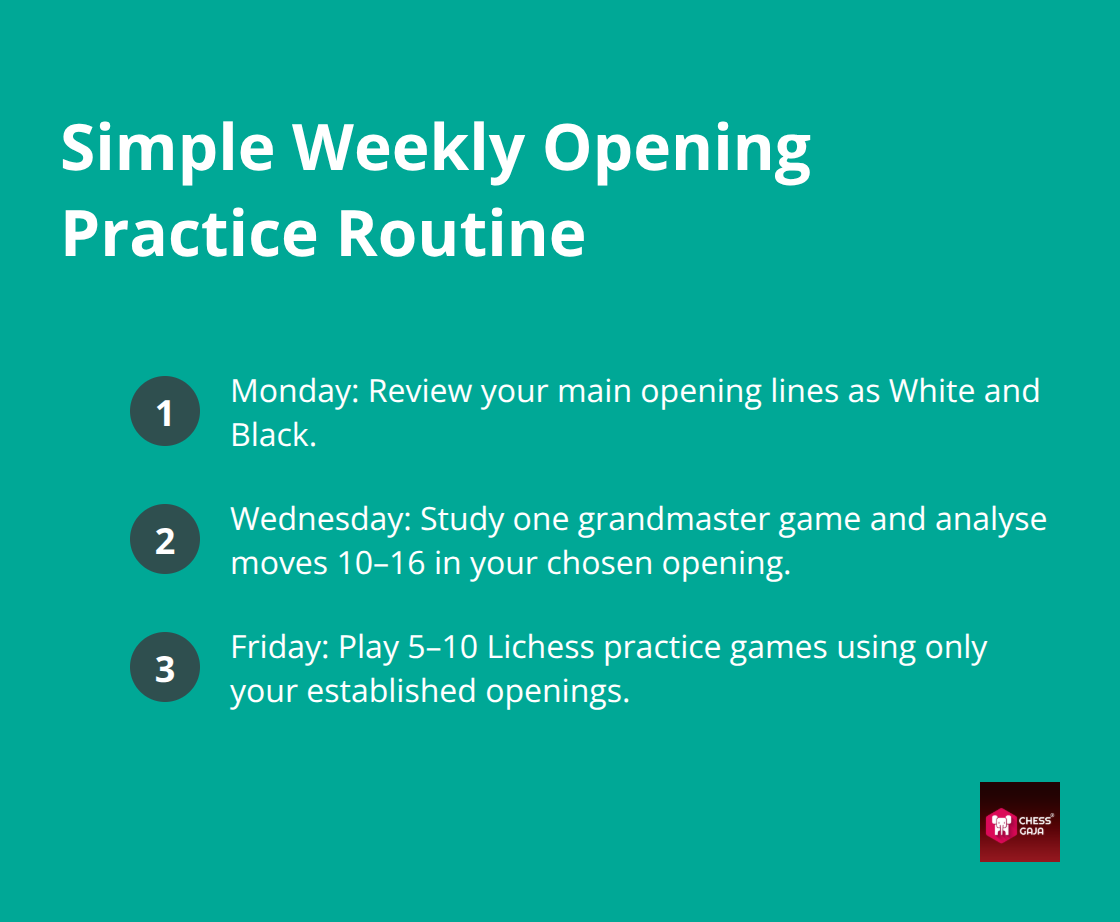
Keep your practice schedule ruthlessly simple: spend 20-30 minutes weekly reinforcing your existing openings rather than trying to memorize brand-new, unfamiliar systems right before a event. On Monday, review your main opening lines as White and Black. By Wednesday, switch to studying one grandmaster game in your chosen opening to analyze moves 10–16. To end the week on Friday, play 5–10 practice games on Lichess using only your established openings, focusing on hitting move 15 with a clear strategic plan.
Building this kind of routine develops pattern recognition so deeply that your opening choices become automatic, freeing mental energy for the middlegame decisions that actually win games. The consistency matters more than the volume. A 25-minute weekly routine you actually complete beats a theoretical 3-hour routine you abandon after two weeks.
Track Your Progress and Identify Patterns
Track your practice in a simple spreadsheet: date, opening played, result, and the exact move where the game departed from known theory. Briefly check this point with an engine or opening database to see what the principled response was, then record one key takeaway. After 4-6 weeks of consistent practice, your openings stop feeling foreign and start feeling like home. You’ll notice specific positions where you consistently struggle or excel, giving you clear targets for the next phase of your preparation.
The real test comes when you step into a tournament and face an opponent who deviates from your expected lines. That’s when your understanding of opening principles-not memorized moves-determines whether you stay in control or panic.
Executing Your Opening Plan in Tournament Games
Active preparation stops the moment the tournament starts. The real test arrives when your opponent plays move three and it doesn’t match the line you studied. Tournament conditions demand that you shift from memorized sequences to principled decision-making fast, without panic. Most young players in the USA, UAE, and Singapore freeze when facing unexpected moves because they relied on memorization instead of understanding. The clock ticks harder, the pressure mounts, and suddenly your preparation feels useless. This section teaches you how to stay composed, adapt intelligently, and transition into the middlegame with confidence intact.
Clock Management Separates Winners from Panicked Players
Time pressure in the opening destroys more young players than tactical blunders. Burning 15 minutes on the first 10 moves leaves you fatigued with a depleted clock by move 15.
Fix this mechanically: play rehearsed main moves in seconds. Limit critical decisions to 1–2 minutes maximum. This approach forces reliance on core principles rather than burning clock early.
If you’ve studied your openings properly during your weekly 20–30 minute practice sessions, you already know your moves through move 8–10. Playing them instantly preserves clock time for the middlegame where decisions actually matter. Tournament data from scholastic events shows that players who maintain a consistent opening pace win significantly more games than those who spend variable time in the opening. The psychological benefit is enormous: your opponent watches you play quickly and confidently, creating a false perception that you’re stronger than you actually are.
Responding to Unexpected Moves Without Panic
When your opponent deviates from your expected line on move five or six, you have two choices: panic and spend eight minutes calculating, or trust your understanding of opening principles and move within your time budget. Choose the second option every time. Your opening preparation taught you center control, piece development, and king safety. Use those principles to respond instantly to deviations.
When an opponent strays from standard theory early on, that choice reveals key details about their preparation and playing style. Lower-rated players who deviate early often act on intuition rather than theory. Higher-rated opponents usually deviate to sidestep your memory, steering the game into unfamiliar territory where general understanding takes over. Neither scenario requires panic.
Should your opponent play a dubious or weak move early, quickly check if there is an immediate tactical punishment. Without a direct tactic available, simply continue with natural development to exploit the created weakness and consolidate your advantage. Whenever facing solid yet unexpected responses, rely on the fundamental principles you practiced. Off-beat choices actually simplify your task by shifting the game away from heavily analyzed theory.
Once the main lines end, solid understanding beats memorization. Your opponent now depends on the same core principles you’ve practiced. Focus on moves that improve your position using basic chess logic: control the center, develop pieces toward active squares, and keep your king safe. Fundamental principles like these work in every position.
The Transition Phase That Determines Tournament Outcomes
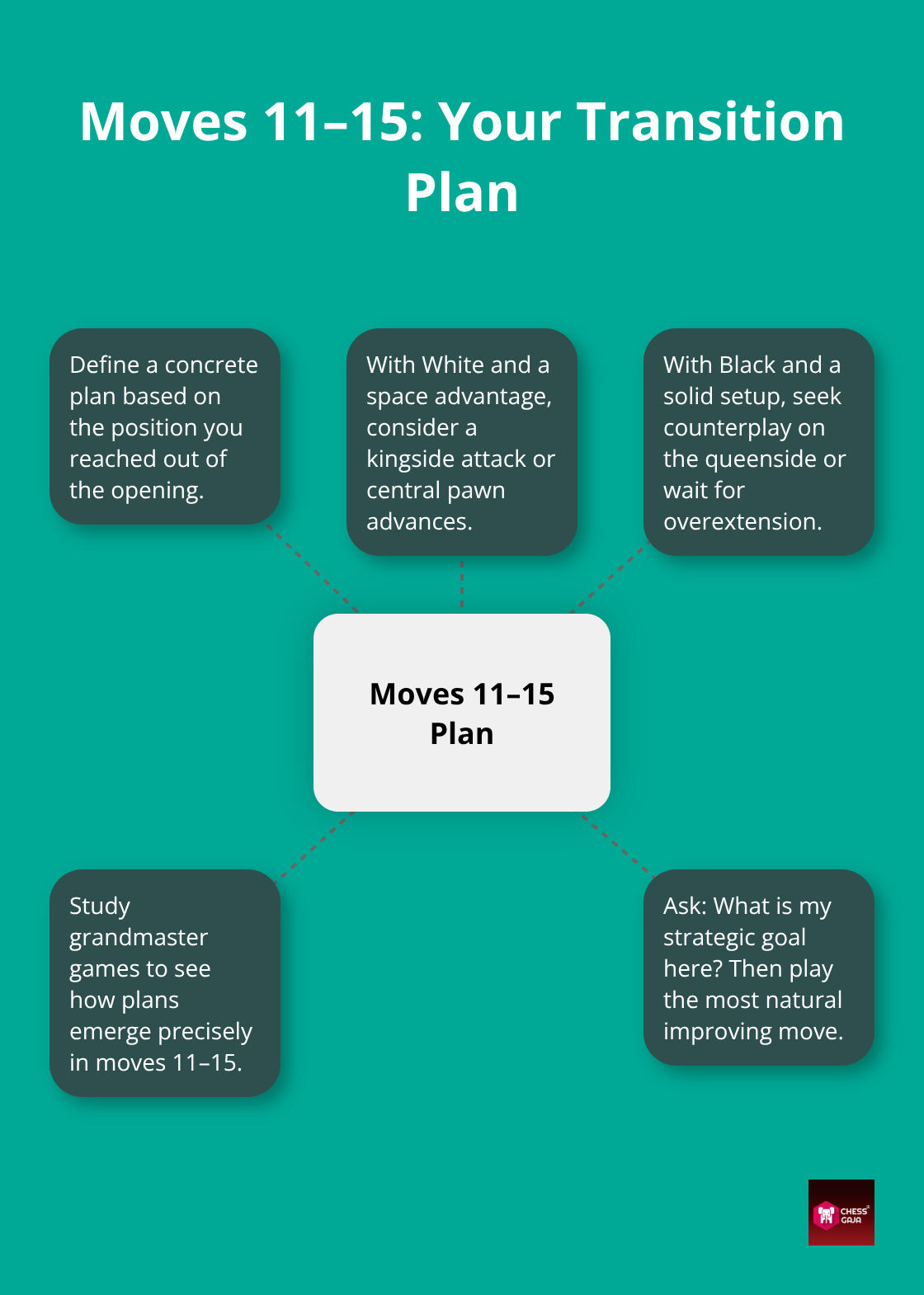
Moves 11–15 determine whether your opening plan translates into tournament wins. During this critical window, players transition from memory to concrete strategy.
Preparation carries you through initial piece development. These next 5–10 moves reveal whether you hold an advantage, equality, or a struggle. Here, you execute active middlegame plans instead of standard piece placement.
Strategic goals depend on position structure. Space advantages call for territorial expansion or direct attacks. Compact setups focus on central breaks and opposite-flank counterplay. Having any clear plan matters far more than finding a perfect one.
When practicing each week, analyze grandmaster moves 11–15 carefully. This stage marks where opening theory ends and concrete middlegame play begins. Observe how elite players shift from piece development to active planning. Studying these key moments reveals strategic ideas that flow naturally from your repertoire.
In your tournament game, after completing basic development and castling, ask yourself one core question: What is my strategic goal in this position? If you can answer clearly, you have a plan. If not, make the most natural move that improves your worst piece or creates a concrete threat.
Master-level preparation focuses on the strategic purpose behind every move rather than blind memorization. Developing players who master these transitional setups navigate moves 11–15 with calm confidence. Improvised play, by contrast, leaves players feeling helpless as soon as the game leaves familiar territory.
Final Thoughts
Building a structured opening plan for tournaments transforms your results. Beyond picking moves, this approach helps match openings to your playing style, study grandmaster games strategically, and execute under pressure without panic. The real payoff happens during your next tournament game when an opponent deviates on move five.
Instead of freezing under pressure, you can rely on internalized opening principles. Proper time management helps you reach move 15 with plenty of clock space and a clear direction. Ultimately, saving mental energy during the opening leaves you sharp and focused for the middlegame battles ahead.
At Chess Gaja, our GM-led curriculum teaches opening principles rather than memorized lines, equipping players to perform under real tournament conditions. By booking a Paid Starter Class with a FIDE-rated coach, you receive a professional evaluation to analyze your style and build a personalized opening plan tailored to your goals.