Your chess class ends, but your learning shouldn’t. AI feedback post session gives you concrete analysis within hours-identifying exactly where you went wrong and what to practice next.
At Chess Gaja, we’ve seen students who act on this feedback jump 200+ rating points in six months, while those who ignore it plateau. The difference isn’t talent. It’s what happens between your lessons.
What Your AI Feedback Actually Contains
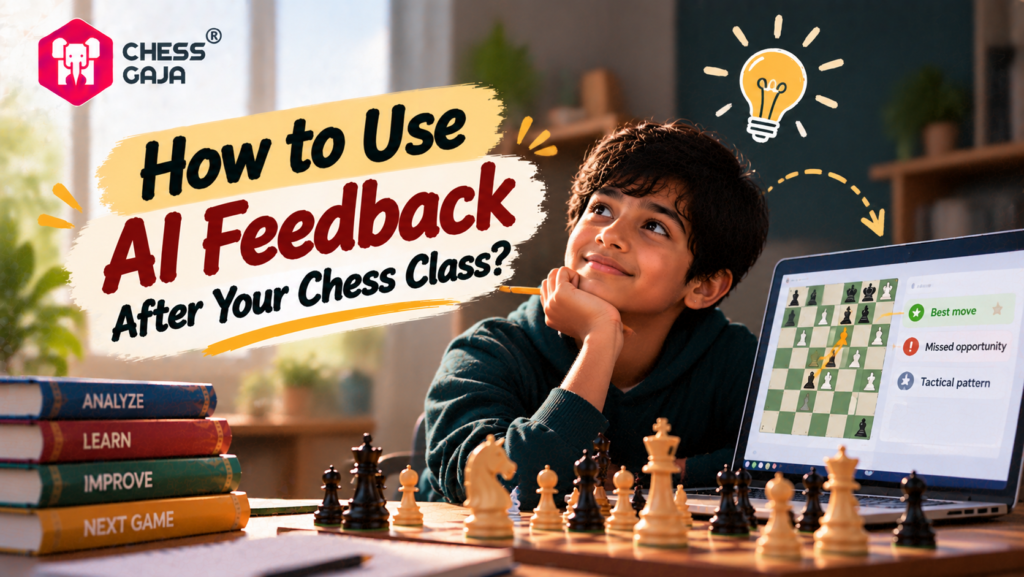
Within hours of class ending, our AI system analyzes every move you made. It pinpoints tactical blunders, positional errors, and missed opportunities. This isn’t a vague summary. The feedback pinpoints the exact position where you went wrong, shows what you should have played instead, and explains why that move was stronger. A student in Singapore who played a blitz game might see that they missed a back-rank combination on move 18 that either resulted in checkmate or forced severe material loss.
The AI doesn’t just say you made an error—it shows the position, the recommended continuation, and the exact evaluation swing (in centipawns or piece material) that single decision cost you.
Where Your Blind Spots Hide
The most dangerous mistakes are the ones you don’t see. Repeating tactical patterns or violating basic opening principles holds back your rating. Poor time management under pressure acts as an invisible ceiling on your progress. Our AI feedback detects recurring weaknesses across your games. If you consistently hang pieces in the first 15 moves because you develop too slowly, the system flags this. If you miss knight forks in similar positions across five different games, the AI extracts that pattern and highlights it for focused practice. This objective analysis separates students who improve steadily from those who spin their wheels.
A student in Dubai might discover through their AI feedback that they consistently bleed evaluation advantage in rook endgames—suddenly, their next two weeks of practice have a laser-sharp target.
How Recommendations Match Your Exact Level
Generic advice doesn’t work. A beginner needs to stop hanging pieces. An intermediate player needs to strengthen their opening preparation. An advanced player needs to refine their calculation and psychological resilience. Our AI tailors recommendations to where you actually are. At 1,400 FIDE, the system targets basic tactical consistency and pawn structures. At 1,800, it focuses on complex endgames and calculation. The recommendations include concrete puzzle positions to solve, specific game positions from your recent matches to review, and a priority order for what to work on before your next class. Students preparing for upcoming events receive recommendations tailored to their tournament date and expected opponents. This ensures every hour of practice produces measurable gains.
How to Turn AI Feedback Into Your Next Rating Jump
Your AI feedback arrives within hours, but most students never open it. Those who do often skim the summary and move on. The ones who actually improve treat feedback like a treasure map with X marks your exact weaknesses.
Open Your Feedback While Positions Stay Fresh
Open your feedback immediately after class while positions stay fresh. Spend 15 minutes reviewing flagged mistakes. Write down the three worst positions. For each one, ask yourself: Did I miss a tactic? Did I play too fast? Did I fail to understand the position? This self-diagnosis matters because it tells you whether you need tactical drills, time-management practice, or strategic study.
A student might discover frequent early-middlegame blunders caused by neglecting rapid development. Premature attacks before king safety often explain sudden losses. Another in Singapore might see they play objectively sound moves but miscalculate in critical moments. Your feedback shows the pattern; you identify the root cause.
Practice Flagged Positions Within 48 Hours
Next, extract the specific positions your AI flagged and set a hard target: solve three similar puzzle positions from your feedback within 48 hours. Don’t just solve them-understand why the recommended move works. If the feedback shows you missed a knight fork in move 18, spend 10 minutes studying knight fork patterns across different board setups. Load those exact positions onto an interactive analysis board. Play them against an engine until the solution becomes automatic. Track your progress through your learning dashboard to monitor your tactical accuracy over time.
While solving puzzles builds recognition, reviewing whether these same tactical themes reappear in your actual games completes the learning loop. Principles of deliberate practice prove that spaced calculation drills build permanent pattern recognition. This strategy beats cramming tactics in a single sitting every time.
Apply Learning in Your Next Practice Game
After you’ve worked the positions, schedule your next practice game within three days and consciously apply what you learned. Your dashboard will show whether you’ve eliminated that error in your next match. If the mistake recurs, the feedback loop tightens. You learn what needs work, allowing your coach to address it immediately. This cycle of feedback, targeted practice, and real-game application creates momentum that compounds over weeks and months.
The students who see the fastest rating jumps aren’t necessarily the most talented; they’re the ones who close the gap between what they learn and what they practice. Structuring your weekly routine around this feedback cycle is the single fastest way to turn analysis into real rating points.
What Happens When You Skip Your Feedback
Students who ignore post-session feedback lock themselves into a cycle of repeated failure that costs them months of potential rating growth. Suppose you receive AI feedback highlighting middlegame evaluation losses from premature attacks. If you ignore the summary, you will repeat that mistake across your next ten games. Their coach won’t know the pattern exists, and their rating stalls completely.
Meanwhile, a peer in Singapore who spent 20 minutes reviewing their feedback, practiced three similar positions, and applied the lesson in their next tournament game sees immediate rating gains and deeper positional understanding. The gap widens fast.
The cost of ignoring feedback is concrete and measurable. Deliberate practice research shows that feedback loops tightened within 48 hours accelerate skill development compared to feedback delivered weeks later. When you wait a week to act on your AI feedback, your immediate recall of the critical board state fades. Without timely review, you miss the opportunity to replace flawed logic with correct candidate move patterns before those bad habits solidify.
A student in the USA preparing for the National Scholastic Chess Championship cannot afford this delay-every missed feedback cycle is a rating point left on the table and a tournament result made worse. Acting on feedback within 48 hours supports measurable improvement in your next rated game. Those who delay beyond a week show improvement in only a small fraction of subsequent games. The difference isn’t effort; it’s timing.
The Tactical Patterns That Trap You Forever
The most expensive mistakes are tactical patterns you repeat without knowing it. You miss the same knight fork setup in five different games across three months. Your AI feedback flags it after game one, but you never open the file. Games two through five cost you material, rating points, and tournament results that could have been wins. A student rated 1,600 FIDE who consistently misses back-rank tactics will struggle to break through their plateau and risk dropping rating points over time. Addressing patterns systematically eliminates blind spots. Students who do this consistently outplay equal opponents and gain rating points fast.
The feedback didn’t create the improvement-your action on it did. Your peers who use feedback consistently are not smarter than you. They simply close the gap between what they learn and what they practice within 48 hours instead of ignoring it for weeks.
The Rating Stagnation That Compounds Over Time
Students who consistently skip feedback hit a rating plateau around 1,400–1,600 FIDE and stay there for years. They play hundreds of games but don’t improve because they never extract the patterns from their losses. Their opponents evolve; they don’t. Meanwhile, a student in the same rating band who acts on feedback every single week climbs 200+ rating points in six months. This isn’t about talent-it’s about the feedback loop. Without targeted feedback, building deep pattern recognition purely through trial and error takes years and thousands of unguided games. With AI analysis, you compress that timeline dramatically because the system pinpoints exactly which patterns require attention.
A student rated 1,200 US Chess who ignores feedback often takes well over a year to reach 1,500. A student at the same starting rating who actively trains on every feedback summary can compress that journey down to just a few dedicated months. The difference accumulates. Your peer preparing for a regional championship will have had three times more deliberate practice than you because they closed the feedback loop faster.
Why Your Coach Can’t Help Without Your Feedback
Your coach can only work with information you provide. If you conceal your AI feedback, your coach must guess what holds you back. Class time shifts away from fixing your true weaknesses. A coach in Dubai might spend 30 minutes on opening theory when your real problem is tactical blindness in the middlegame. A coach in Singapore might focus on endgame technique when you actually need time-management drills.
When you share your AI feedback with your coach before your next session, they tailor the entire class to your specific gaps. This targeted approach means every minute of coaching produces measurable improvement. Students who bring their feedback summaries to class advance significantly faster than those who don’t because the coach stops guessing and starts solving.
Final Thoughts
AI feedback removes guesswork. Your coach cannot watch every online game, and peers rarely notice where your rating leaks away. Combining objective AI analytics with GM-led coaching ensures every blind spot is uncovered—from the tactical patterns you miss repeatedly and the opening principles you violate, to the time-management habits that cost you games under pressure. This feedback arrives within hours, while the positions remain fresh in your mind, giving you a concrete window to act on what matters most.
The students who improve fastest are not the most talented; they are the ones who treat AI feedback post session as non-negotiable information, not optional reading. A student who reviews their AI feedback, practices critical exercise positions within 48 hours, and applies the lesson in their next game sees direct rating gains, while a peer who ignores the analysis continues repeating the same blunders and stagnates. Always bring this feedback to your coaching sessions. Sharing AI analysis allows your coach to stop guessing and start solving problems.
Ready to experience how AI feedback accelerates your development? Book a Paid Starter Class with one of our FIDE-rated coaches and receive your first professional skill evaluation. Your coach will show you exactly how to use AI feedback to close the gap between what you learn and what you practice.