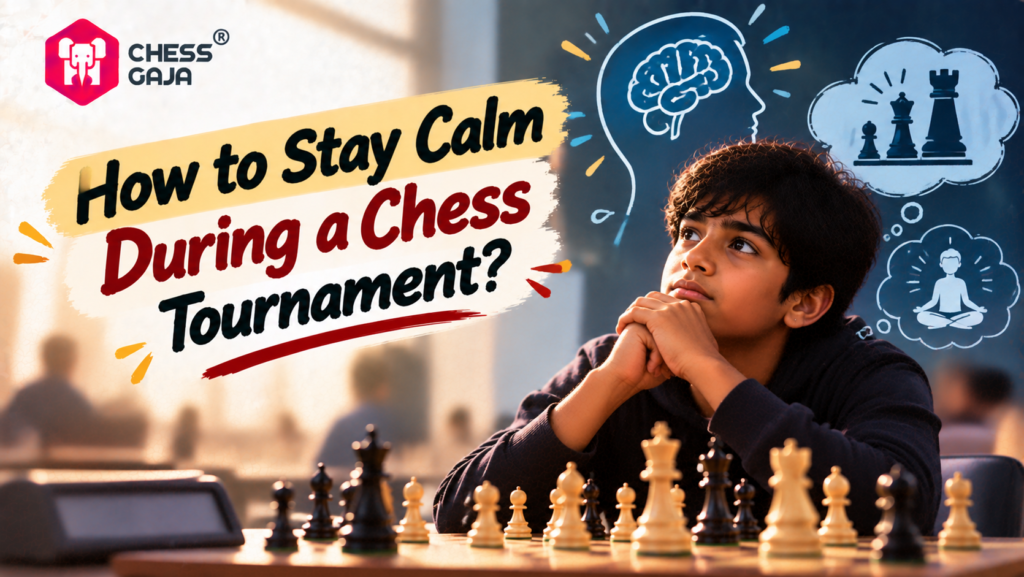
Mastering tournament psychology strategies is essential when your hands start shaking before sitting down at the board. You’ve prepared the openings and studied tactics, but executing under official time controls requires complete mental control.
Tournament psychology strategies separate players who crumble under pressure from those who perform at their best. Executing under official time controls requires mental control. Mastering chess tournament anxiety protects your hard-earned USCF or FIDE rating. At Chess Gaja, we’ve worked with thousands of students across the USA, UAE, and Singapore. They discovered that mental skills are just as trainable as tactical patterns. Practice and competition are very different. Playing well in high-stakes games comes down to how you manage your mind.
Managing Pre-Tournament Nerves
Calming Your Body Before the Board
The moment you walk into the tournament hall, your nervous system hijacks your performance. Your heart races, your hands shake, and the opening you studied yesterday vanishes from your mind. stress triggers your fight-or-flight response. This floods your body with adrenaline and cortisol, clouding your judgment.
You cannot think clearly when your body is in this state. The solution is not positive thinking or willpower; it is physical intervention. Deep, rhythmic breathing activates your parasympathetic nervous system, the biological brake that calms you down.
Before you sit at the board, spend two minutes breathing in for four counts, holding for four counts, and exhaling for six counts. The longer exhale is what matters-it signals safety to your brain. Young players in the USA and UAE who practice this technique before each round report sharper focus and fewer blunders in the opening phase. This works because you are not fighting your anxiety; you are changing your physiology. Do this routine the same way every tournament, in the same location if possible. Your body learns to associate this pattern with readiness, not panic.
What Your Pre-Tournament Routine Must Include
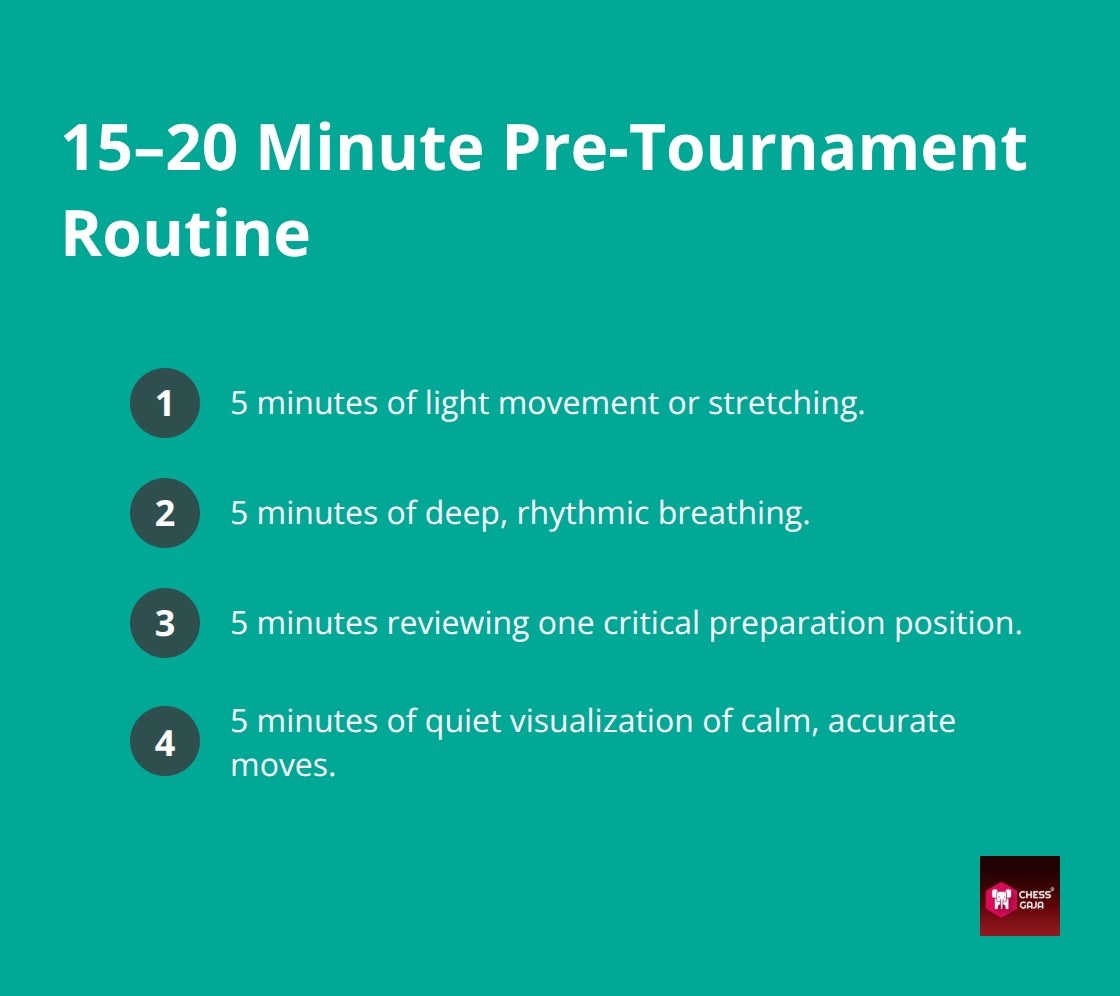
Your routine anchors confidence. Players who follow the same sequence before every game-whether it is a specific song, a particular warm-up puzzle, or a visualization exercise-perform more consistently than those who improvise. We recommend a routine that takes 15 to 20 minutes: five minutes of light movement or stretching to release physical tension, five minutes of breathing work, five minutes reviewing one critical position from your preparation, and five minutes of quiet visualization where you see yourself making calm, accurate moves. The exact activities matter less than consistency.
If you change your routine for a tournament, your nervous system treats it as unfamiliar, which increases anxiety. Stick with what you practice in training.
Building Confidence Through Repetition Under Real Conditions
Confidence does not come from hoping you will play well; it comes from knowing you have played well under similar conditions before. If you only practice tactics at home but never play blitz games with time pressure, your brain has no evidence that you can think clearly when the clock ticks down. Tournament simulation with rated games improves performance by reducing panic-related mistakes. Play monthly rated tournaments on Lichess or your local chess club before entering larger competitions. Each game teaches your nervous system that pressure is manageable. You are not just preparing your chess knowledge; you are training your emotional response to competition. This foundation of real tournament experience sets the stage for the next critical skill: making sound decisions when the pressure intensifies and your time runs short.
Decision-Making Under Pressure
Slowing Down When Time Pressure Strikes
The moment your clock drops below five minutes, your brain shifts into panic mode. You start moving pieces faster, skipping calculation steps, and making moves you would never play in a training session. This is not a character flaw; it is a predictable cognitive response. Under time pressure, your working memory shrinks. You lose access to the careful analysis that won you games during preparation. The solution is not to play faster or to trust your intuition more. It is to slow down your decision-making process deliberately, even when the clock screams at you to hurry.
Research shows that players who pause before moving make significantly fewer blunders. This holds true even in rapid games where time is scarce. The pause serves one purpose: it forces your prefrontal cortex to engage rather than letting your amygdala (the fear center) control your moves. Before each move, ask yourself three questions in order:
- What is my opponent threatening?
- What are my candidate forcing moves (checks, captures, threats)?
- Does my chosen move safely handle their threat or create a stronger counter-threat?
This framework takes 15 seconds maximum and eliminates the vast majority of tactical mistakes young players make in tournaments.
Recognizing Mental Traps Before They Cost You
Common mental mistakes under pressure follow predictable patterns, and recognizing them mid-game stops them from costing you rating points. Tunnel vision is the most frequent error. You focus solely on your offensive plan while ignoring your opponent’s counterplay across the board. The second trap is overestimating time pressure; you convince yourself you must move instantly, when taking even 10 to 15 deliberate seconds allows you to accurately verify the position before moving. The third trap is emotional decision-making after a mistake. When you lose material, do not panic and play recklessly. Fight for a draw or a practical position.
These patterns are not signs of weakness. They are signs you need structured practice against time pressure. The antidote is tournament simulation with real time controls. Playing monthly rated games on Lichess or in your local chess club before major competitions trains your nervous system to handle these moments without spiraling. Each game teaches you that mistakes are survivable and that calm calculation beats panic every time.
Building Trust Through Tournament Experience
When you trust your preparation, you stop second-guessing your openings, your tactical patterns, and your endgame technique. This trust only comes from evidence-from having played similar positions under similar pressure and succeeded. Consistent competition accelerates rating improvement and provides measurable progress. The players who perform best at tournaments are not the most talented; they are the ones who have logged the most tournament experience and learned to separate real danger from the noise of time pressure.
Players in Singapore and the USA who practice this mental checklist during rated games report lower anxiety and higher accuracy in critical positions. The key is making this process automatic through repetition, not trying to invent it during a tournament. Each tournament experience adds another layer of evidence that you can handle pressure, and that evidence becomes your foundation for the next challenge: recovering quickly when things go wrong mid-tournament.
Recovery and Resilience After Setbacks
Stop the Immediate Analysis
The game ends badly. You missed a tactic in the middlegame, your opponent converted the advantage, and now you stare at a loss on the pairing sheet. Your rating just dropped. Your confidence cracks. The natural instinct is to spiral-to replay the mistake over and over, to question whether you belong in this tournament, to convince yourself that the next round will go the same way. This mental state is exactly what loses tournaments. Players who recover quickly finish significantly higher. Do not let one bad result poison your mindset for the rest of the event.
The moment you leave the board, stop analyzing the game immediately. Avoid pulling up computer analysis or engine evaluations immediately on your phone. If you wish, conduct a brief, polite 5-minute post-mortem with your opponent at the board to share ideas, then step away completely before touching an engine. Analyzing immediately after a loss is harmful. Your emotional brain is active, which can trigger negative self-talk. Instead, spend 30 minutes on physical recovery. Walk outside without your phone, grab a light healthy snack (like nuts or fruit), and save heavy meals for after the final round of the day to keep your mind sharp for the next game. Players who maintain consistent nutrition and hydration between rounds perform more consistently across tournament games. Drink water, not sugary drinks that spike and crash your energy.
Extract One Lesson, Then Move Forward
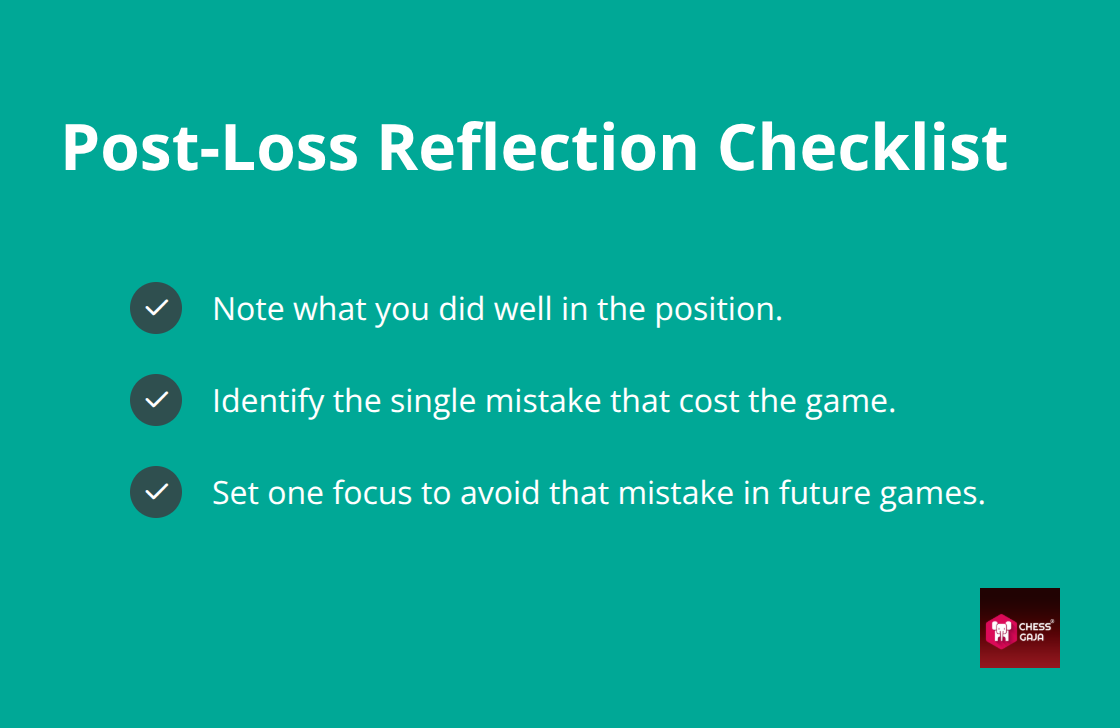
After 30 minutes of physical separation from the result, write down three things: what you did well in the position, what mistake cost you the game, and one specific thing you will focus on to avoid that mistake in future games. This is not rumination; this is structured reflection. Write it down, close the notebook, and move on.
The goal is to extract one lesson without letting the loss define your identity as a player. Young players in the USA and Singapore who follow this protocol stop playing worse after losses and often play better in the next round because they have something concrete to focus on rather than vague self-doubt.
Refocus on the Present Position
When you sit down for your next game, your only job is to play the position in front of you-not the position from round two, not the rating points you lost, the board you are looking at right now.
If you find yourself thinking about the previous loss during your next game, use the same three-question mental checklist you learned under time pressure:
- What is my opponent threatening?
- What are my candidate forcing moves (checks, captures, threats)?
- Does my chosen move safely handle their threat or create a stronger counter-threat?
This framework pulls your attention away from the emotional residue of the loss and back into concrete chess calculation.
Adjust Strategy Only When Evidence Demands It
Players often adjust their tournament strategy mid-event based on results, and sometimes this is necessary. If you have played three games and lost to much lower-rated opponents due to careless mistakes, then yes, you need to slow down and double-check your moves. But do not make wholesale changes to your approach based on one loss. If your opening preparation was solid but you missed a tactic, the problem is not your opening; it is your calculation under time pressure, which you already know how to fix. Stay with your plan. The players who finish tournaments with strong results are not those who panic and reinvent themselves after round two. They are the ones who trust that their preparation is sound and that one loss does not erase the hours they spent studying.
Tournament experience teaches you that a strong finish is possible if you play the remaining games with focus. A slow start can still salvage a respectable result if you stop the bleeding and win the final rounds. Every remaining game is a fresh opportunity to gather evidence that you can play well under pressure, regardless of what happened earlier.
Final Thoughts
Tournament psychology strategies work because they are trainable skills, not innate talents. These breathing techniques and decision-making frameworks build resilience. Competitive players across the USA, UAE, and Singapore use these exact protocols to perform under pressure. Calm decision-making beats panic, and structured recovery beats rumination.
Most young players lack consistent, guided practice under real conditions. They need structured feedback from a qualified coach who understands competition psychology. At Chess Gaja, we have built our entire curriculum around tournament psychology because we know that rating improvement stalls without it. Our FIDE-rated coaches work with students across 40+ countries to integrate mental resilience into every training session, not as an afterthought but as a core skill alongside tactics and openings.
The next step is simple: book a Paid Starter Class with Chess Gaja. During this session, one of our coaches will evaluate your current tournament performance, identify which mental skills need the most work, and build a personalized study plan that addresses both your chess knowledge and your psychological readiness.