

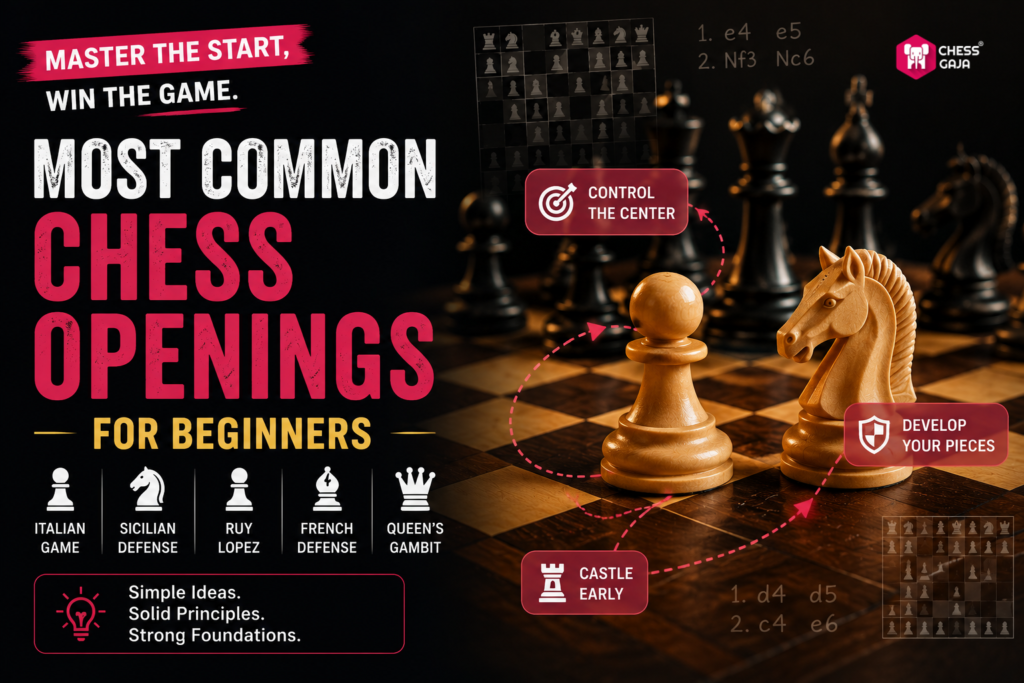
Your first tournament is coming up, and you’re wondering which opening to play. The most common chess openings for beginners work because they follow simple principles that even young players can master quickly.
At Chess Gaja Academy, I always tell beginner students: avoid getting lost in theory. As Grandmaster Priyadharshan Kannappan, I believe the best beginner openings follow clear, simple rules. You must control the center and develop your pieces fast.
In this guide, I highlight reliable openings like the Italian Game, French Defense, and Ruy Lopez. These setups let you focus on playing chess rather than memorizing endless variations. Consequently, you will build a solid foundation to transition from beginner to competitor with confidence.
Italian Game: The Solid Foundation
Why the Italian Game Works for Beginners
The Italian Game starts with 1.e4 e5 2.Nf3 Nc6 3.Bc4, and it’s the opening we recommend most often to beginners in our coaching programs. This isn’t because it’s fancy or historically important-it’s because the moves make immediate sense.
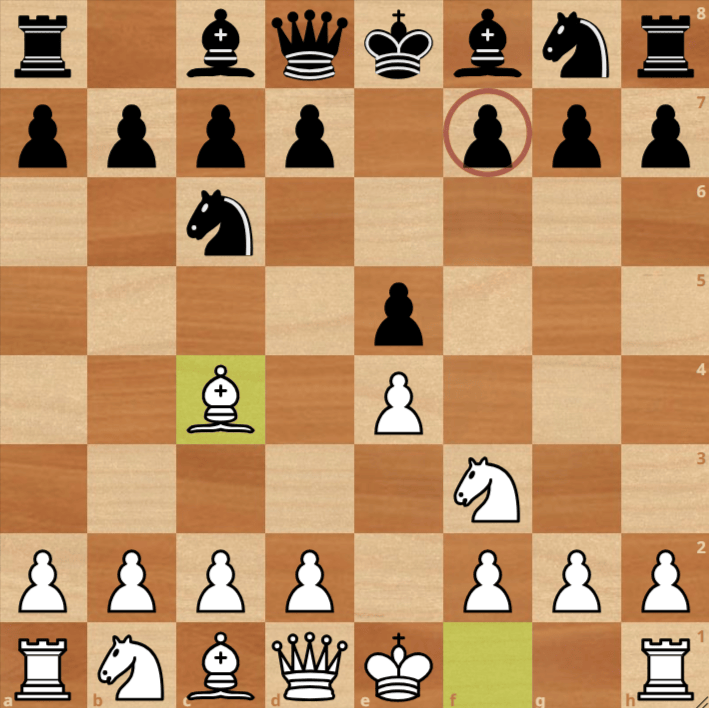
Your pieces develop toward the center, your bishop lands on an active square, and you build real pressure on Black’s position without memorizing 20 moves of theory. Chess.com data shows that 1.e4 remains the most popular first move at beginner levels, and the Italian Game represents the clearest path forward from there.
When a student in Singapore’s youth circuit or a tournament player in the UAE sits down to play, they need an opening that teaches them something valuable every single game. The Italian Game does exactly that.
The Three Principles That Win Games
The first three moves accomplish three things simultaneously: you control the center with your e4 pawn, you develop your knight to f3 where it supports that center, and you place your bishop on c4 where it attacks f7, Black’s weakest square. This isn’t arbitrary.
The f7 square is weak because only Black’s king defends it, and beginners learn quickly that attacking weak points wins games. After Black plays 3…Bc5, you’ve reached the Giuoco Piano, where both sides have made sensible moves and the position teaches you how to handle piece activity.
If Black plays 3…Nf6 instead, you enter the Two Knights Defense, where tactical themes emerge naturally. Neither line requires you to memorize obscure variations-you simply follow the principle of developing your pieces, controlling the center, and looking for opportunities to attack f7.
Your goal in the opening is clear: get your pieces out, castle kingside to safety, and enter the middlegame with more active pieces than your opponent. The Italian Game delivers this repeatedly.
Three Mistakes That Cost Beginners Games
The biggest mistake is playing too fast and leaving the king in the center too long. After 3.Bc4, some beginners skip castling and attack immediately with moves like Ng5 or h4, thinking they’re being aggressive. This backfires because your king becomes a target instead of your opponent’s weaknesses. Castle kingside by around move 8 or 9-it’s not defensive, it’s practical.
A second common error is placing the light-squared bishop on d3 too early instead of c4, which blocks the d-pawn and stops White from controlling the center. The bishop on c4 pressures f7 and controls key central squares right away, giving you active piece play from the start.
Beginners also trade pieces without purpose. Needlessly trading off your active c4 bishop (or allowing Black to exchange it without a clear benefit) reduces your attacking chances. Keep your pieces active, and only trade when it improves your position or removes a defender of f7. The Italian Game punishes lazy play immediately, which makes it perfect for learning.
Moving Forward With Confidence
The Italian Game gives you a real foundation because it works the same way in every game. You develop, you pressure f7, and you transition into a middlegame where your pieces control the board. Once you master this opening, you’re ready to explore how Black defends against 1.e4 with other systems-and that’s where the French Defense enters the picture.
French Defense: Building a Strong Position
When a student from Dubai or a tournament player in the USA faces 1.e4, they need a second weapon beyond the Italian Game. The French Defense (1.e4 e6) works because it refuses to play White’s game. Instead of fighting for the center immediately with e5 like in the Italian Game, Black plays e6, which supports a d5 pawn push on the next move.
This creates a fundamentally different battle. White gains space advantage early, but Black builds a solid wall that frustrates aggressive players. Beginners learn something here that the Italian Game doesn’t teach: how to defend well and counterattack from a cramped position. This opening remains one of the most solid Black responses to 1.e4 at all levels because it doesn’t require sharp tactical accuracy-it requires patience and understanding pawn structure.
When you play the French as Black, you’re not trying to win in the opening. Instead, you’re trying to reach move 15 with a playable position while White’s pieces sit awkwardly. That’s a completely different mindset from the Italian Game, and it’s exactly why beginners need both.
The Pawn Structure That Defines Every Game
The French Defense creates a pawn chain that shapes the entire game. After 1.e4 e6 2.d4 d5, Black has a solid center and White has a space advantage. The critical square becomes e5, which White wants to control and Black wants to prevent. This isn’t something you memorize-it’s something you see in every French Defense game.
White’s dark-squared bishop often lands on g5 or e3, attacking pieces and controlling key squares. Black’s c8 bishop becomes the problem piece because it sits behind the e6 pawn and has limited options early on. The Exchange Variation (3.exd5) simplifies the position but reduces White’s attacking chances, making it popular with beginners who want to avoid theory. The main line (3.Nc3) defends the e4 pawn and leads to rich tactical and strategic battles depending on how Black responds.
A beginner playing Black in the French needs to know one concrete plan: push …c5 to challenge White’s central d4 pawn, put pressure on d4 and b2 using …Nc6 and …Qb6, and look to activate the light-squared bishop (the ‘bad French bishop’) later via …b6 and …Ba6, or through …Bd7–Be8–Bh5. You don’t need to memorize 25 moves—understand the pawn structure and where your pieces belong.
Playing Without Drowning in Theory
Most beginners avoid the French Defense because they fear complex theory like the Winawer Variation (3…Bb4). Instead, stick to natural development. Against 1.e4 e6 2.d4 d5 3.Nc3, Black can play 3…Nf6 (the Classical Variation). After White plays 4.Bg5, Black simply plays 4…Be7, unpinning the knight and preparing to castle.
Develop your dark-squared bishop to e7, fight for central space with c5, castle kingside, and connect your rooks. You will reach a playable, solid position without memorizing dozens of lines. You’ll reach move 12 or 13 having made natural moves that follow basic principles. White will have more space, but your position holds. From there, you play for c5 breaks, queenside expansion, and piece activity.
If you’re playing White against the French Defense, avoid hasty, uncalculated attacks. Protect your central pawn with 3.Nc3, or resolve the tension with 3.e5 (the Advance Variation). Once your center is secure, develop methodically with Nf3 and Bd3, castle kingside, and build up pressure gradually. The French rewards patience—wait for Black to overextend on the queenside before launching your strike.
Why This Opening Prepares You for Ruy Lopez
The French Defense teaches you to think in terms of pawn structures and long-term plans rather than short-term tactics. This skill transfers directly to your next opening: the Ruy Lopez, which allows White to develop its pieces and disrupt Black’s pawn structure. The Ruy Lopez builds on everything you’ve learned about piece placement, center control, and patience-but it adds a new layer of complexity that separates beginners from intermediate players.
Ruy Lopez: Why This Opening Separates Strong Beginners From Weak Ones
The Ruy Lopez (1.e4 e5 2.Nf3 Nc6 3.Bb5) looks deceptively simple. White plays three moves that seem natural enough, and suddenly you’ve entered one of the most important chess openings in history. Named after a Spanish clergyman who wrote about chess in the 16th century, the Ruy Lopez remains the most popular opening at all competitive levels because it works.
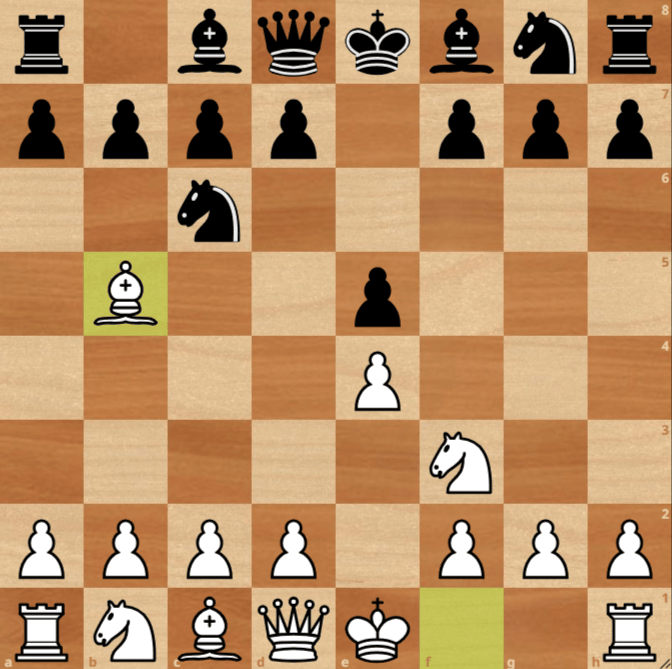
Unlike the Italian Game, which attacks f7 directly, the Ruy Lopez takes a more sophisticated approach. Your bishop on b5 pressures the knight on c6, which defends e5. While taking on c6 doesn’t win the e5 pawn immediately (because Black can recover it with …Qd4), it creates long-term strategic tension and forces Black to address the pressure.
How Black Responds to Your Bishop Attack
Black must decide whether to trade the knight, move it, or defend it further. Each choice leads to completely different positions, and that’s why the Ruy Lopez teaches you more than any other opening. The critical moment comes after 3…a6, when Black attacks your bishop and forces a decision.
Most beginners play 4.Ba4, keeping the bishop on the board and maintaining tension. This is correct. Your bishop on a4 still influences the center and Black’s pieces, and you haven’t committed to any specific plan yet.
Two Main Paths for Beginners
From here, the position branches into dozens of variations, but beginners should understand two primary setups after 4.Ba4 Nf6 5.0-0. The Open Ruy Lopez is sharper and teaches tactical patterns, while the Closed Ruy Lopez is more positional and teaches you how to build pressure over time. Pick one and commit to learning it deeply:
- The Closed Ruy Lopez (
5...Be7 6.Re1 b5 7.Bb3 d6 8.c3 0-0): Black builds a solid position, castling quickly and preparing to fight for the center. White slowly maneuvers pieces viac3,d4, andh3to maintain a long-term strategic advantage. Choose this line if you prefer strategic patience and solid positional play.
- The Open Ruy Lopez (
5...Nxe4): Black boldly captures thee4pawn, leading to faster piece activity and direct tactical play for both sides. Choose this line if you enjoy sharp, dynamic tactical battles.
Building Your Advantage Slowly
Your goal in the Ruy Lopez is not to win immediately in the opening. Instead, you try to reach move 15 with a small but real advantage.
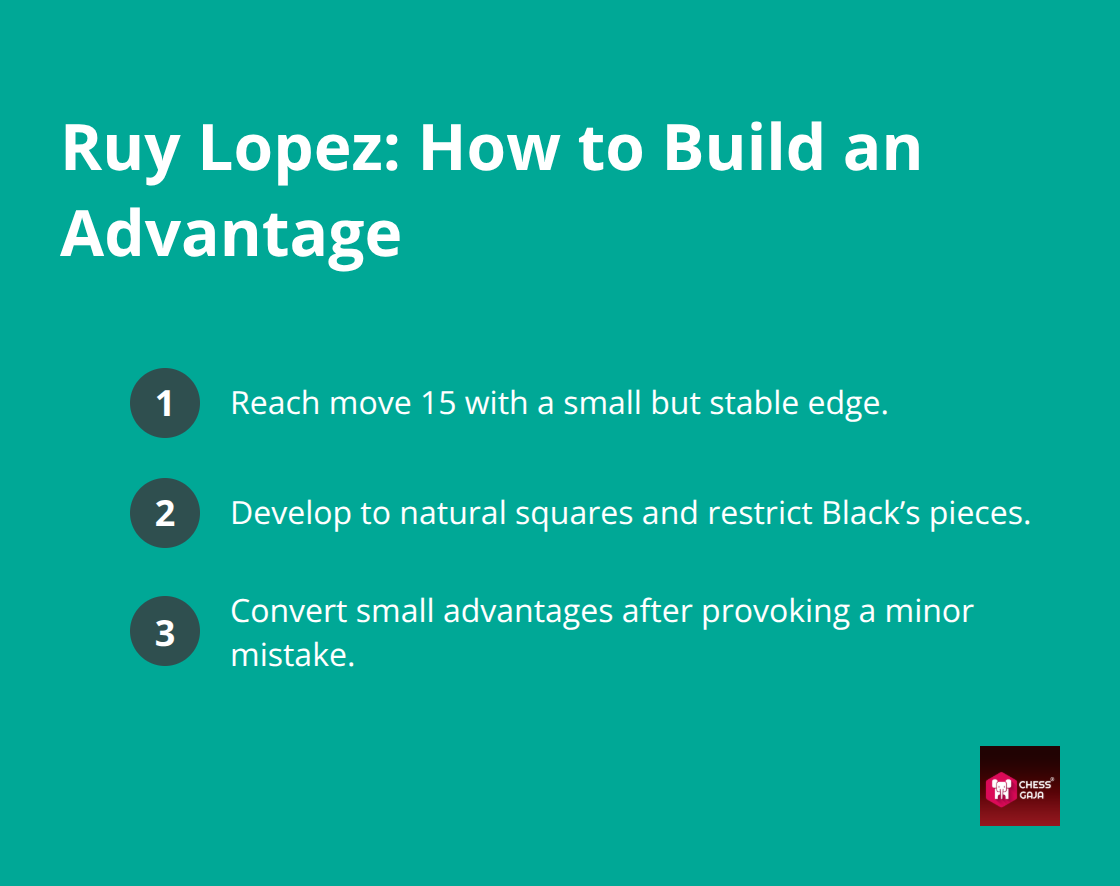
White’s advantage in the Ruy Lopez comes from piece placement and space control,not from a crushing attack. You develop your pieces to natural squares and keep Black’s pieces cramped. Then you wait for Black to make the small mistake that turns your advantage into a win.
This patience separates the Ruy Lopez from the Italian Game, where you can sometimes attack and win quickly. Here, you learn that chess is about accumulating small advantages and converting them in the middlegame. Beginners who master this opening develop a much stronger understanding of how pieces interact. That happens because it forces you to think two or three moves ahead, since Black has real options, not just one obvious response.
Final Thoughts
The Italian Game, French Defense, and Ruy Lopez form the foundation of solid opening play. Each one teaches principles that apply to every game you play. Quick development and direct attacks suit the Italian Game. Patient, cramped positions favor the French Defense. Long-term piece interaction and lasting advantages point toward the Ruy Lopez. These openings work because they force you to think about what your position needs, not just which moves to play.
Avoid the Common Beginner Trap
Most beginners fail because they try to learn every opening at once instead of picking one opening for White and one for Black, then playing them repeatedly until the moves feel natural. After 20 or 30 games with the same opening, you stop thinking about which moves to play and start thinking about what your position needs.
The next step is to analyze your games after you play them and look at where you deviated from the opening principles we’ve covered-where you castled too late, where you left your pieces passive, where you traded pieces without purpose. This self-analysis accelerates your progress faster than playing more games without reflection.
Get Personalized Coaching to Improve Faster
We at Chess Gaja work with students across the USA, UAE, and Singapore who want to move beyond trial-and-error learning, and our FIDE-rated coaches provide personalized instruction that identifies exactly which openings suit your playing style. If you’re serious about improving your opening play and want professional guidance tailored to your specific needs, book a Paid Starter Class with Chess Gaja for a skill evaluation. Our coaches will analyze your current games, recommend which of these openings fits your style, and create a concrete plan for your next 30 days of study.