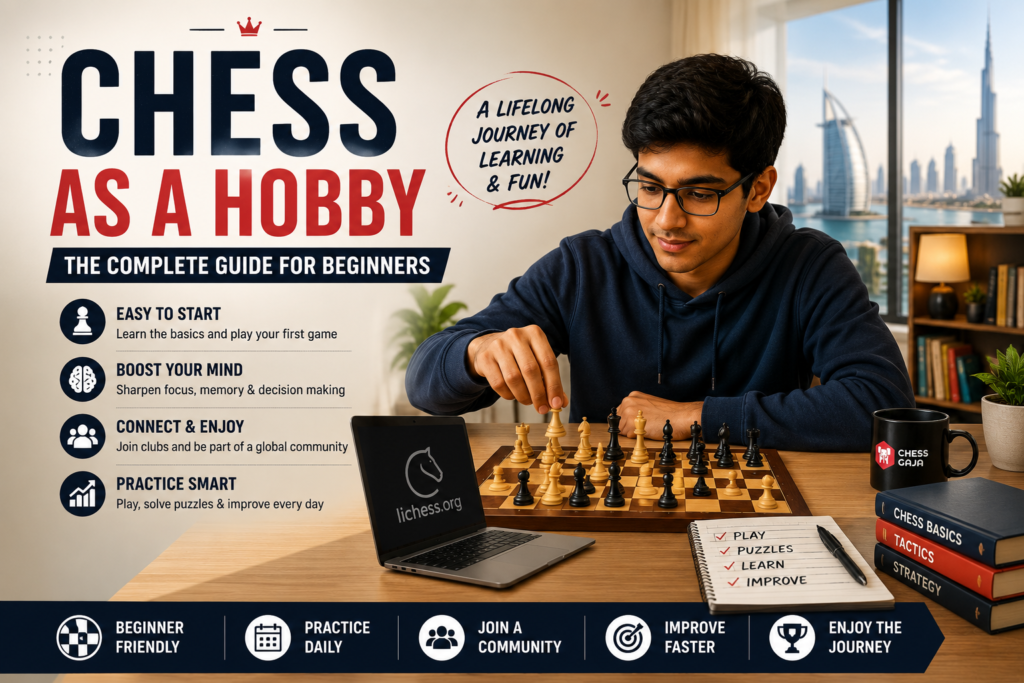
Chess has become one of the fastest-growing hobbies in the USA, UAE, and Singapore over the past five years. Whether you’re looking for a mental challenge, a way to unwind, or simply a fun activity to enjoy with others, chess offers something for everyone.
At Chess Gaja, we’ve helped thousands of beginners discover how chess as a pastime can transform the way they think and interact with the world around them. This guide walks you through everything you need to know to start your chess journey today. This guide walks you through everything you need to know to start your chess journey today.
Starting Your Chess Journey: What You Actually Need
The Minimal Setup to Begin
You don’t need a fancy setup to begin playing chess. A basic board, pieces, and access to one free online platform will get you moving within hours. The most critical step is understanding piece movement and playing your first game. Chess.com and Lichess offer free accounts to start playing within minutes. Both platforms feature beginner-friendly interfaces that highlight legal moves when you hover over pieces. In the USA, UAE, and Singapore, thousands of beginners launch their chess hobby this exact way every month.
Why Most Beginners Stumble Early
The real mistake most newcomers make is spending weeks studying openings before they’ve played ten games. You’ll learn piece movement far faster through actual play than through videos or books. Set up a standard board place your rooks on the corner squares (a1/h1 and a8/h8). Place White’s pawns along the second rank and Black’s pawns along the seventh rank. On the first rank for White (eighth rank for Black), place your rooks on the corner squares (a1/h1 and a8/h8), knights next to them, followed by the bishops. The critical rule for the remaining pieces is “Queen on her own color”—White Queen on a light square, Black Queen on a dark square—with the King standing right beside her. White always moves first.
Understanding Each Piece’s Role
Each piece has one job: the king moves one square any direction but cannot move into check, the queen moves any number of squares in straight lines, rooks move horizontally along ranks and vertically along files, bishops move diagonally and stay on their own color, knights jump in an L-shape and can hop over pieces, and pawns move forward one square (or two on their first move), capture diagonally, and promote to any piece (usually a Queen) upon reaching the opposite end of the board. That’s it. You now understand the mechanics.
Your First Month of Practice
The next step is playing 20 to 30 casual games on an online platform to internalize how pieces interact. Don’t memorize openings yet; just play. After those initial games, spend 10 to 15 minutes daily solving tactical puzzles on Lichess or Chess.com to build pattern recognition for key tactical motifs like forks, pins, skewers, and discovered attacks. Join a local chess club in your city — most clubs meet weekly and cost under $50 per year — where you’ll find players of all levels happy to play casual games and answer your questions. Many clubs in major US cities, Dubai, Abu Dhabi, and Singapore have beginner nights specifically designed for players learning the game.
Getting Professional Guidance From the Start
If you want structured guidance from the start, Chess Gaja offers a free course called Everything You Need to Know About Chess with five chapters covering the fundamentals in about 1.5 hours. Our team at Chess Gaja recommends a Paid Starter Class. In this session, a FIDE-rated coach evaluates your level and learning style. Then, we build a personalized study plan tailored to your goals and schedule. This evaluation removes guesswork and ensures your practice hours count toward measurable improvement rather than spinning your wheels on content that doesn’t match where you are right now. Once you’ve built this foundation, you’re ready to accelerate your skills at a pace that fits your life.
How to Practice Without Wasting Time
The Three Parallel Tracks That Actually Work
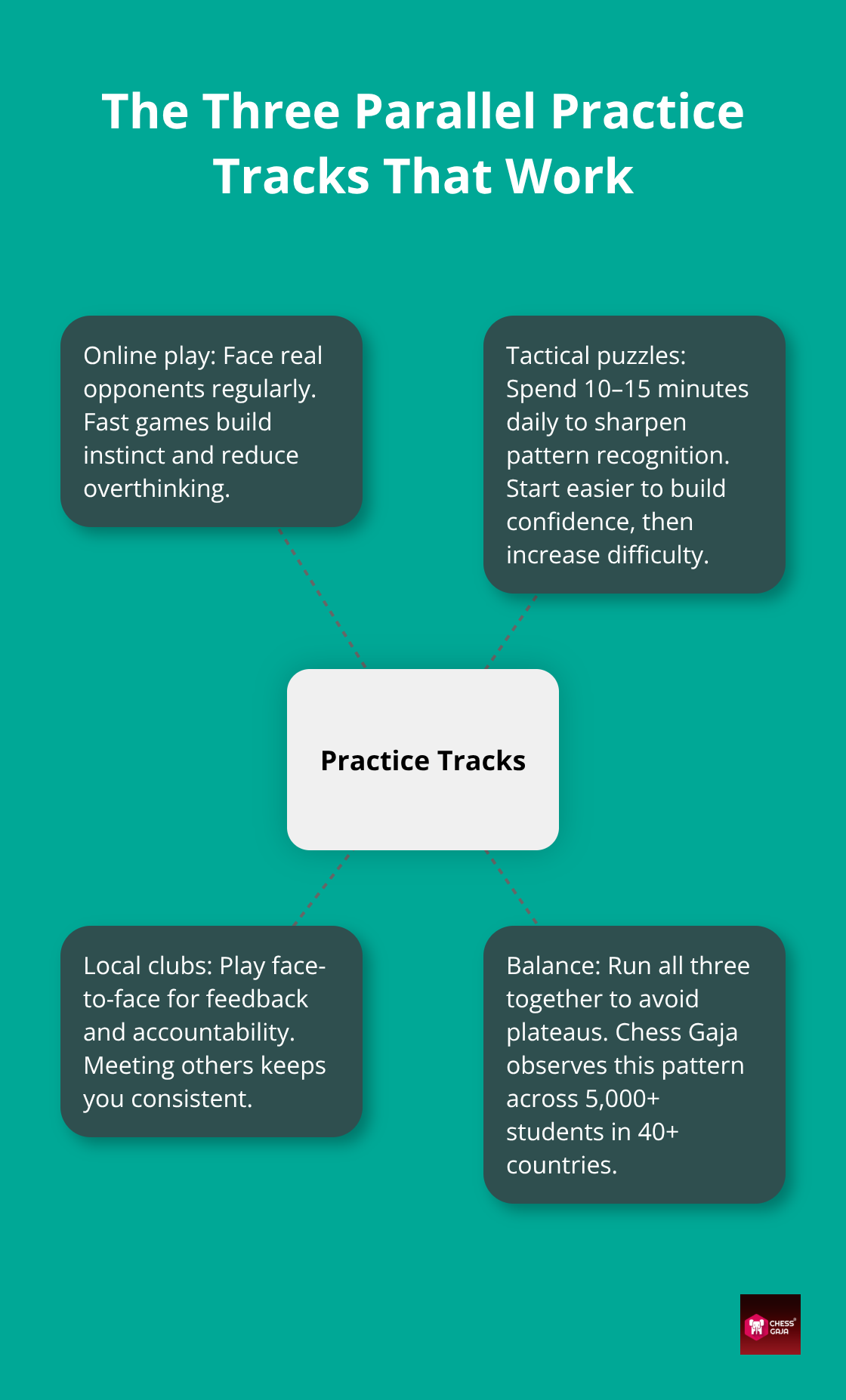
The path from your first game to genuine skill requires a specific rhythm that most beginners get wrong. You need three parallel tracks running simultaneously: online play on platforms where you face real opponents, tactical puzzle training to sharpen your pattern recognition, and casual games with other humans who can give you feedback. Most hobbyists pick one and abandon the others, which explains why they plateau after a few months. The players who accelerate fastest run all three at once, and we at Chess Gaja have observed this pattern consistently across our 5,000+ students in 40+ countries.
Online Play: Speed Builds Instinct
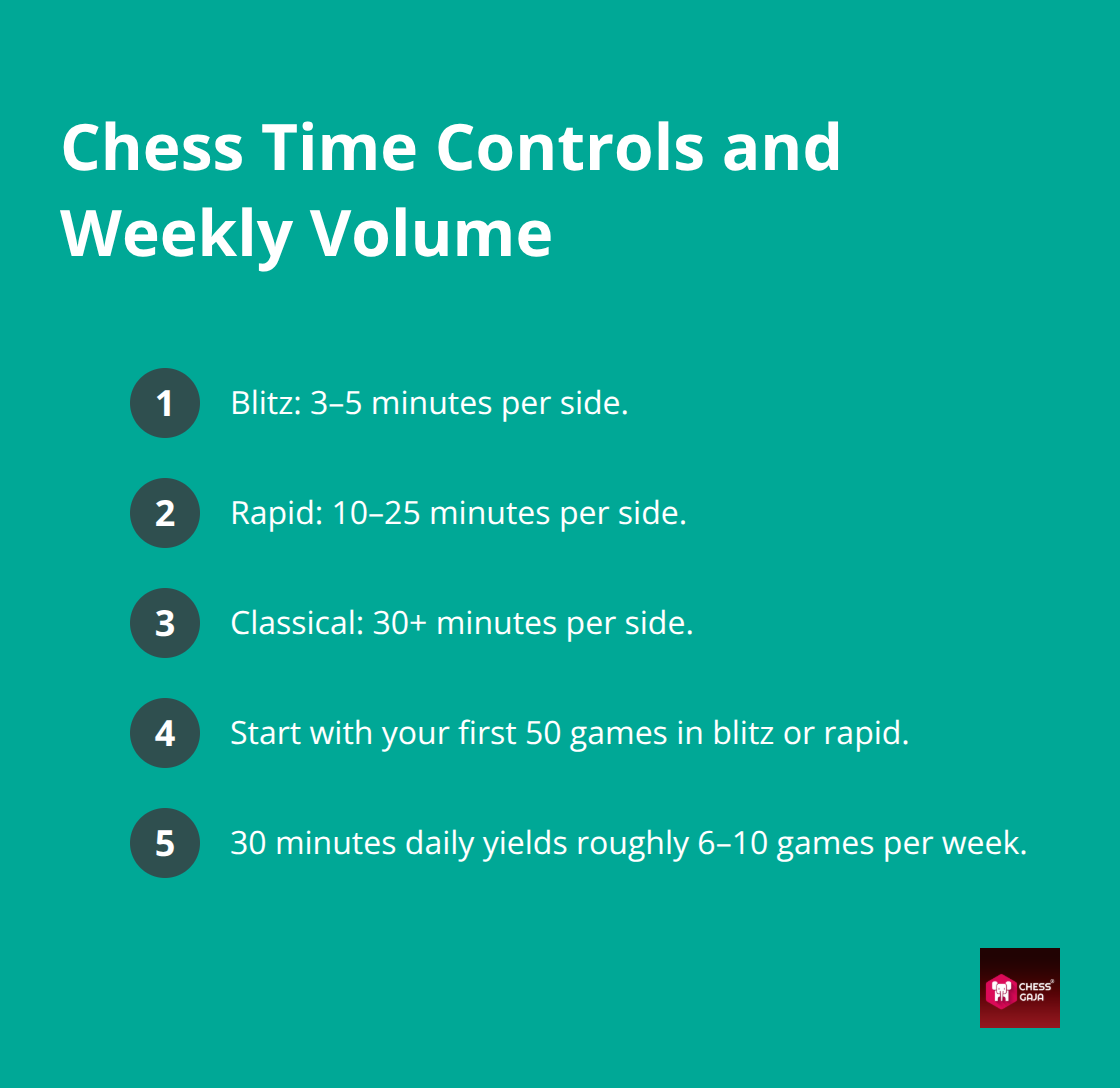
Online platforms like Chess.com and Lichess offer blitz (typically 3 to 5 minutes per player), rapid (10 to 30 minutes per player), and classical formats. Your first 50 games should focus strictly on rapid or classical time controls—rapid play gives you enough time to double-check your moves for blunders and apply basic tactical ideas without the panic of a ticking blitz clock. Spend 30 minutes daily on these platforms, which will allow you to complete roughly 4 to 6 solid rapid games per week.
Tactical Puzzles: Pattern Recognition Compounds
After those initial games, dedicate 10 to 15 minutes each day to tactical puzzles on Lichess or Chess.com. Focus on beginner-friendly tactical categories—such as Mate in 1 or 2 moves, forks, pins, skewers, and exploiting undefended (hanging) pieces—rather than complex multi-step puzzles. Solving easier, fundamental puzzles repeatedly builds confidence and trains your eye to spot core patterns instantly in real games. Research from chess coaches across the USA and UAE shows that players who solve 5 to 10 puzzles daily improve their tactical accuracy measurably within three weeks.
Local Chess Clubs: The Human Element
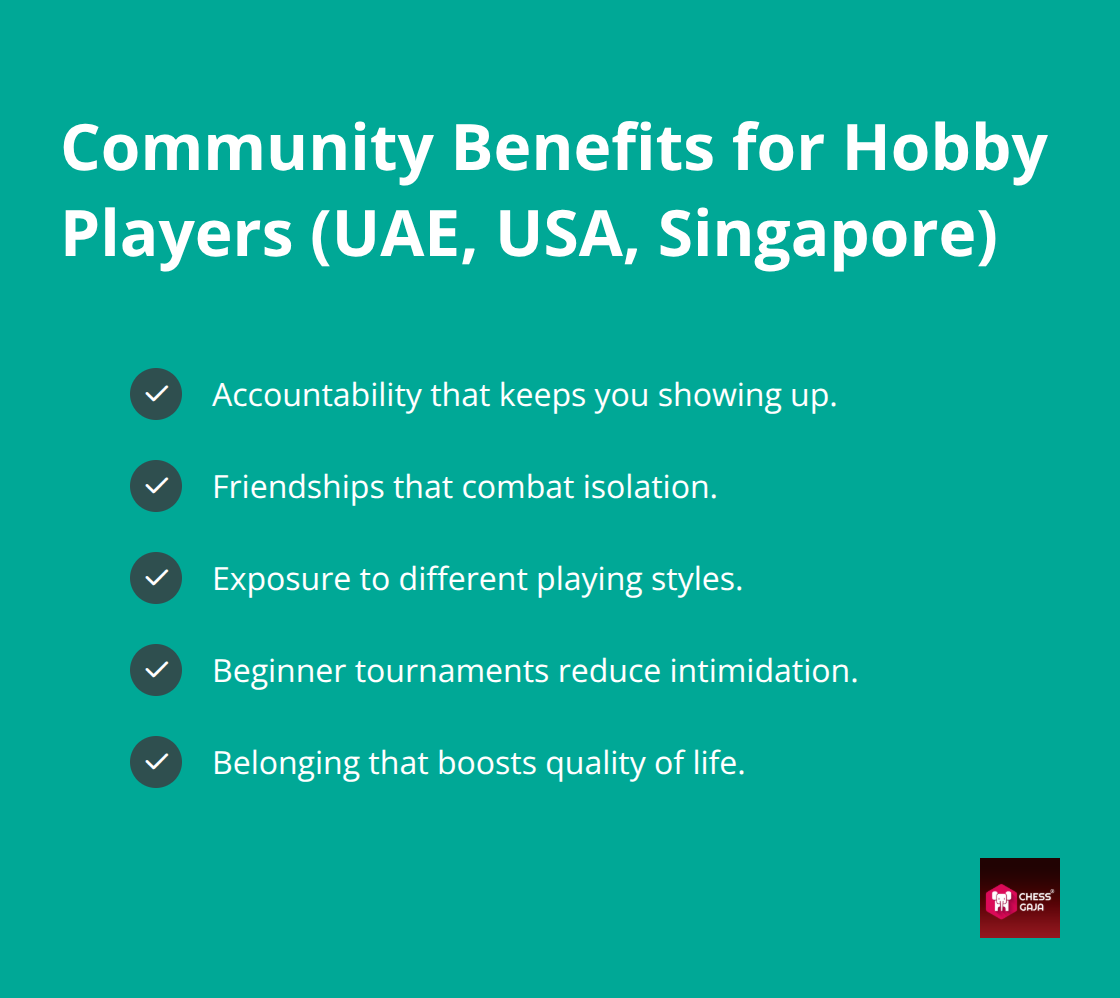
The third track is the one most online players skip: joining a local chess club and playing face-to-face. Chess clubs across the USA, Dubai, Abu Dhabi, and Singapore typically meet weekly. Membership usually costs between $40 and $100 per year. These clubs matter because they introduce you to diverse playing styles and give you real-time feedback.
Club play also exposes you to classical time controls (45+ minutes per side). This forces you to think deeper than blitz allows. Many clubs host monthly beginner tournaments where you play opponents near your skill level. The Chess Federation of UAE reported over 8,000 registered members as of 2025, showing how rapidly over-the-board play is growing worldwide.
Building Your Weekly Schedule
A practical schedule looks like this: 20 to 30 minutes daily on online rapid, 10 to 15 minutes daily on tactical puzzles, and two club visits per month for casual games and tournaments. This schedule requires roughly 5 to 6 hours per week total, which fits easily into the life of someone treating chess as a serious hobby rather than a competitive pursuit. The structure matters more than the intensity—consistency over months beats sporadic cramming every single time.
Once you establish this rhythm, patterns will emerge in your games. For example, you will notice positions you handle well and themes you miss. Therefore, that self-awareness opens the door to faster progress. Targeted study and personalized coaching will then accelerate your skills far beyond random practice.
Why Chess Teaches You to Think Differently
Pattern Recognition Across Life Domains
Chess trains your mind to see multiple moves ahead and spot patterns others miss, but the real benefit extends far beyond board position. When you play 4 to 6 rapid games per week alongside your puzzle training, you face decisions with incomplete information and limited time—exactly how strategic thinking works in real life.
A student in Dubai spent three months playing casual club games and started noticing patterns in her work presentations the same way she noticed tactical threats on the board. This isn’t mystical; it’s how pattern recognition actually transfers between domains.
The strategic thinking chess builds isn’t about memorizing brilliant moves from Grandmasters. It’s about training your brain to evaluate options, weigh consequences, and act decisively under pressure. Players who log consistent hours on platforms like Chess.com develop what researchers call decision velocity-the ability to make quality choices faster.
In the USA, corporate teams use chess training for executive development. The skill transfers directly to boardroom scenarios where leaders must think several steps ahead while adapting to incomplete data.
Research confirms that calculated decision-making mindsets developed through chess transfer to management and other fields where structural analysis matters.
Stress Reduction Through Focused Attention
The benefits of playing chess as a hobby are equally concrete, though often overlooked. Stress reduction through focused attention lowers cortisol, the stress hormone, and regular players often notice improved mood and sharper thinking. The mechanism is simple because chess demands complete, undivided attention. This forces your brain to pause work worries or personal stress.
Therefore, when you solve a puzzle or play a game, you cannot simultaneously worry about daily chores. Players in Singapore and Abu Dhabi often treat chess as a weekly mental break. They report that two hours at a chess club provides mental relief comparable to meditation or exercise.
Building Community and Lasting Connections
The social dimension amplifies the wellness benefits significantly. Casual club games create strong friendship networks. This builds social accountability and combats isolation. You’re not just playing; you’re part of a community of people who share your interest. Chess clubs across major cities in the USA, UAE, and Singapore report that regular attendees form lasting friendships. Consequently, many members even coordinate travel to regional tournaments together.
This human connection is the reason club attendance matters far more than playing the same number of games alone online. The combination of focused mental engagement, stress reduction, and social belonging creates a hobby that genuinely improves quality of life.
Personalized Development for Your Goals
If you want structured guidance on building a sustainable practice routine that balances skill development with the wellness benefits chess offers, a professional evaluation can identify your learning style and priorities. A Paid Starter Class with a FIDE-rated coach assesses where you stand, determines whether you’re seeking rapid improvement, stress relief, or competitive success, and builds a tailored study plan that matches your actual goals and available time.
Final Thoughts
Chess as a hobby transforms how you think, reduces stress, and connects you with people who share your passion. Over the past five years, thousands of beginners in the USA, UAE, and Singapore have started their chess journey without years of study or tournament pressure. You play at your own pace, improve measurably, and form genuine friendships along the way.
Starting your chess hobby requires only three basic steps: understanding piece movement, playing online games, and solving daily puzzles. Within three months, you will notice real progress in your play. Because this hobby rewards patience over raw talent, anyone can succeed regardless of background.
If you want structured guidance rather than figuring out the path alone, professional coaching removes guesswork and accelerates your progress.
At Chess Gaja, our FIDE-rated coaches work with 5,000+ students across 40+ countries. In a Paid Starter Class, a coach evaluates your current level and identifies your learning style. We then build a personalized study plan tailored to your goals and schedule. This ensures every practice hour leads to measurable improvement.