Most chess players know they should have a plan, but few understand how to build one that actually works. The gap between spotting an advantage and converting it into a win is where middlegame strategies separate strong players from the rest.
At Chess Gaja, we’ve coached thousands of students through this exact challenge. This guide walks you through the complete process: identifying your strategic idea, turning it into concrete moves, and executing it with precision.
Identifying Your Strategic Idea
What Your Position Actually Tells You
The moment you finish your opening, you face a critical choice: move forward with purpose or drift through the middlegame reacting to threats. Most players skip the essential step of reading what the position actually offers them. They see a few pieces and move them around without understanding the imbalances that exist right in front of them.
Start by counting material, then stop. Material equality means you need a different plan than being up a pawn. When ahead, your job is to simplify and convert. When behind, you must complicate and create threats elsewhere. This isn’t theoretical-it’s the foundation of every middlegame decision.
Evaluating Pawn Structures and Center Control
Next, examine the pawn structure. Where are they weak? Where are they strong? A backward pawn on d6 or an isolated pawn on c4 becomes a target you can pressure repeatedly with pieces. Pawn breaks matter too. Having a well-timed pawn break like c4/c5 or e4/e5 available that opens files for your rooks or diagonals for your bishops isn’t just an option—it’s often your strongest plan.
Control the center squares (d4, e4, d5, and e5) because they determine where your pieces can go and where your opponent’s pieces cannot. A player who controls the center controls the middlegame. Look at your opponent’s most active piece and ask yourself: can I neutralize it? If their knight sits beautifully on d5, exchanging it for your least active piece shifts the entire balance of the position. This exchange strategy separates strong players from weak ones. Many beginners overlook it and let their opponent’s best piece dominate the board indefinitely.
Find Concrete Targets, Not Vague Ideas
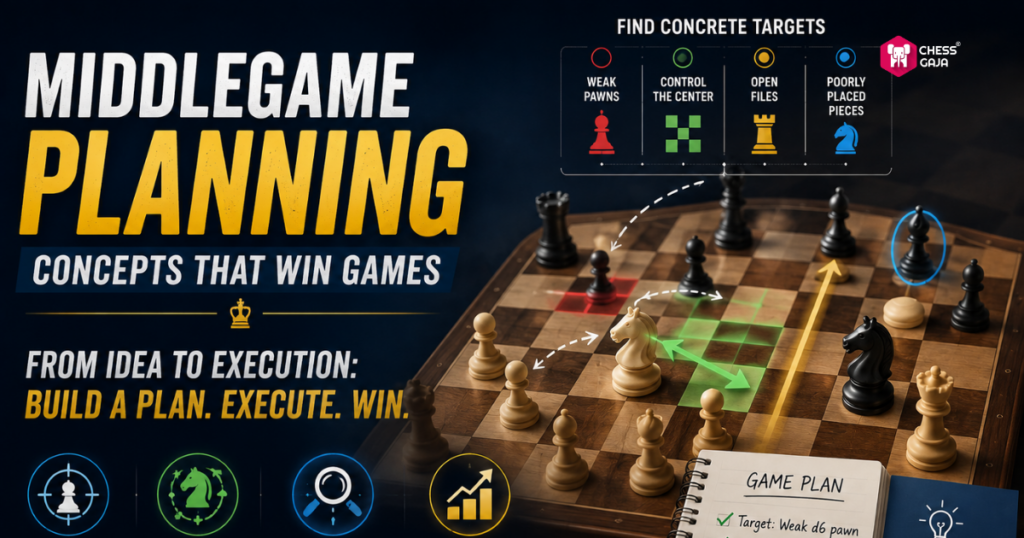
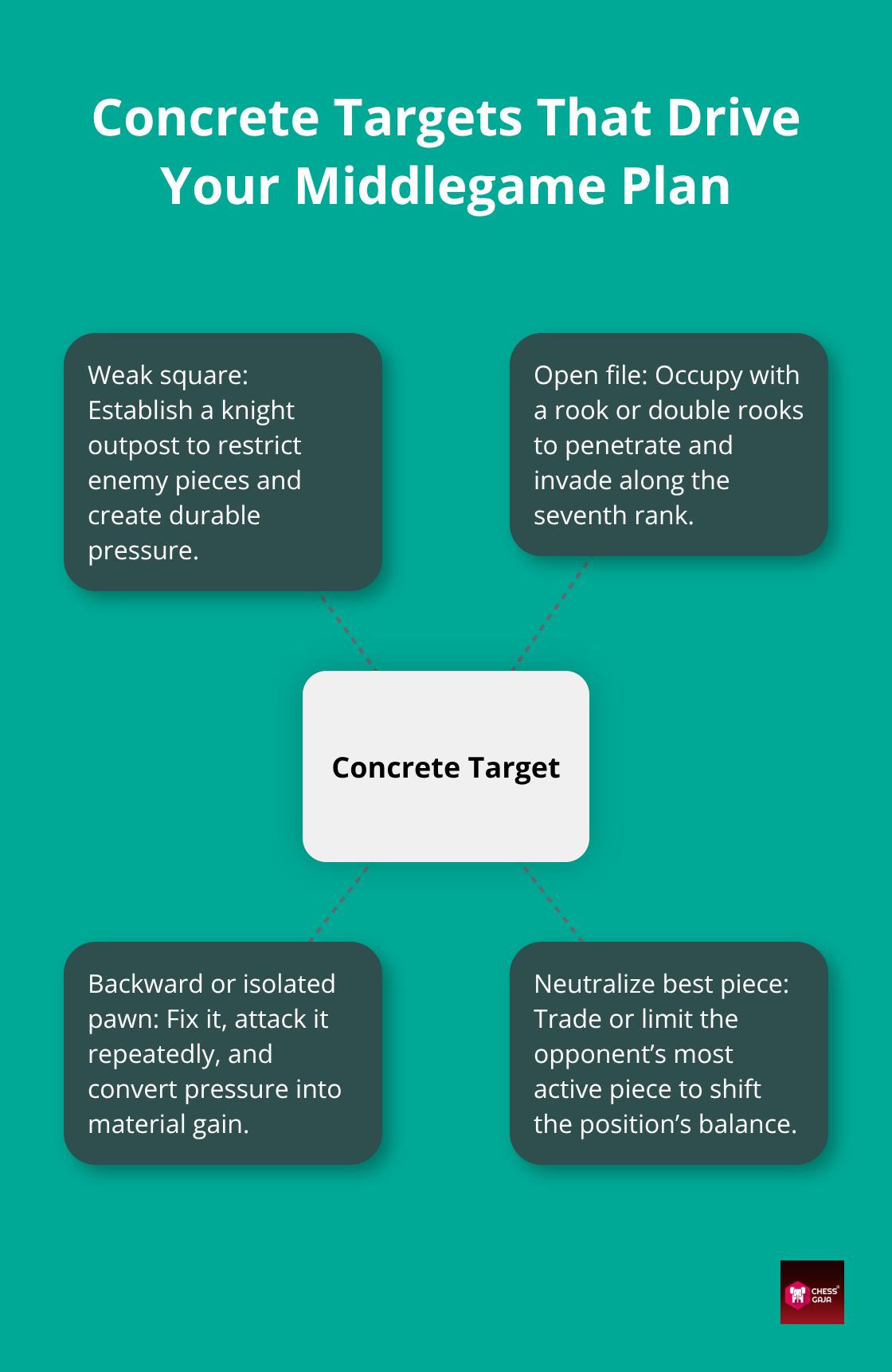
Once you’ve assessed the position, identify what you’re actually attacking. Not the opponent’s king necessarily-not yet. You need specific targets: a weak square where you can plant a knight, an open file where a rook belongs, a backward pawn that collapses under pressure.
One student in Singapore’s recent scholastic tournament played without targets and drifted for twelve moves before losing material. That same player, after learning to spot targets, won three consecutive games by pressuring specific weaknesses. Write down your target. If it’s the d6 pawn, your plan involves moving your knight to Ne4 or Nc4 to target d6, positioning your rook on the open d-file, and advancing your e- or c-pawns to take away key escape squares from your opponent’s defenders; this is concrete & executable. Vague ideas about attacking the kingside or improving your position lead nowhere.
Convert Your Assessment into a Sequence
Now connect your assessment to candidate moves. If you identified that your opponent’s bishop on g5 is their most active piece and your rook on a1 is passive, consider trading that bishop and activating your rook on an open file simultaneously. This isn’t luck-it’s systematic thinking.
Calculate a few moves ahead. What happens after your candidate move? Does your opponent have a forcing response? Can they create counterplay that derails your plan? If the answer is no, or their counterplay is weaker than your attack, commit to the move. The gap between spotting an advantage and converting it closes when you stop guessing and start calculating specific sequences tied to concrete targets. This approach transforms vague intuition into actionable chess decisions that you can execute with confidence in your next game.
How to Turn Your Target Into Actual Moves
Your target exists. You know which pawn is weak, which square needs a knight, which file your rook belongs on. Now comes the part most players rush: translating that target into a sequence of moves that actually accomplishes something. The difference between a vague plan and a winning plan is precision. You need to know exactly which moves get you closer to your objective, in what order, and what happens when your opponent fights back.
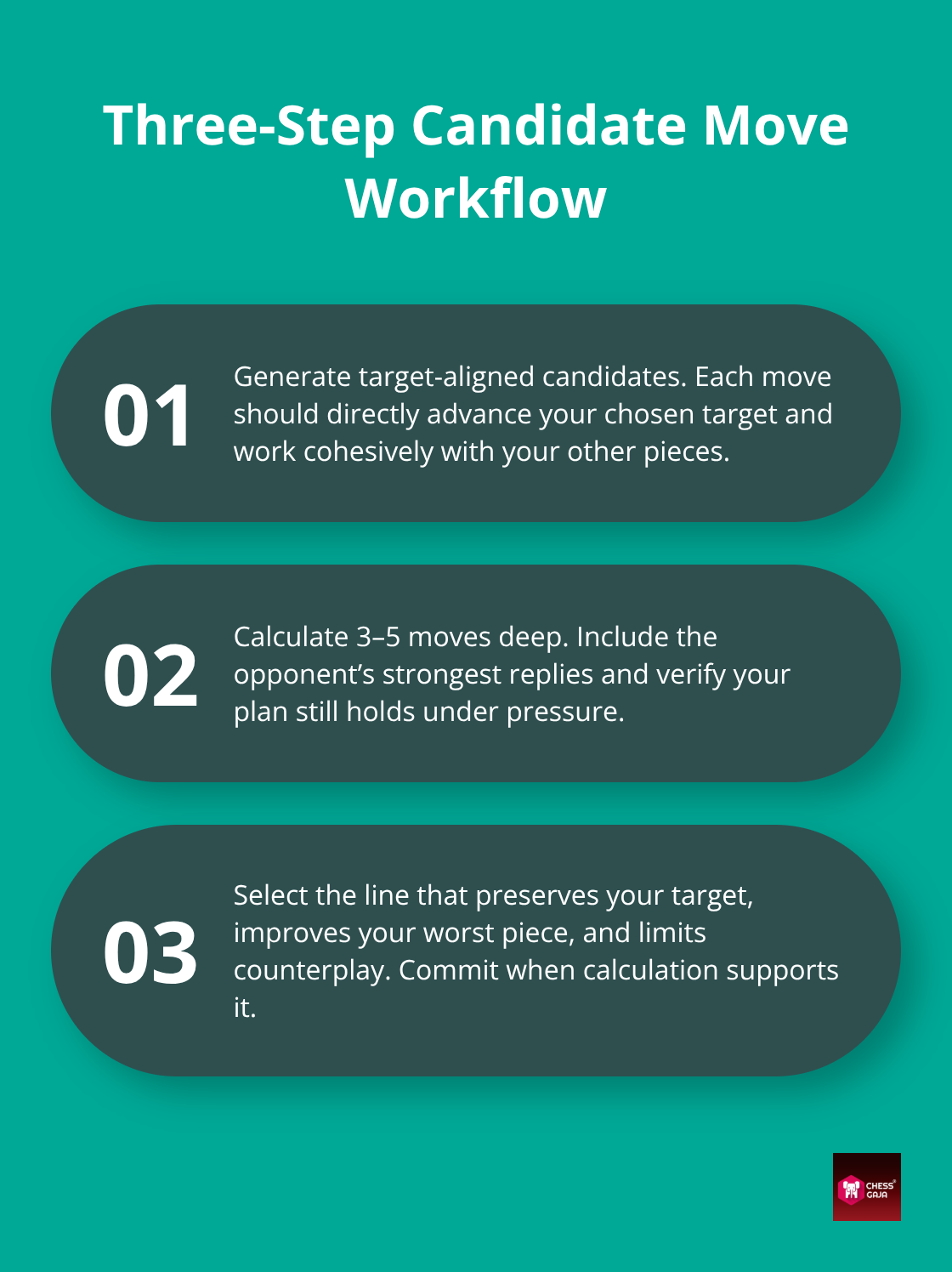
Write Down Three Candidate Moves
Start with three candidate moves that advance your target. If your goal is to plant a knight on d5 to dominate the center and pressure the c7 or e7 weaknesses, your candidates might be: reroute your knight via Nd4 (heading toward d5), move your c-pawn forward to support the knight’s arrival, or trade your opponent’s defender of d5 first. Calculate each candidate three to five moves deep.
Once you choose a first move, consider your opponent’s best response. Following that reply, identify your logical follow-up. This isn’t memorization—it’s asking what happens next.
In a recent Dubai scholastic tournament, a student lost because he played Nd2 without considering that his opponent could push e4, attacking the knight and driving it back. Without anticipating opponent replies, blunders occur quickly. However, once he began calculating responses, his tournament results improved within two months.
Test Each Candidate Against Opposition
The second candidate, advancing the c-pawn, might block your own rook’s influence on the c-file, so that fails the test. The third candidate, trading the defender, looks promising because after the trade, your knight reaches d5 uncontested and your c6 target becomes vulnerable. This is concrete planning. You eliminate weak ideas before moving them.
Tactical opportunities hide inside strong plans. Trading defenders on d5 creates a secondary tactic: once that central defender is removed, your fianchettoed bishop on g2 suddenly has full control of the long diagonal toward your opponent’s queenside weaknesses. From there, your rook can join the attack. What looked like a positional squeeze becomes a tactical pile-up that your opponent cannot defend. This is where patient planning and tactical alertness meet. You build pressure methodically, and when pieces align, the tactics arrive naturally.
Stay Flexible When Your Opponent Responds
Your plan doesn’t change just because your opponent moves; it requires strategic adjustments as the game unfolds. After you calculate your sequence, you must stay flexible. If your opponent plays e5 when you expected e6, your plan shifts. The knight reroute toward the central outposts still works, but now it supports a different tactical idea. Maybe you’re no longer attacking c6-instead you’re controlling the center and preparing f4 to open lines.
Strong players adjust without abandoning their core target. Weak players rigidly execute the first plan they found and wonder why it fails. Think of your target as the destination and your moves as the route. When a road gets blocked, you find another path without changing where you’re ultimately going.
Prioritize Forcing Moves in Your Sequence
Calculate forcing moves first: checks, captures, threats that demand your opponent’s attention. If your plan involves quiet setup moves like Nc3 followed by Nd5, or rerouting via Nd4, but you also have a check available, the check might force your opponent to respond defensively, actually accelerating your plan. A forcing move creates urgency that opponents cannot ignore. Maintaining this level of control matters far more than playing the quietest move first.
How Time Controls Affect Execution
Time pressure amplifies the cost of imprecise planning. Classical games with 90 minutes or more give you space to recalculate if your plan falters. When playing rapid games with 25 minutes, you need a clearer roadmap before move one. In blitz games at five minutes, vague targets are fatal. Build your planning habit in longer time controls where you can afford mistakes.
As you get faster, your intuition improves because you’ve already seen these patterns hundreds of times. The players who execute plans best are the ones who practiced planning when they had time to think. This foundation-built through deliberate calculation in classical games-transfers directly to faster formats and prepares you for the next critical phase: maintaining your focus when the position becomes tense and your opponent fights back.
Execution Without Distraction
Your plan exists. You know which square your knight needs to reach, which pawn to pressure, which file to control. The moment you start playing, everything changes. Your opponent fights back. Unexpected tactics appear. Clock pressure mounts. This is where most players lose their way. They abandon the plan at the first sign of resistance and react desperately to threats instead of pushing forward methodically. Execution requires ruthless focus on your strategic goals while staying alert to genuine threats that could derail you entirely.
Separate Real Threats from Phantom Moves
The first mistake is confusing distraction with danger. Your opponent plays a move that looks aggressive but doesn’t actually threaten anything immediate. You panic and defend a piece that wasn’t under attack. Meanwhile, your plan stalls because you’ve wasted two moves on phantom threats. A student in a UAE scholastic tournament faced this exact problem. His opponent played h6, a quiet pawn move that appeared threatening. The student spent his next move defending his bishop, which was never in danger. He lost the initiative and eventually the game.
Calculate whether your opponent’s move creates a real threat before reacting. Unless they hold a check, capture, or genuine tactical blow, ignore the move and push forward with your plan. This discipline separates strong players from reactive ones.
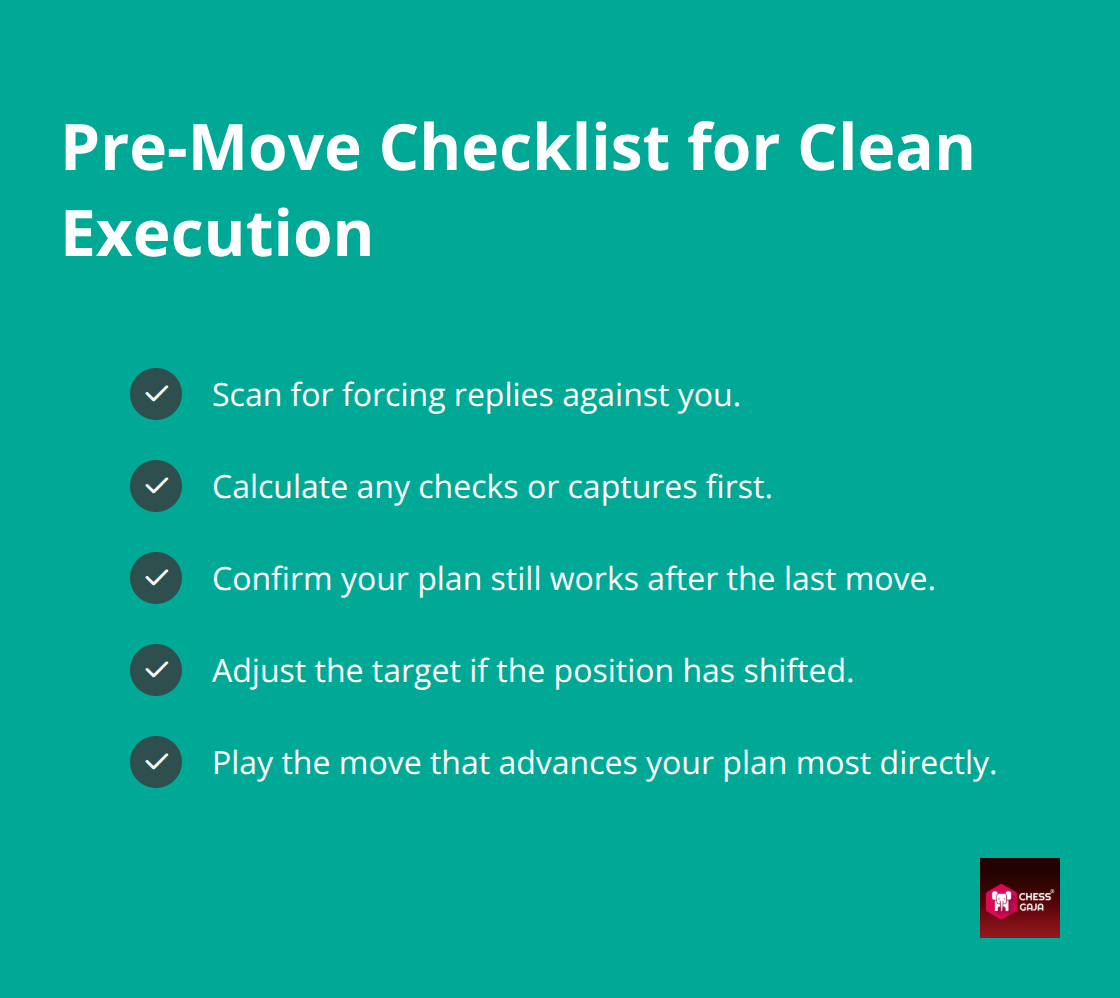
Use a quick pre-move checklist before playing any move:
- Check forcing responses: Does your opponent have a check or capture that wins material? Calculate that first.
- Re-evaluate the target: Does your plan still work after their last move? Should a quiet move subtly alter the position and erase your target, adjust your focus while maintaining your strategic direction.
- Select the direct move: Which candidate move advances your plan most effectively? Play that move.
This checklist takes thirty seconds and prevents most blunders. Skipping these quick checks often leads to wasting moves on phantom threats while missing key opportunities.
Timing Determines Execution Success
Your key moves have a window. Acting prematurely gives your opponent time to organize a defense, while waiting too long allows their counterplay to overwhelm you. This timing question separates technical execution from real execution. Consider a position where you’ve built pressure on your opponent’s weak d6 pawn. Your plan involves moving your rook to the d-file and your knight to c4, creating a squeeze. If you play Rd1 immediately, your opponent responds with Qd7 and the d6-pawn is comfortably defended. Your pressure evaporates. But if you spend three moves rerouting your knight (e.g., Ne1–Nc2–Ne3) or two moves (e.g., Nd2–Nc4) to add pressure to d6, your opponent will use those free tempos to organize their defense.
The timing question is: when is the moment your opponent cannot defend d6 anymore? The answer comes from calculating sequences three to five moves ahead. If moving your knight first, then playing Rd1, leads to a position where your opponent’s queen cannot defend both d6 and other critical squares, that’s your timing. You’ve found the moment when your plan converts into material gain or a dominant position. This is not intuition. This is calculation tied to concrete targets.
Managing Time Pressure During Execution
Clock management determines whether you can execute this timing at all. A student in Singapore playing rapid games complained that his plans fell apart under time pressure. The problem wasn’t his plans-it was that he’d spent too much time thinking about the opening and had no time left for the critical middlegame decisions. In classical games with longer time controls, you have space to recalculate timing if your first plan fails. In rapid, you must identify the critical moment before the middlegame begins. Spend your early time calculating the key sequences where your plan converts. When you reach those moments at the board, the decision is already made. This preparation-heavy approach saves time and prevents the panic that destroys execution.
Pivot When Your Plan Hits a Wall
Hitting a resistance point is the hardest part of execution. Although a plan may look perfect during calculation, an opponent’s defense often proves tougher than expected. The temptation is to force the plan forward and hope it works, but such stubbornness leads directly to losing positions. Strong players know when to pivot. If your knight cannot reach d5 because your opponent has created a fortress around that square, and your backup plan doesn’t exist, you need a different target. Refusing to force the issue isn’t failure—it’s essential adaptation.
Rather than a sign of failure, adapting to tough defense shows high-level mastery. Your overall objective remains unchanged—improving your position and creating winning chances—even if the path shifts. If defending a backward pawn on d6 costs your opponent nothing, stop targeting it. Shift your focus to the c6 weakness or launch a kingside initiative that forces structural concessions. Maintaining high flexibility alongside a relentless focus on concrete targets is what separates grandmaster execution from amateur play. Strong players never drift, keeping a clear target in sight at all times. Should that target become unreachable, a new one is identified within one or two moves—not five.
The players who execute best maintain this balance: committed enough to push their plan forward, flexible enough to change course when the position demands it, and disciplined enough to never play without a concrete purpose. While your opponent’s defense tests you and clock pressure mounts, unexpected tactics will inevitably appear. Ultimately, successful execution comes down to staying focused on your target while remaining alert to the position’s actual demands.
Final Thoughts
The process you’ve learned in this guide-identifying strategic ideas, converting them into concrete moves, and executing with precision-mirrors how strong players actually think during games.
Players assess the position, find a target, calculate sequences, and commit to a plan while staying flexible enough to adjust when an opponent fights back. Adopting these middlegame planning strategies transforms chess from a reactive game into a purposeful one.
Most players lose because they drift through positions without targets. By now, it is clear that every move must serve a purpose tied to a concrete objective. Each candidate move requires testing against opposition before playing it, and all decisions demand three to five moves of calculation behind them, not guesswork. Such discipline compounds over time—completing fifty games with this method sharpens pattern recognition instantly, while reaching a hundred games makes your intuition far more reliable.
The students we coach at Chess Gaja across 40+ countries see measurable improvement within weeks of applying these principles. If you want structured guidance through this process, Chess Gaja offers personalized starter classes where a FIDE-rated coach evaluates your current level and builds a study plan tailored to your goals. Book your starter class today and start playing with purpose.