
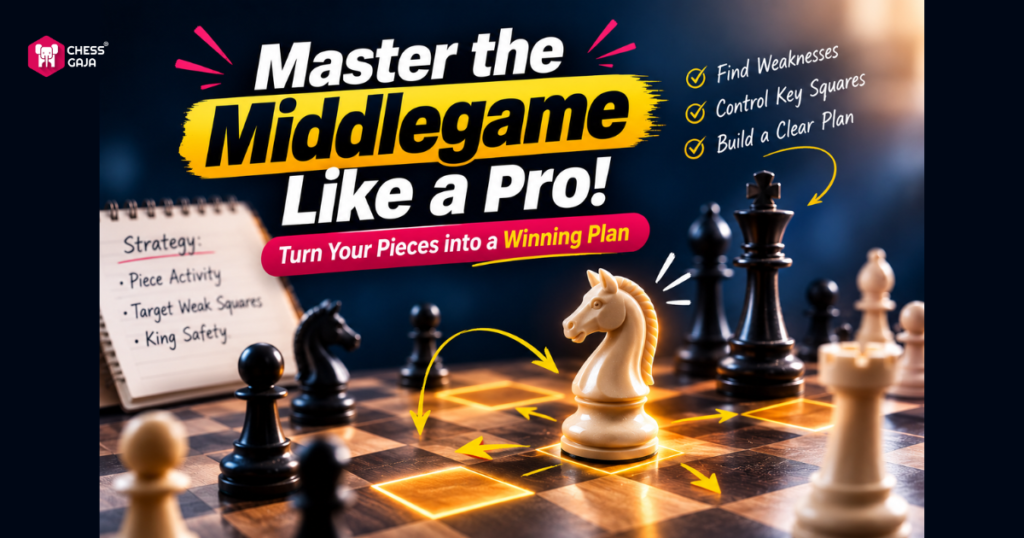
The middlegame is where most chess games are won or lost. Many players move pieces without a real plan, hoping tactics will save them later. That approach fails quickly against prepared opponents.
At Chess Gaja, we teach students that middlegame planning ideas separate strong players from weak ones. A clear strategy turns your pieces into a coordinated force instead of scattered units.
How to Read Your Position Like a Pro
The foundation of smart middlegame planning starts with seeing what’s actually on the board. Most beginners focus on immediate threats and miss the structural reality that determines whether their plan will work. You need to train yourself to identify three things: where your pieces can operate most effectively, which squares your opponent cannot defend, and what the pawn structure tells you about realistic goals.
Finding Your Most Powerful Squares
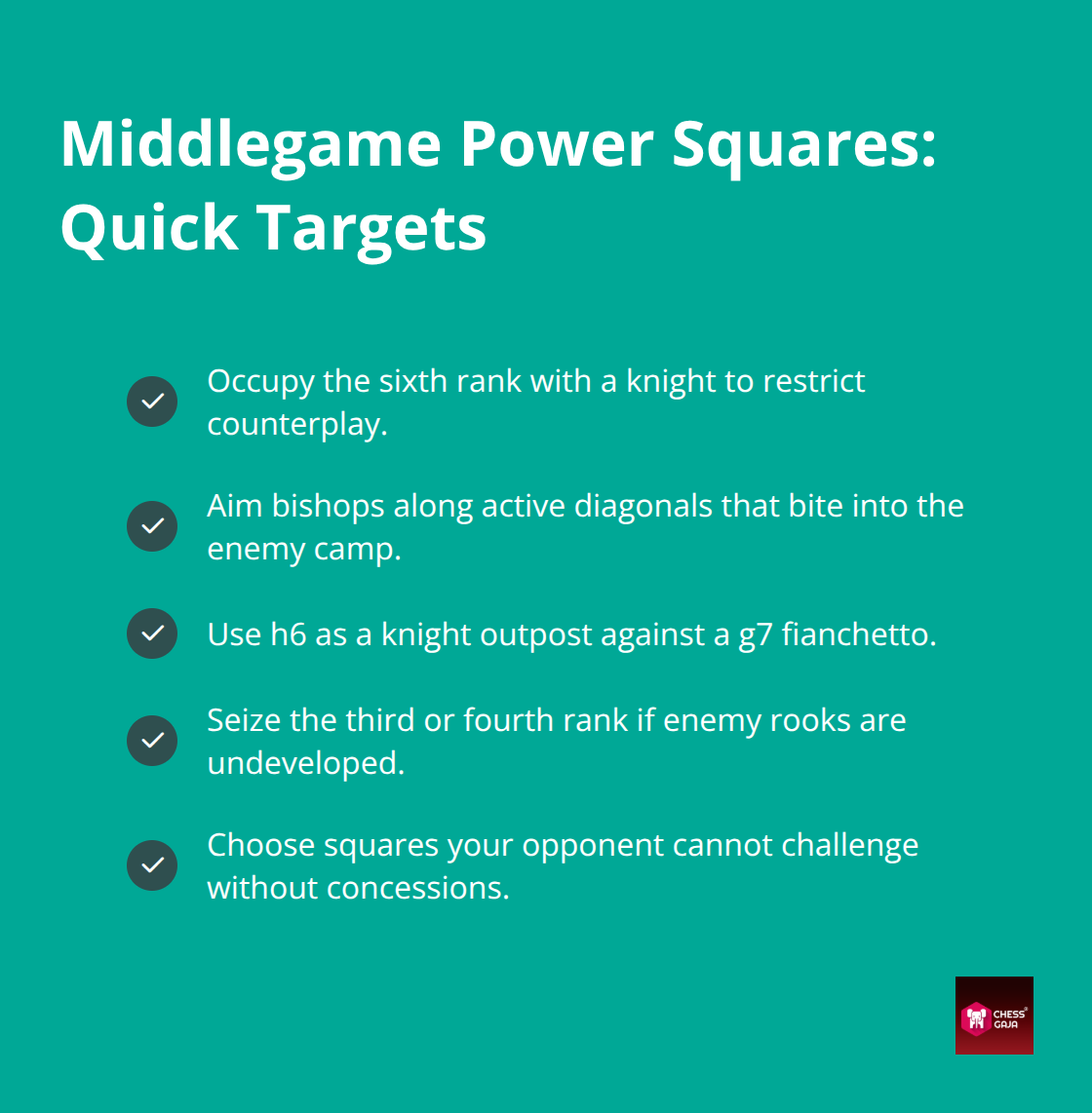
Control points are not abstract ideas. They are specific squares where placing a piece creates problems your opponent cannot solve quickly. In recent championship tournaments, the strongest young players demonstrated this principle repeatedly. They placed knights on the sixth rank or bishops on active diagonals where the opponent’s pieces could not challenge them without making structural concessions. A knight on e6 forces your opponent to make a decision: accept a worse position or spend moves removing it. This is concrete power. Look at your current position and ask yourself: where can I place a piece that my opponent will regret leaving unattacked? That square is worth planning toward.
If your opponent has a fianchettoed bishop on g7, the h6 square becomes a natural target for your bishop to trade off their key defender; once traded, dark squares like f6 or d6 become powerful outposts for your knight. If your opponent’s rooks sit on their starting squares, the third or fourth rank often gives you control that translates into pressure.
Exposing Your Opponent’s Structural Weaknesses
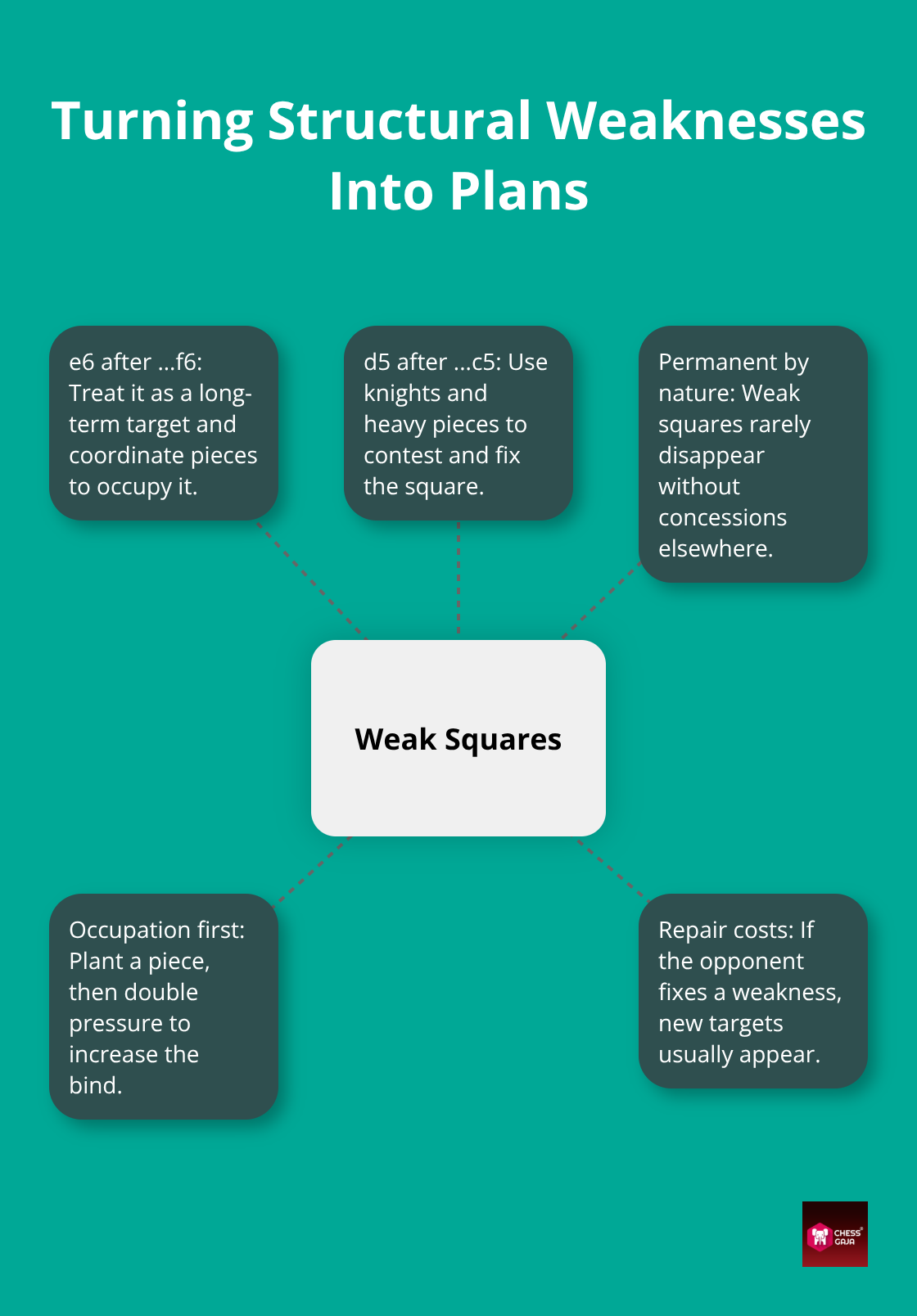
Weak squares appear when your opponent’s pawn structure creates gaps that pawns cannot defend. These weaknesses are permanent unless your opponent repairs them with moves that damage other parts of the position. The difference between strong players and weaker ones is that strong players spot these weaknesses early and build plans around them. If your opponent plays f6 to support a kingside expansion, the e6 square and the a2–g8 and h5–e8 diagonals leading to their king become permanently weakened. If your opponent advances the c-pawn to c5 after already pushing e5, the d5 square becomes a permanent hole that invites your pieces. These are not theoretical observations. They directly shape what moves you should make next.
Once you identify a weak square, your plan becomes simple: get a piece there. This clarity turns the middlegame from chaotic piece movement into purposeful action.
How Pawn Structure Shapes Your Strategy
Pawn structure determines which pieces matter most and which squares matter most. In positions with opposite-side castling, a rapid pawn storm or open-file attack on the flank where your opponent’s king sits becomes a race where speed and tempo dictate success. In symmetrical positions, central control and piece activity dominate. Understanding these patterns enhances strategic thinking in chess, making middlegame planning straightforward. Players can see exactly where their pieces belong and what they are fighting for. Contrast this with complex, unclear positions where planning becomes guesswork. Your pawn structure is not just a defensive setup. It is the blueprint for your entire middlegame strategy.
Moving From Analysis to Action
Once you read these three elements-control points, weak squares, and pawn structure-you transform your position assessment into concrete moves. The strongest players convert this reading into a short-term objective that advances their long-term advantage. Your next step is to determine what you actually want to accomplish in the next five to ten moves, and how your piece placement supports that goal.
Building Your Piece Placement Into Concrete Objectives
Your position assessment means nothing without a plan that moves your pieces toward specific goals. Many intermediate players identify weak squares and control points correctly but then waste moves shuffling pieces aimlessly. The critical step is converting what you see into a sequence of moves that accomplishes something concrete within the next five to ten moves.
Activate Your Passive Pieces First
Start with this question: which of my pieces does useful work right now, and which piece sits passively? A bishop tucked away on c1 or b2 blocked by your own pawns on d4 and e3 contributes almost nothing to your middlegame plans. That piece needs repositioning onto an active diagonal. If your knight sits passively on f3, look for routes via e5 or d2 to target central outposts and force your opponent onto the defensive. Strong players execute this principle consistently by actively involving all their pieces in the game and avoiding poorly placed pieces. They do not keep pieces on their starting squares hoping for tactics. They reroute inactive pieces to squares where they either attack weak squares directly or support other pieces creating threats. This activity is non-negotiable. A passive position loses games regardless of how good your plan sounds in theory.
Define Your Short-Term Objective
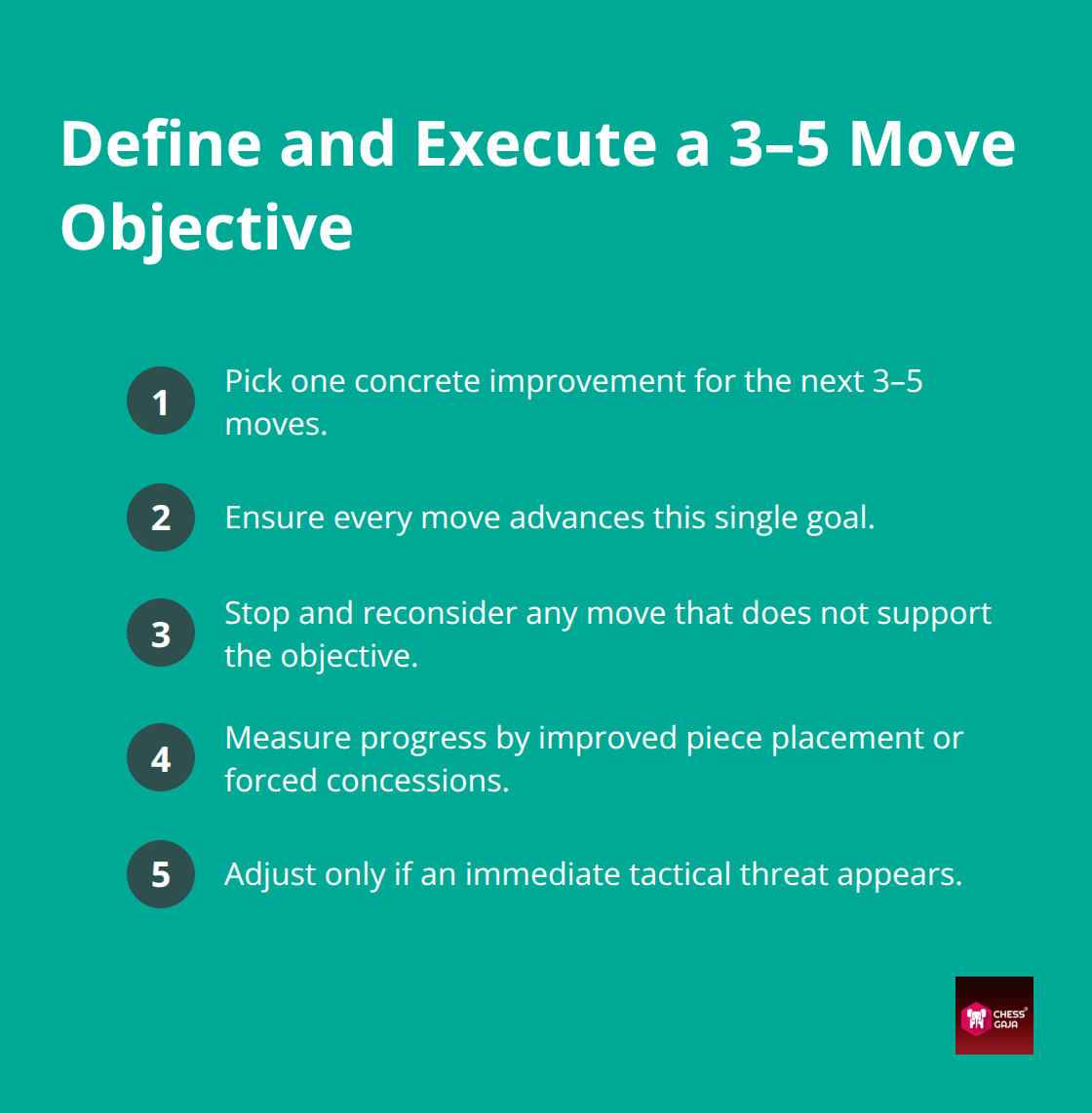
Once your pieces are active, your short-term objective becomes clear: accomplish one specific thing in the next three to five moves that improves your position measurably. This is not about finding a brilliant combination. It is about making progress. If your opponent’s d5 square is weak and you identified it correctly, your objective might be: place a knight on d5 and force your opponent to exchange it or accept a worse position.
Count your piece moves in your next five games to track whether your pieces are advancing your plan or drifting. Every move you should make advances toward this objective. If you play a move that does not support this goal, stop and reconsider. This discipline separates players who drift through the middlegame from players who dominate it.
Chain Your Objectives Into Momentum
After you achieve your short-term objective, you immediately identify the next one. Your knight on d5 forces your opponent to weaken the kingside. Your new objective becomes: exploit that kingside weakness with a pawn storm or piece attack. This sequential approach keeps your pieces coordinated and your position improving steadily. Tactical opportunities emerge naturally when your pieces are well-placed and your opponent is forced into defensive positions (you do not hunt for tactics randomly). Tactics appear because your strategic plan created them. This is how strong players consistently convert middlegame advantages into wins. The transition from one objective to the next determines whether you maintain pressure or allow your opponent to reorganize. Your next challenge is recognizing when your opponent’s threats demand immediate attention and how to balance your own plans against defensive necessity.
Where Your Plan Falls Apart
The gap between identifying weak squares and executing your plan is where most games slip away. Players see the right ideas but fail to act on them consistently, or they become so focused on their own objectives that they ignore what their opponent is building.
We observe this pattern repeatedly in student games: a player spots a weak square on d5, correctly identifies that a knight belongs there, but then plays five moves that have nothing to do with getting the knight there. Meanwhile, the opponent launches a kingside attack that the player never saw coming. This is not a lack of tactical ability—it is a failure of discipline and awareness. The solution is straightforward: every single move must either advance your stated objective or defend against a genuine threat. If your move does neither, it is a wasted tempo that your opponent will exploit.
The Plan Without Urgency Problem
Many intermediate players construct a solid middlegame plan but execute it too slowly. They know their knight needs to reach d5. They understand that d5 weakens their opponent’s structure. But they play h3 to prevent a pin, then a4 to gain space, then Kh2 for king safety. Four moves later, their opponent has consolidated the position and the d5 outpost no longer matters. Strong players move faster—they prioritize the moves that matter most and defer everything else until later.
If your short-term objective is to place a knight on d5 within five moves, count exactly how many moves that requires. Your knight on f3 needs one move to reach a central outpost like e5 or d4, or four moves to maneuver onto d5 (such as Nf3-d2-e4-c3-d5 or Nf3-e1-d3-c5-d5 depending on the position)
Defending Without Abandoning Your Attack
The second major failure is recognizing threats too late or overreacting to them. A player is building a kingside attack when they suddenly notice their opponent’s rook can invade on the seventh rank.
They abandon their attack entirely to defend passively. This is the wrong response. Balance attack and defence. Attack when you have the ingredients – but don’t ignore counterplay or king safety.
One concrete example: your opponent threatens Rc7 to invade your 7th rank. Instead of playing a purely passive defense like Ra8 or Rf8, consider an active counter-resource like Rc8 to contest the c-file directly, or Rc2 to counter-attack their 2nd rank while maintaining piece coordination. You solve the threat while maintaining momentum. This economy of moves is what separates intermediate players from strong ones.
Recognizing When Timing Changes Everything
The final mistake is missing the exact moment when a transition becomes possible or necessary. A player has been working toward a d5 outpost for eight moves. Finally, they place a knight there. But instead of exploiting it immediately, they play a quiet move. Their opponent removes the knight and the advantage vanishes. Timing means recognizing that certain positions demand immediate action—once your knight lands on d5, your opponent has one or two moves to respond. If you waste time with unrelated moves, the opportunity closes.
Similarly, timing determines when you should simplify the position and when you should maintain complexity. If you have converted your middlegame advantage into a winning endgame scenario, trade pieces and simplify. If your opponent has more pieces active than you, maintain complexity and keep pieces on the board where tactics can work in your favor. Players who understand this principle win consistently—players who treat all positions identically lose games they should have won.
Final Thoughts
Strategic planning techniques transform scattered piece movement into coordinated strategy. The three principles you learned-reading your position accurately, building concrete objectives, and executing with discipline-form the foundation of every strong player’s approach. When you identify weak squares, activate passive pieces, and chain objectives together, your position improves steadily. When you recognize threats without abandoning your attack and understand timing, you convert advantages into wins.
We at Chess Gaja have built our coaching curriculum around these exact principles because they work across all playing strengths. Our coaches teach students in over 40 countries how to develop strategic thinking through structured analysis and personalized game review. Rather than memorizing endless variations, our students learn to recognize patterns, build plans, and execute them with precision.
Start applying these middlegame planning ideas in your own games immediately. Play five games where you write down your short-term objective before each move, then review afterward to identify where you drifted or missed timing.
If you want professional guidance tailored to your specific weaknesses, Chess Gaja offers a Paid Starter Class where one of our coaches evaluates your current level, identifies your biggest gaps, and creates a personalized development path.