

Tactical patterns are the difference between a player who spots winning moves and one who misses them entirely. At Chess Gaja, we’ve seen countless students transform their game once they learn to recognize tactical patterns with speed and confidence.
This guide walks you through building a pattern recognition engine that works in real tournament play, not just in puzzle books.
What Makes Tactical Patterns Stand Out
A tactical pattern is recognizable because it follows a repeatable structure. The pin, the fork, the skewer-these aren’t random sequences. They’re geometric arrangements of pieces that create the same winning opportunity over and over, whether you’re playing in a youth tournament in Dubai or a scholastic event in New York. What separates a player who wins material consistently from one who doesn’t is the ability to spot these arrangements instantly.
A fork isn’t just two pieces under attack at once; it’s a specific positioning where a single piece creates two simultaneous threats—such as attacking two enemy pieces or threatening material while setting up a checkmate—forcing your opponent into a losing choice.
A pin isn’t abstract; it’s a piece that cannot move without exposing something more valuable behind it. When you train your eye to recognize these exact configurations, you stop calculating endlessly and start playing chess.
The five core motifs—pin, skewer, fork, removing the defender, and discovered attack—appear in the vast majority of tactical sequences between 1200 and 2000 rating. Mastering these five patterns gives you immediate tournament leverage.
Why Beginners Miss Tactics That Strong Players Catch
The difference isn’t intelligence. It’s familiarity. A strong player has seen a fork in fifty different positions, so their brain recognizes it in the fifty-first instantly. A beginner sees an unfamiliar arrangement and calculates move by move. This burns mental energy and often leads to errors under time pressure.
When you solve tactical puzzles consistently-especially puzzles calibrated to your current rating-your pattern library grows. A student who solves 30 puzzles featuring the same motif will spot that motif in tournament play far faster than someone who solves 100 random puzzles. This is why puzzle sets tailored to your rating work better than generic puzzle collections. The structure matters as much as the volume.
How Tournament Positions Differ from Puzzle Diagrams
Tournament positions are messier than puzzle diagrams. They contain extra pieces, blocked squares, and defensive resources that don’t appear in clean puzzle settings. This gap between puzzle training and game play is where many students plateau. The solution is studying real games from strong players-not memorizing their moves, but analyzing the exact moment they spotted a tactical opportunity and how they executed it.
When a Grandmaster converts a fork into a winning advantage in a real tournament game, you see not just the tactic itself but the context that made it possible. You see how the pieces arrived at that position and what came next. A fork in a puzzle might seem obvious. However, recognizing that same fork on move 22 of a real game under tournament pressure is entirely different. That skill is what drives true rating gains.
Building Recognition Speed Through Real Game Analysis
Analyzing positions from World Champion games and recent tournament play shows you how tactics actually win at competitive levels. This isn’t theory; it’s the exact pattern recognition that separates players who convert advantages from those who miss them.
When you study how elite players position their pieces to create tactical opportunities, you train your mind to spot the same arrangements in your own games. The pattern library you build through puzzle training becomes practical only when you apply it to real positions with all their complexity and noise. Your next step is to accelerate this recognition through deliberate practice methods that lock these patterns into your memory permanently.
How to Start Building Pattern Recognition Right Now
The single biggest mistake beginners make is solving random puzzles without structure. You pick a puzzle app, solve whatever appears on your screen, and hope something sticks. It doesn’t. Pattern recognition requires deliberate sequencing, not random exposure.
Master One Motif at a Time
Start with the core tactical motifs—pin, fork, skewer, removing the defender (including deflection), and discovered attack—and commit to mastering one motif at a time before moving to the next. Spend one to two weeks solving only pin puzzles, calibrated to your current rating. If you’re rated 800, solve pins around the 800–900 level. If you’re rated 1400, target puzzles between 1400 and 1500 to stay right at the edge of your rating zone.
This targeted approach works because your brain builds a dense mental library around a single pattern before adding complexity. A student who solves 40 pin puzzles in sequence recognizes pins faster and more reliably than someone who solves 200 random tactical puzzles. T
he rating-matched difficulty matters enormously. While high-volume easy puzzles build raw speed, puzzles far below your level won’t stretch your calculation; conversely, puzzles that are far too hard cause frustration and foster guessing instead of clear visual recognition.
After mastering pins, move to forks for a week, then skewers, removing the defender, and discovered attacks. This targeted process completes your core foundational cycle in about six to eight weeks.
Identify Your Weakest Patterns
Track which motifs you solve fastest and which ones still cause hesitation. The motif where you hesitate longest needs an extra week of focused work. Some students sail through forks but struggle with discovered attacks; others master pins instantly but miss skewers repeatedly. Your weakness reveals where your pattern library has gaps. Fill those gaps with additional puzzle sessions on that specific motif before advancing.
The Numbers Behind Rating-Matched Practice
Research in skill acquisition shows that practicing at a moderate difficulty level produces the fastest improvement. You should solve most puzzles correctly while still feeling challenged. Puzzles that are too easy feel pointless; puzzles that are too hard produce frustration and incorrect pattern associations. When you solve a puzzle at your exact rating level, you operate in that optimal difficulty zone, which is precisely where learning happens fastest.
After completing your four-to-six-week foundation cycle, start mixing motifs—split your practice between single-motif puzzles and mixed-motif puzzles. This trains your brain to recognize which pattern applies before executing it.
In tournament play, you never see a puzzle labeled fork; you see a position and must identify what tactic exists. Mixed-motif practice builds that recognition skill.
Track Accuracy and Solve Time
Track your accuracy weekly. A strong signal that you’ve internalized a motif is when you consistently solve it with high accuracy and confidence. Once you hit that threshold, you’re ready to shift focus. Many students spend weeks on a motif after mastering it, which wastes training time. Move when you’re ready, not when arbitrary weeks pass.
Your progress tracker-whether that’s a spreadsheet, a puzzle app’s built-in stats, or coaching notes from an instructor-must show your accuracy by motif and your solve time. Solve time matters. A pin you recognize in 3 seconds is worth more than one you solve correctly but take 15 seconds to identify. Tournament time pressure is real.
As you improve, try to reduce your time on single-move pattern spots to under 5–10 seconds while maintaining high accuracy. Simple forks should jump out instantly, whereas multi-step tactics like discovered attacks may take slightly longer to verify.
This speed differential (the gap between slow recognition and fast recognition) determines whether you capitalize on tactical opportunities when they appear in real games.
Once your accuracy stabilizes at a consistently high level and your single-motif recognition time drops below 5 to 10 seconds per puzzle, you’re ready to test these tactical patterns against real tournament positions—where the noise and complexity of actual games will challenge your recognition in ways pure puzzles cannot.
Accelerating Pattern Recognition Through Deliberate Practice
Puzzle training produces results only if you revisit the patterns you’ve learned at precisely the right intervals. Most students solve a pin puzzle, move on, and never encounter that pattern again until weeks later-by which point their brain has partially forgotten it. This approach wastes training time. Spaced repetition reverses that decay by forcing you to meet the same pattern multiple times over expanding intervals.
Cognitive psychology shows that reviewing material across expanding intervals produces far stronger long-term retention. Spacing reviews across 24 hours, three days, one week, and two weeks beats cramming into a single session. Following this cycle ensures similar motifs reappear just as your memory begins to decay, locking the pattern into your long-term memory.
This spacing trains your pattern recognition to stick permanently. The practical result is that a pattern you’ve reviewed four times across two weeks becomes instantly recognizable in tournament play, while a pattern you solved once becomes invisible under pressure.
Schedule Reviews at Expanding Intervals
Your puzzle app or chess coach must track which motifs you’ve mastered and schedule review sessions automatically. Without a structured system or platform for spaced repetition, you risk losing valuable training momentum as old patterns fade. Solve a motif, mark it as done, then actively schedule a review session three days later. This single habit-treating pattern review as mandatory, not optional-accelerates recognition speed far more than solving additional new puzzles. Most students skip this step and wonder why their puzzle accuracy doesn’t translate to tournament performance.
Extract Lessons From Your Own Games
Every game you lose contains at least two or three positions where a tactical pattern existed but you missed it. These missed tactics are your most valuable learning data because they show exactly where your pattern library has gaps. After each tournament game or serious practice match, spend 15 minutes analyzing key critical moments—especially during the transition into the middlegame—where tactical opportunities typically peak. Look specifically for forks, pins, and skewers you could have played but missed. Write down the move number and the motif you missed.
Track these missed tactics in a notebook or spreadsheet: log the date, opponent rating, motif missed, and the root cause—such as time pressure, miscalculation, or simple visual oversight. After 10 games, patterns emerge. If you’ve missed four forks but only one pin, your fork recognition needs work-go back to fork puzzles for an extra week. If you missed a tactic because you didn’t see an opponent’s defensive resource, highlight that position—defensive patterns (such as intermediate checks or counter-attacks) require their own dedicated pattern recognition training alongside calculation practice.
Most students skip this step entirely, which is why they plateau. They solve puzzles correctly in training but miss the same patterns in games. The gap exists because puzzle training is artificial. Real games have time pressure, emotional stakes, and board noise. Analyzing your losses forces you to see patterns in realistic conditions. A student who reviews five of their own games in detail will improve faster than one who solves 200 random puzzles. Detailed game review trains pattern recognition directly in the context where it matters most.
Study Real Tournament Games to See Patterns in Action
Tournament games from strong players show you how tactical patterns actually create winning advantages. A fork in a puzzle might seem obvious, but watching a Grandmaster build piece activity and spatial control over several moves to force that tactical opening teaches you something isolated diagrams cannot: how positional pressure creates tactical opportunities. When you study a real game where a player converts a fork in move 24 into a decisive material advantage by move 28, you see not just the tactic but the setup, the opponent’s defensive errors, and the follow-up technique. This context accelerates your pattern recognition because your brain learns the full sequence, not an isolated position.
Focus your study on well-annotated games from strong master-level players and Grandmasters, as well as players rated slightly above your current level. Master games demonstrate textbook setups for tactics, while games near your rating level show how opponents at your level typically blunder into those same patterns. Analyze 5–10 games monthly, spending 20 minutes per game. Pause before each critical move and ask yourself what tactic the player is setting up. Then check the move and see if you spotted it correctly.
This active prediction trains your brain far more effectively than passively reading annotated games. A student who analyzes five real tournament games monthly will recognize emerging tactical patterns in their own games within two months. This recognition-catching a tactic before it’s too late-is what transforms puzzle training into tournament results.
Final Thoughts
Pattern recognition compounds over months and years of deliberate practice. The students who achieve the biggest rating gains at Chess Gaja commit to this work consistently. Strong players in Dubai, Singapore, and New York all started where you are now. They didn’t possess special talent. Instead, they used a structured plan to build their tactical vision systematically. A student who spends six weeks on pin puzzles, analyzes five tournament games monthly, and tracks their progress honestly will recognize tactical patterns in their next scholastic event that would have remained invisible six months earlier.
Your pattern recognition engine sharpens when you measure your progress against concrete benchmarks: consistently high accuracy on a motif signals mastery, and fast, confident recognition times indicate you’re tournament-ready. The gap between puzzle training and tournament performance closes when you stop treating pattern recognition as an isolated exercise. Instead, feed every game, analysis session, and puzzle into your growing mental library. A student who achieves these metrics will convert tactical opportunities in real games far more reliably than someone who rushes through training without tracking results.
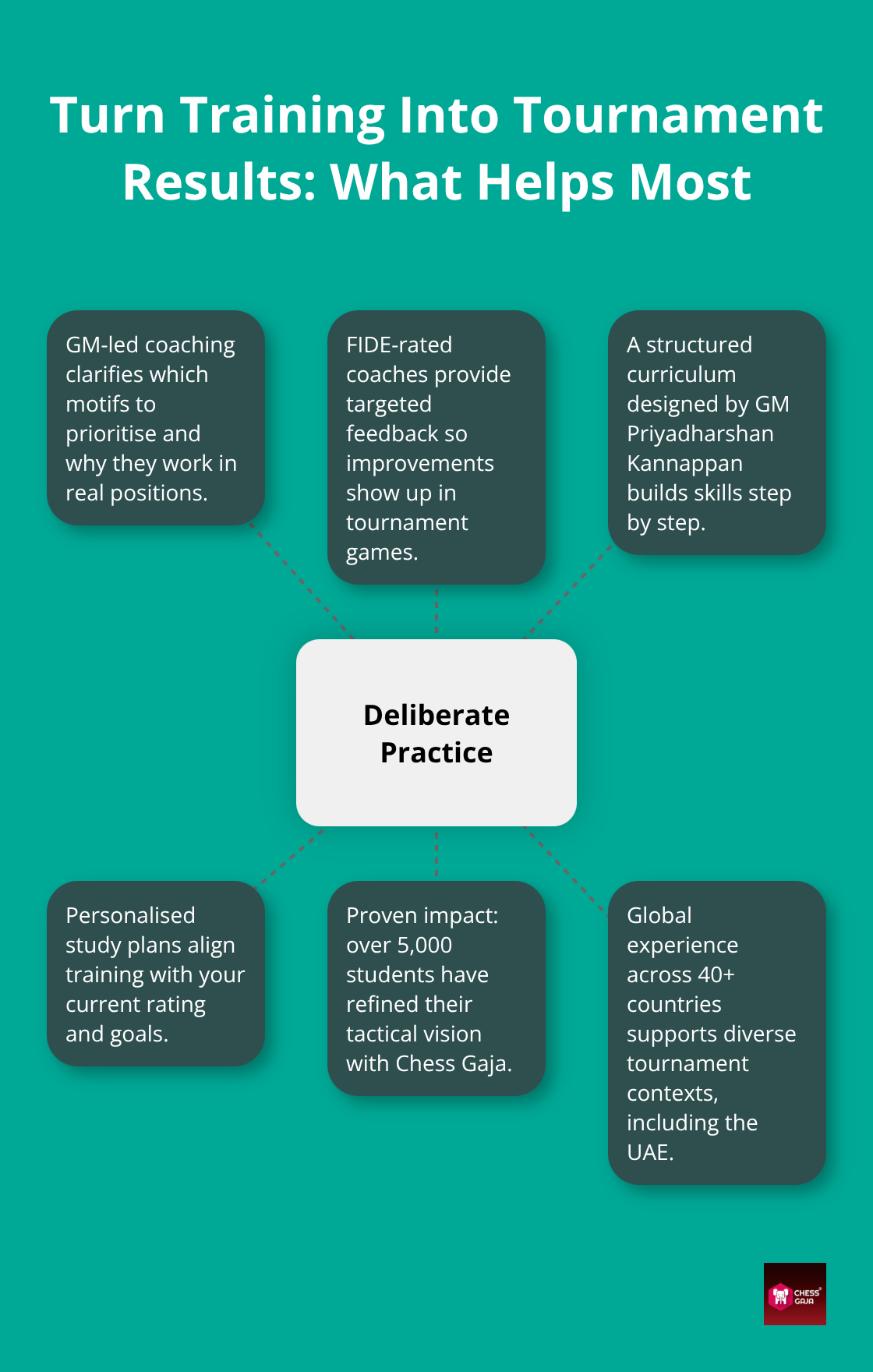
At Chess Gaja, we have helped over 5,000 students across 40+ countries transform their tactical vision. Our structured curriculum is designed directly by Grandmaster Priyadharshan Kannappan. Book a Paid Starter Class with one of our FIDE-rated coaches, and you’ll receive detailed feedback on your current tactical vision, the specific patterns you need to strengthen, and a personalized study plan built for your rating and goals.