

Top players need deep opening knowledge. Basic rules are not enough at high levels. Advanced lines need clear plans and modern prep. At Chess Gaja, we studied how masters pick their lines. This guide covers hard systems and top methods to help you win.
How Do Expert Players Master Complex Opening Theory?
Experts study openings differently than club players. Beginners focus on basic piece play. In contrast, experts must master key lines up to 20 moves deep. Therefore, this shift needs deep study of exact moves instead of simple rules.
For example, top grandmasters like Magnus Carlsen and Fabiano Caruana study new moves for five hours every day. Consequently, this daily prep sets grandmasters apart from intermediate players.
Strategic Opening Selection
Pick openings that fit your style and goals. Attacking players like the Sicilian Dragon or King’s Indian. Quiet players like the Queen’s Gambit or English Opening. The Sicilian Najdorf enjoys wide popularity among grandmasters, regularly chosen when a sharp fight for the initiative is needed. Always target your opponent’s weak spots.
Professional Repertoire Construction
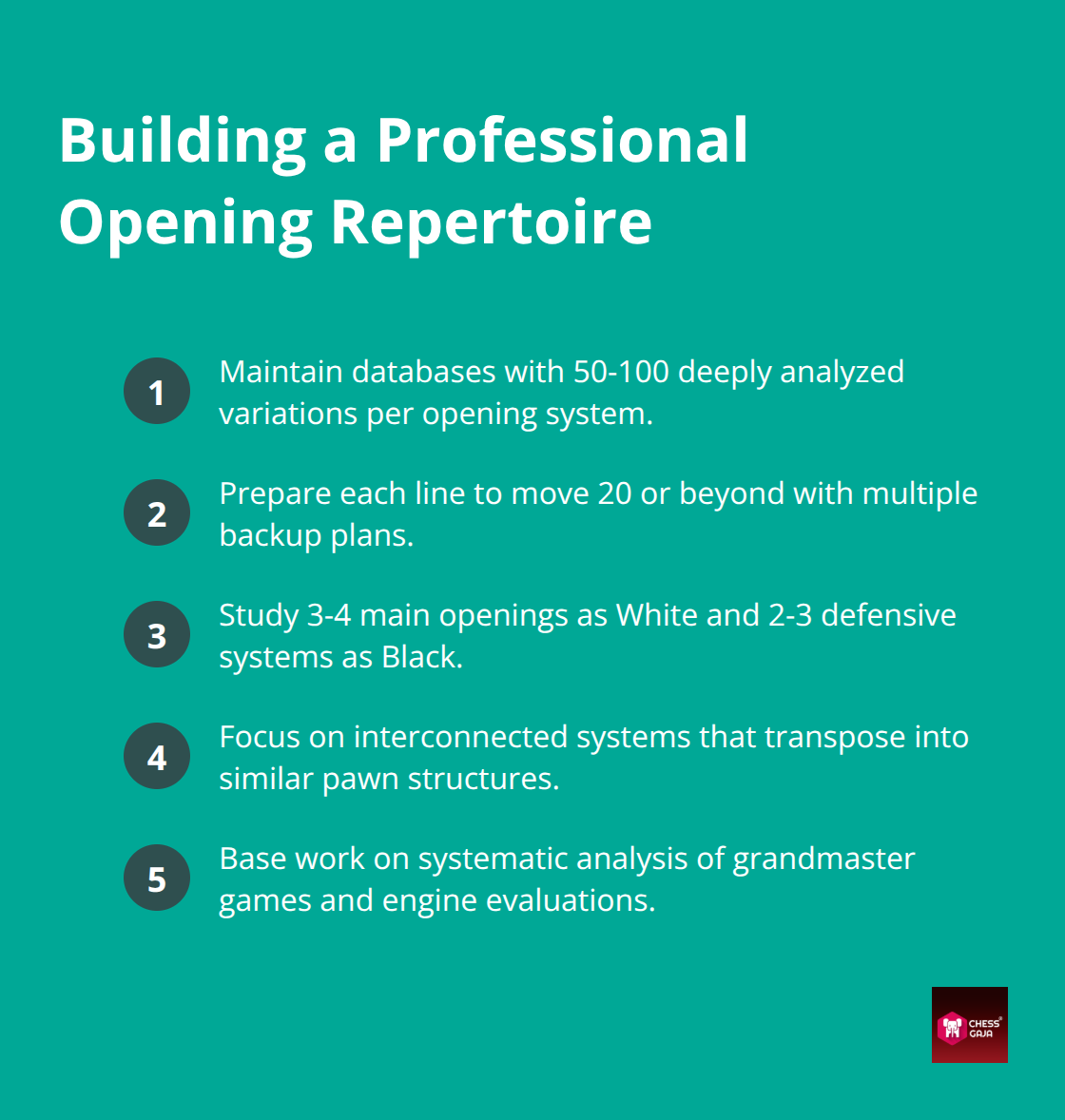
Building a solid opening set needs regular game study and engine work. First, top players keep clean files with dozens of deep lines.
Each main line needs prep up to move 20, plus backup plans. Furthermore, world champions usually prep 3 to 4 openings for White and 2 to 3 for Black. As a result, focusing on lines with similar pawn setups saves study time and speeds up learning.
Engine-Assisted Analysis Methods
Masters use engines to spot tricks and test lines. Tools like Stockfish 16 calculate far deeper than humans. Top players spend 2 to 3 hours a day checking key lines.
First, find spots where you have two or three good moves. Next, analyze each option 25 moves deep. This step shows hidden tactics and plans. Combine engine work with good chess books to learn faster.
Which Opening Systems Define Expert-Level Chess
The Sicilian Najdorf is a very tough opening. It takes sharp calculation and good memory. The main line starting with 1.e4 c5 2.Nf3 d6 3.d4 cxd4 4.Nxd4 Nf6 5.Nc3 a6 6.Bg5 e6 7.f4 Be7 demands 25 moves of memorized theory.
Alternatively, White’s English Attack (6.Be3 e6 7.f3) leads to wild opposite-side castling attacks on both sides. Here, one small mistake loses the game. Champions like Bobby Fischer and Garry Kasparov played the Najdorf for years. Likewise, the Poisoned Pawn Variation (1.e4 c5 2.Nf3 d6 3.d4 cxd4 4.Nxd4 Nf6 5.Nc3 a6 6.Bg5 e6 7.f4 Qb6) requires deep, accurate home preparation.
Dragon Variation Tactical Complexity
In the Dragon Variation, White launches a kingside pawn storm while Black attacks on the queenside. The sharp positions after 1.e4 c5 2.Nf3 d6 3.d4 cxd4 4.Nxd4 Nf6 5.Nc3 g6 6.Be3 Bg7 7.f3 0-0 8.Qd2 Nc6 9.Bc4 Bd7 10.0-0-0 Rc8 11.Bb3 Ne5 force both players to calculate 15 moves ahead. When White knows the theory deeply, the Yugoslav Attack offers strong winning prospects and high scoring chances. However, Black’s exchange sacrifices on c3 with …Rxc3 can turn the game around quickly if White makes one mistake.
King’s Indian Defense Modern Theory
The King’s Indian Defense relies on sharp pawn setups and deep plans. In the Classical line (1.d4 Nf6 2.c4 g6 3.Nc3 Bg7 4.e4 d6 5.Nf3 0-0 6.Be2 e5 7.0-0), Black concedes queenside space to launch a direct assault against White’s king. The Main Line continues 7…Nc6 8.d5 Ne7. Garry Kasparov proved that Black’s piece activity and kingside pawn storm fully compensate for White’s queenside space advantage.
Sämisch System Strategic Depth
By contrast, the Sämisch Variation (1.d4 Nf6 2.c4 g6 3.Nc3 Bg7 4.e4 d6 5.f3) leads to sharp, closed positions. White builds a massive pawn center and aims to trade dark-squared bishops with Be3, Qd2, and Bh6. Black must counter with timely central strikes like …e5 or …c5.
English Opening Strategic Complexity
The English Opening suits players who prefer strategy over wild tactics. The Hedgehog setup lets Black build a solid wall before breaking out with …d5 or …b5.
While Sicilian games often resolve through early tactical firestorms, the English Opening tends toward extended positional maneuvering. This fact shows its slow, patient nature. To master these lines, you need good preparation and solid endgame skills.
How Do Modern Engines Transform Opening Preparation
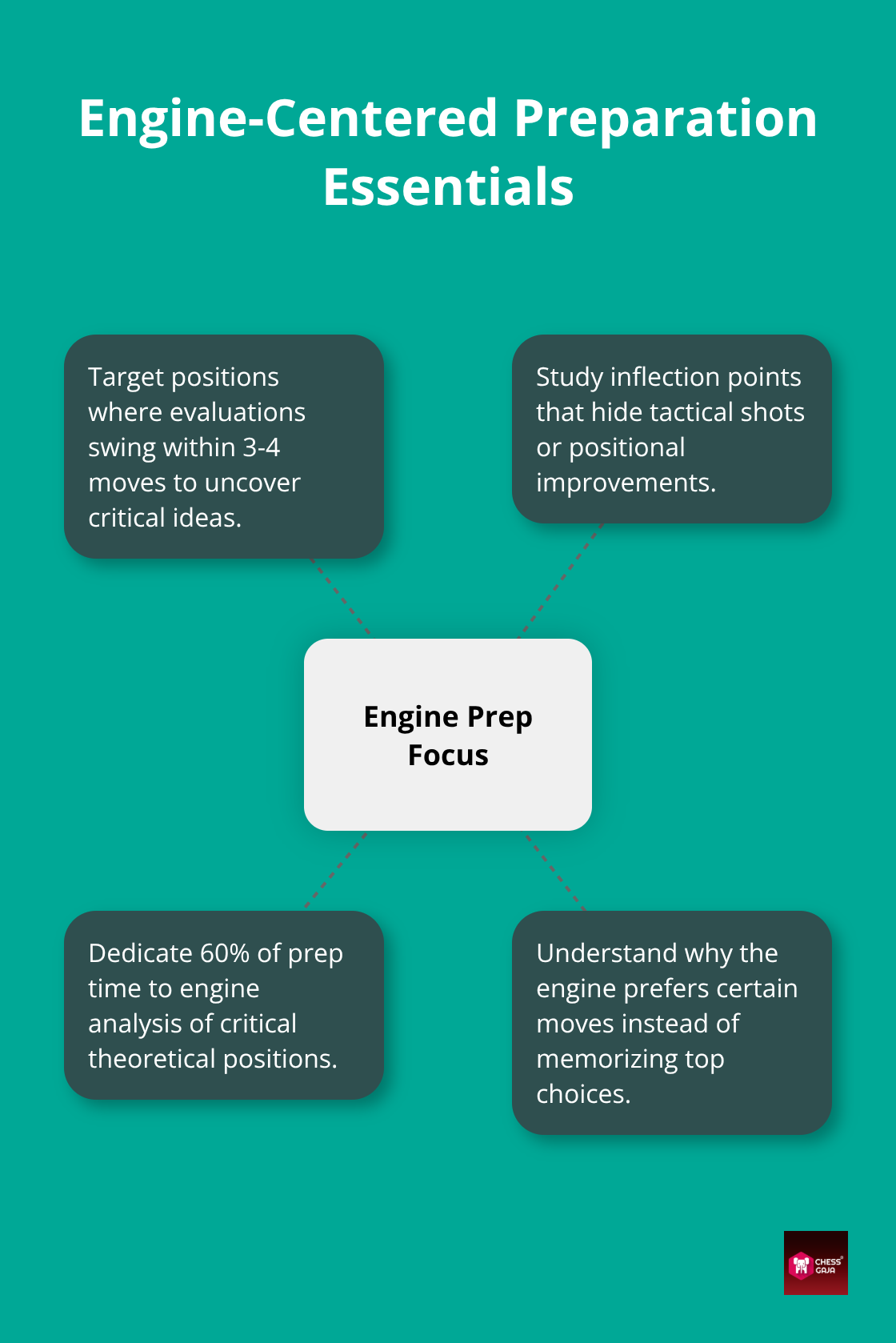
Modern players must master engine techniques to stay competitive. First, tools like Stockfish 16 and Leela Chess Zero spot tactical tricks that humans easily miss. Furthermore, the best approach is to study positions where evaluations jump suddenly within 3 or 4 moves.
As a result, these sharp points reveal key tactical turns and subtle improvements. Top grandmasters spend most of their preparation time dissecting critical engine positions rather than trying to memorize long move sequences. Therefore, focus on understanding why the engine chooses a move, rather than blindly copying its top pick.
Personal Database Construction Methods
Organizing your games well is essential for long-term growth. Using ChessBase format helps you store games along with engine notes and personal thoughts. In addition, experts maintain separate databases for each opening, archiving thousands of high-level master games per line.
However, instead of filing moves by order, group them by pawn setups. Consequently, this helps you find clear ideas across different lines. For example, top grandmasters build personal databases containing hundreds of thousands of curated key positions. To keep your edge, update your files weekly and review key lines each month.
Practical Ideas from Grandmaster Games
Modern prep focuses on recent grandmaster games rather than older classical lines. In fact, reviewing games from recent years highlights key trends and fresh ideas.
Specifically, the best games show how strong players break away from established theory. In addition, analyzing 2650+ rated games teaches you how to handle high-pressure decisions. Try to review 20 to 30 recent games for each opening every month. As a result, you will easily spot emerging trends and know which lines remain dangerous.
Engine Evaluation Interpretation
First, do not rely only on numerical engine scores. For example, a score of +0.5 often means a long-term strategic lead, not an easy win. In addition, if evaluation scores swing at depth 25+, the position contains complex tactics.
Therefore, focus on positions where two or three moves have equal scores. As a result, these present the best choices in practical play. Ultimately, knowing when to trust your intuition over the computer is a key skill when using modern chess engines.
Final Thoughts
Mastering advanced opening strategies gives players a strong edge in tournaments. In fact, regular engine work, organized databases, and game study form the foundation of elite prep. In fact, regular engine work, organized databases, and game study form the foundation of elite prep.
However, complex lines demand confidence and sharp calculation skills. Because theory changes every week as grandmasters test new ideas, updating your files monthly keeps your repertoire sharp. Finally, at Chess Gaja, we offer personalized instruction and game analysis to help you master expert opening theory and win more games.