
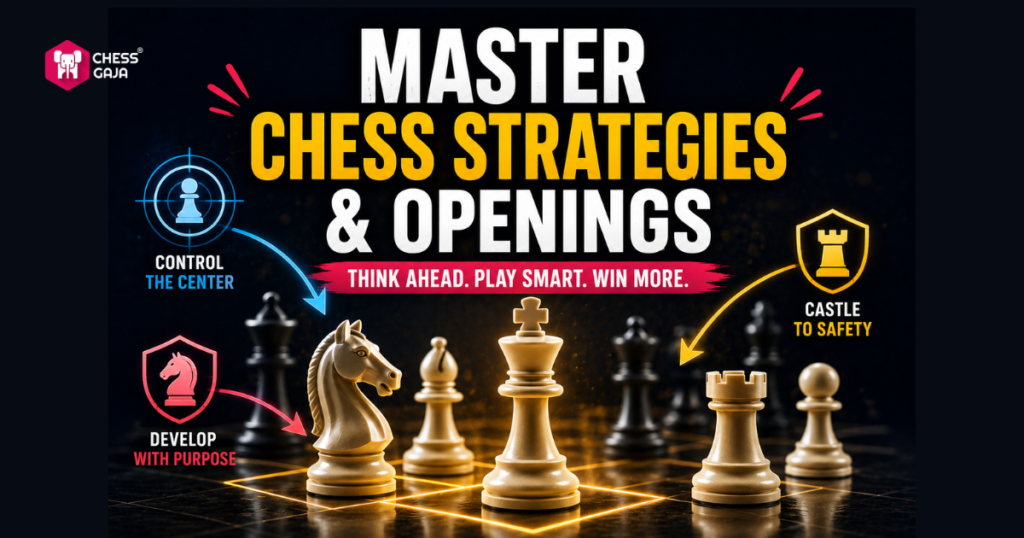
Winning tactics and openings separate winners from players who struggle. At Chess Gaja, we coach students across 40+ countries. We see how fundamental skills transform results. Talent is not the secret. Instead, knowing what to do in the first ten moves matters most. This guide shows you how.
The Three Moves That Control Every Opening
Why the First Moves Matter Most
Your opening succeeds or fails in the first three to five moves. A student competing in the UAE Junior Championship made a critical error. She moved her pieces randomly while her opponent built a strong center. Consequently, her position collapsed within eight moves. This happens constantly with beginners who skip the fundamentals. Fortunately, openings follow a clear pattern, and mastering this pattern transforms your results immediately.
Control the Center First
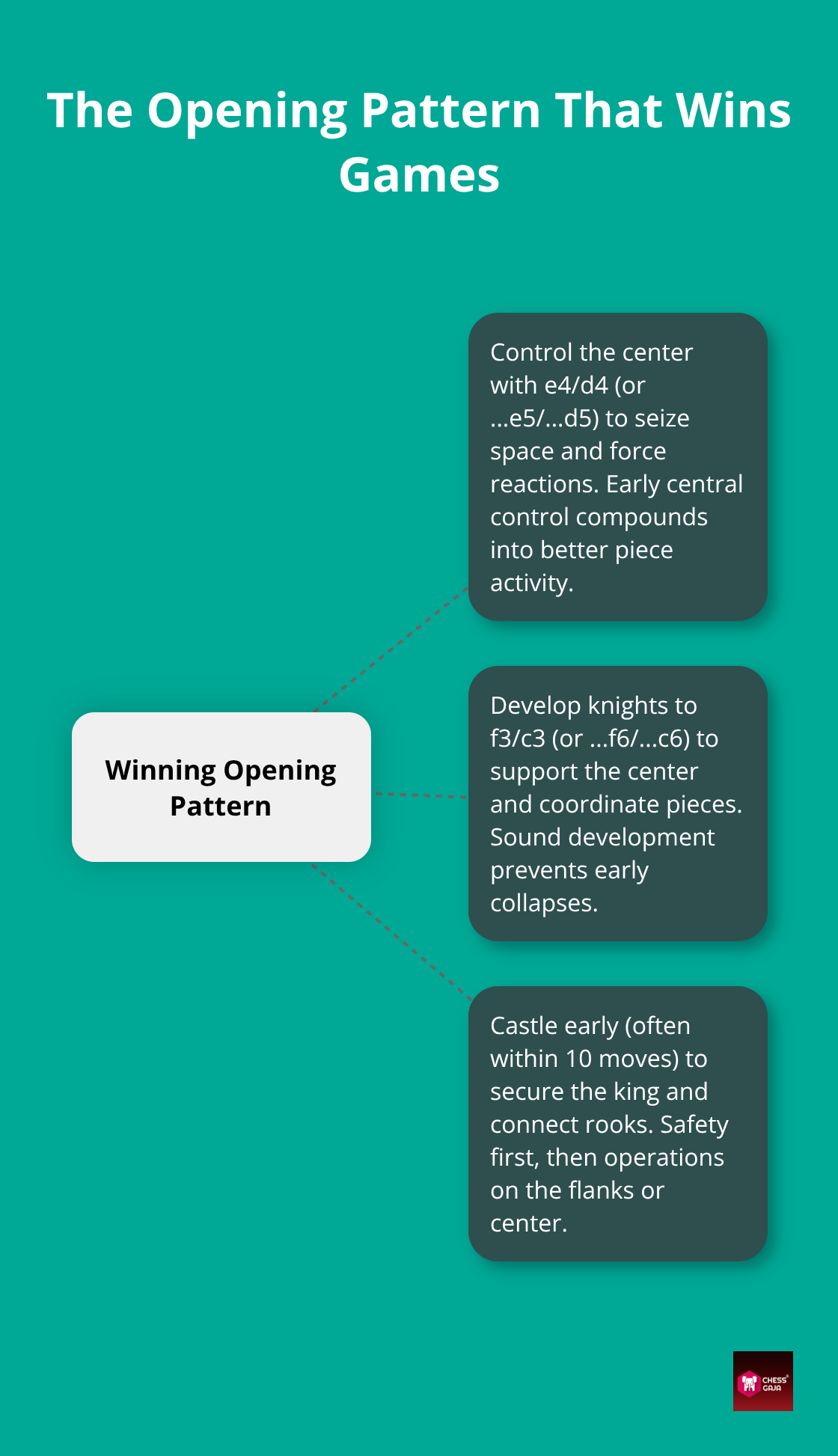
The center of the board-the squares e4, d4, e5, and d5-determines who controls the game. Classical openings like 1.e4 dominate beginner levels. Controlling the center with your first pawn gives you an immediate spatial edge. Playing e4 or d4 early claims territory and forces your opponent to react. Over time, this advantage compounds.
Develop Your Knight to Support Your Center
Next, your second priority arrives quickly. Specifically, move your knight to f3 or c3 on moves two and three. This step supports your center pawn and prepares your pieces. A knight on f3 exerts influence over d4 and e5 while pressuring enemy pieces. It also prepares your kingside for rapid castling. Without this step, your center crumbles under pressure.
Castle Your King to Safety
Therefore, king safety requires immediate attention. You should control the center and develop your first pieces quickly. Most beginners castle between moves eight and twelve. However, stronger players castle much earlier. Consequently, a king stuck in the center invites quick tactical attacks that can end games within ten moves.
The Italian Game illustrates this principle clearly: after 1.e4 e5 2.Nf3 Nc6 3.Bc4 Bc5 4.O-O, White stakes a claim in the center, develops key minor pieces, targets f7, and secures the king—all within White’s first four moves. Black can then respond with 4…Nf6 to complete their own development. This order matters more than memorizing variations.
The Pattern That Wins Games
Players who follow center control, piece development, and king safety win games consistently. Players who ignore this sequence lose material and positions within the first fifteen moves. Understanding this three-step pattern gives you a foundation that applies across every opening you encounter. Next, we’ll examine how to recognize weak squares in your opponent’s position and exploit them strategically.
Strategic Weaknesses and How to Exploit Them
Spotting Weak Squares Your Opponent Cannot Defend
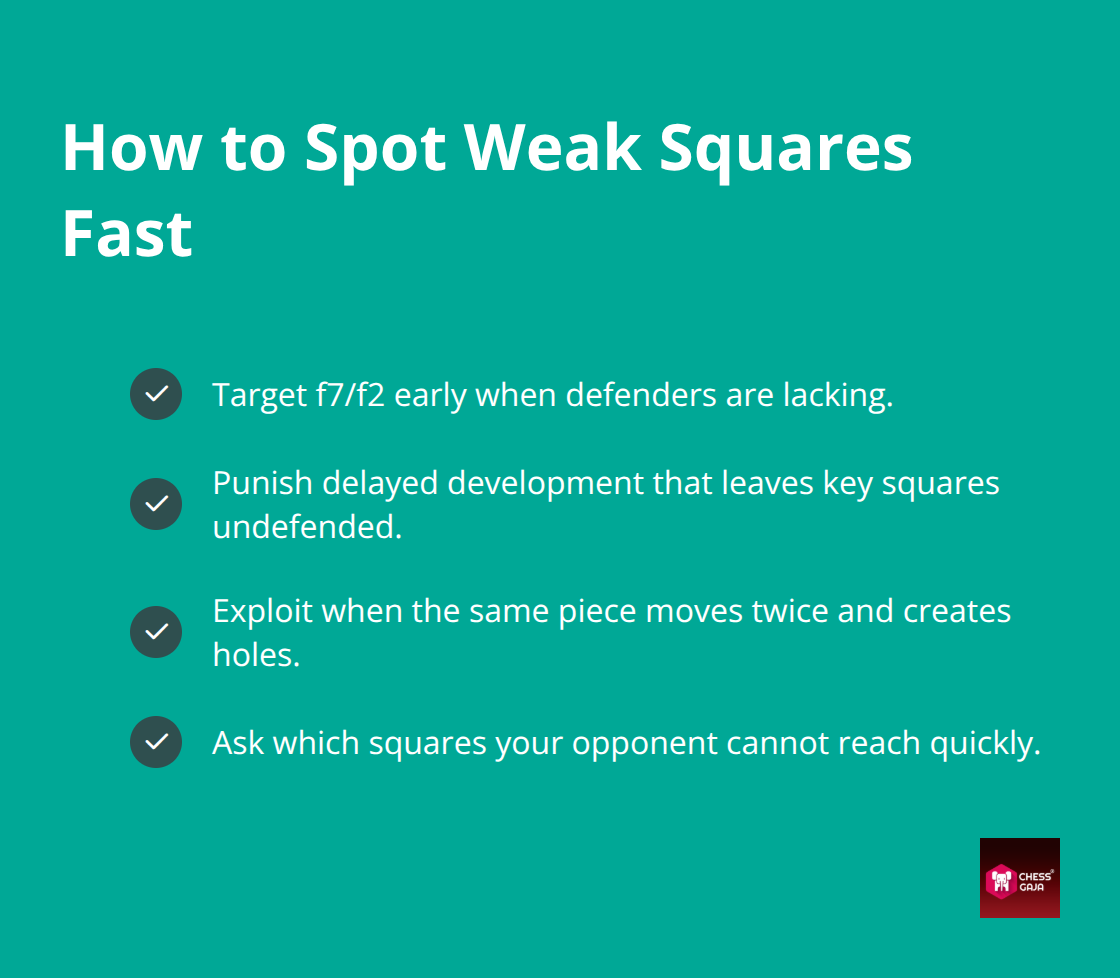
First, control the center and castle safely. Next, find weak spots in your opponent’s setup. Weak squares are squares that can no longer be protected by pawns—since pawns cannot move backward—and are poorly defended by enemy pieces. In addition, f7 (for Black) and f2 (for White) become targets fast because, in the starting position, they are defended solely by the king.
For instance, a student from Singapore realized this during the Southeast Asia Junior Circuit. As a result, she lost three games because opponents targeted f7 while she lacked counterplay. She learned a key lesson: when opponents neglect piece development, f7 relies only on the king for defense. This makes it vulnerable to early attacks. Now, she targets f7 aggressively to win material or force concessions.
You spot weak squares by asking one question: which squares can my opponent’s pieces not reach quickly?
If your opponent delays developing their knights or bishops, their overall development lags behind, creating exposed central squares and severe king safety issues, including a vulnerable back rank once pieces get trapped on the first rank. If they move the same piece twice while you develop three pieces, they’ve created holes in their position that your pieces will occupy within five moves.
Creating Imbalances That Favor Your Strengths
Creating imbalances means guiding the game toward your strengths. Do you prefer open setups like the Italian Game? Steer positions toward active piece play instead of quiet setups. Does your opponent prefer closed positions while you excel at tactics? Force tactical complications where calculation speed decides the winner.
Coaches working with students across multiple regions consistently see players win by forcing opponents into unfamiliar positions rather than playing symmetrical, balanced games. The player who controls the game’s character controls the outcome.
Timing Attacks and Defenses for Maximum Impact
Proper timing separates winners from players who panic under pressure. Attack when your opponent’s king lacks defenders. Ensure their pieces stand uncoordinated first. A premature attack on move ten fails easily. Yet, the same attack succeeds five moves later if your opponent wastes time on non-defending pieces.
Defend actively. Move your pieces to squares that protect your king and threaten your opponent at the same time. Passive defense leaves your opponent in total control. Avoid moving pieces just to block threats. Instead, force your pieces to work on two fronts: protecting your king and attacking key targets.
These strategic concepts transform how you read positions, but beginners often stumble when executing them. The next chapter reveals the specific mistakes that hold back most players and shows you exactly how to avoid them.
Common Mistakes Beginners Make in Strategy and Openings
Playing Without a Plan Costs You Material
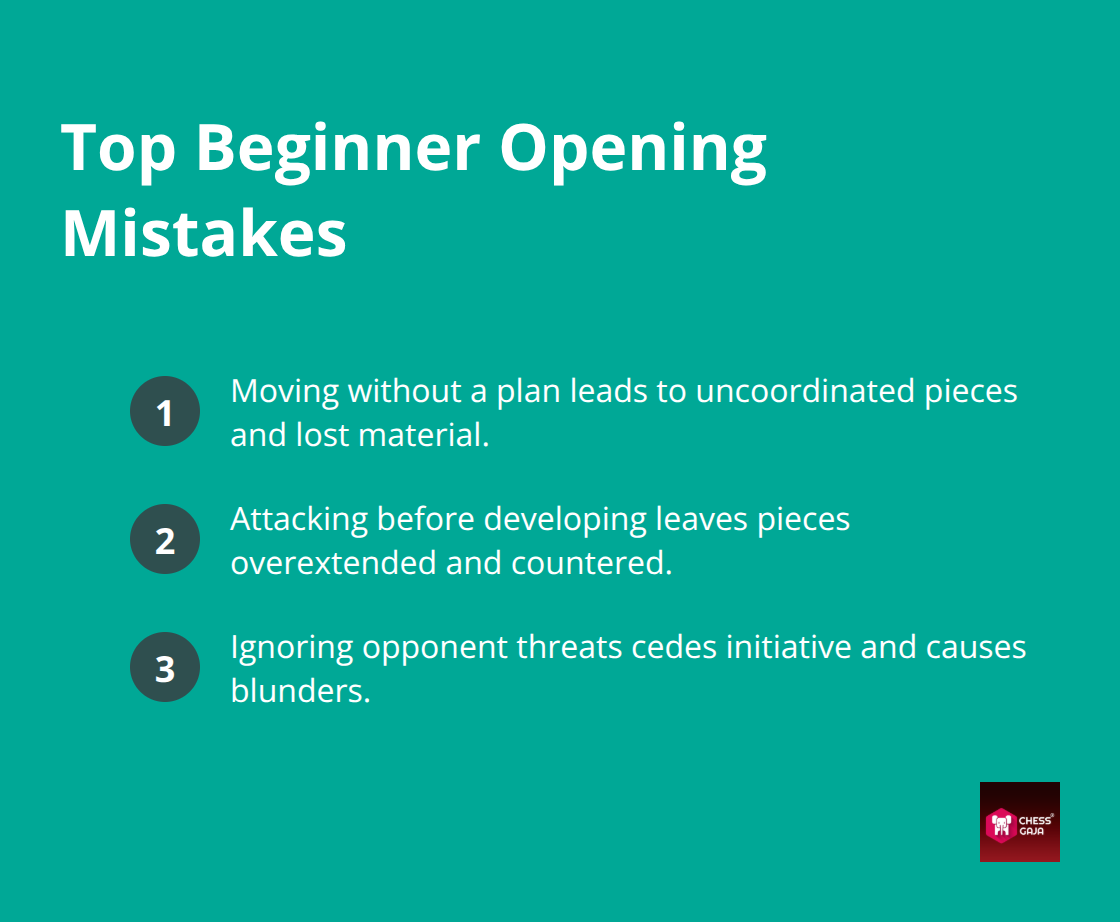
Most beginners lose because they move pieces without connecting them to a concrete goal. A student from Houston played in the Texas Youth Championship. She moved her queen on move six. Next, she moved her bishop on move seven. Then, she moved her knight on move eight. Each move attacked a different square without a plan. Meanwhile, her opponent developed pieces and castled on move nine. By move twelve, her pieces fell apart and lost material.
Beginners confuse activity with purpose. You need a clear plan before move one. Every move from two to fifteen must serve that plan. Can you explain your move in one simple sentence? If not, you moved without a plan. Coaches analyzing games across the UAE, USA, and Singapore see this pattern daily. Players make aggressive moves, then abandon them two turns later.
The fix is simple. Decide your goal for move fifteen before the game starts. Do you want center control? Active piece placement? A direct attack on a weak square? Pick one goal. Ensure every move serves that goal. Off-target moves waste precious time and let your opponent execute their plan freely.
Attacking Before You Develop Loses Pieces
The second catastrophic mistake beginners make is attacking f7 or h7 before developing enough pieces to support the assault. A beginner sees that f7 is weak after 1.e4 e5 2.Bc4 Nc6, so she plays 3.Qh5 immediately to threaten mate on f7 (or after 1.e4 e5 2.Nf3 Nc6 3.Bc4, plays 4.Qh5).
Her opponent simply plays 3…g6 (or 4…g6 / 4…Qf6), defending f7 while gaining a tempo on White’s queen. White brought the queen out prematurely and now must waste crucial time retreating, allowing Black to defend f7 and develop smoothly with a tempo advantage.
However, beginners often prioritize attacks over development. Therefore, the proper order is simple: develop first, attack later. Bring four to five pieces to active squares. Castle your king to safety. Then, launch your attack with full piece support. Five developed pieces attacking one weak square win material. Conversely, two pieces attacking the same square risk losing material to simple counterattacks.
In the first fifteen moves, the player with more developed pieces wins consistently against beginners. Your job is to develop faster than your opponent, not to attack faster. Attacks come after development finishes.
Ignoring Your Opponent’s Threats Leaves You Defenseless
The third mistake is ignoring your opponent’s threats. Many beginners focus so intensely on their own plans that they miss their opponent’s attack developing on the opposite side of the board. A student from Singapore played 1.e4 as White against 1…c5, focused heavily on a kingside assault, and failed to notice her opponent expanding aggressively on the queenside along the semi-open c-file. On move fourteen, her opponent executed a tactical knight fork that won White’s queen, leaving her with no defense because she failed to anticipate the threat.
This is not carelessness-it is a failure of methodology. After your opponent moves, ask two questions before you move: What did they threaten? Can I defend it while advancing my own plan? If your opponent’s threat requires immediate defense, defend it. Can you ignore the threat because your attack is faster? Calculate the exact move counts required for both sides. If your attack takes five moves but theirs takes four, defend immediately.
The player who spots threats controls the game’s pace. Beginners who ignore threats end up constantly reacting. The fix is simple: pause for ten seconds after every opponent move. Ask yourself what they threaten before planning your next move. This brief pause prevents costly tactical blunders.
Final Thoughts
Mastering chess tactics and openings takes weeks of consistent practice. The students who improve fastest across the USA, UAE, and Singapore play the same opening repeatedly. They analyze every game and adjust their approach. After twenty to thirty games, patterns emerge. You will clearly see where you drifted from your plan, attacked too early, or missed threats.
Practice without feedback wastes time, but a coach who reviews your games identifies exactly where you deviate from sound principles and shows you the correct approach.
At Chess Gaja, our FIDE-rated coaches train students across 40+ countries. We use a curriculum designed for rapid improvement. In our personalized Paid Starter Classes, a coach analyzes your games directly. We identify your exact weaknesses and build a custom 30-day study plan.
Book a professional skill evaluation with one of our coaches today. We will show you exactly what holds your game back and how to fix it. This structured approach eliminates all guesswork. It focuses your practice on what truly improves your rating.