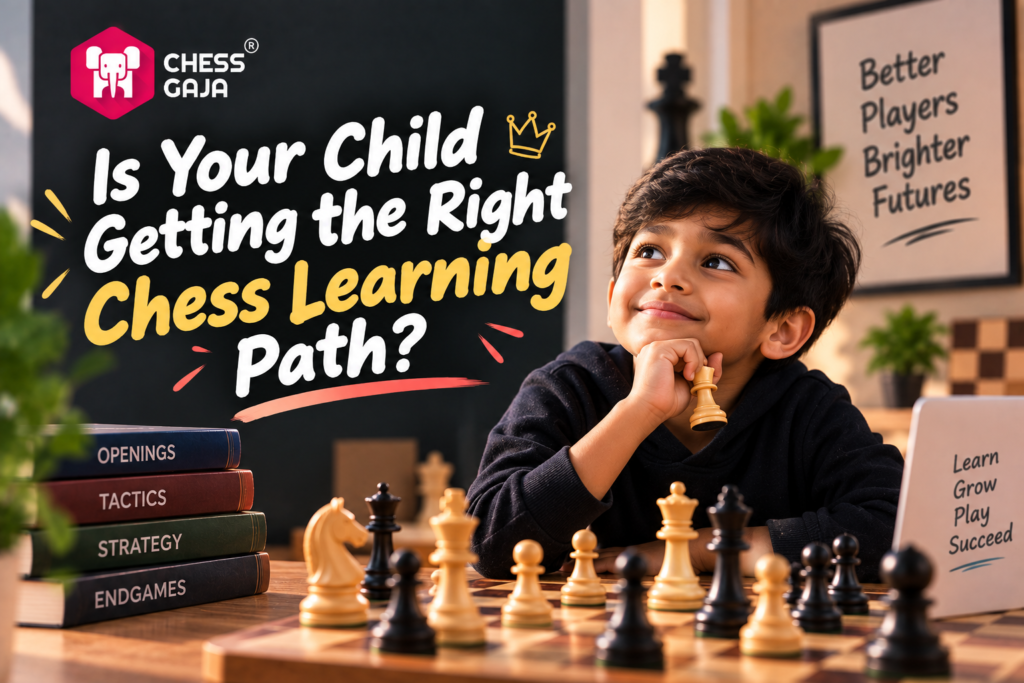
Your child’s chess rating stagnates because they’re learning the same way as every other student in their group. Generic instruction doesn’t account for where they actually stand or where they need to go.
At Chess Gaja, we’ve built online chess lessons for kids around rating-based pathways and Grandmaster guidance. This approach has produced national champions and tournament winners across 40+ countries. The difference isn’t talent—it’s structured progression matched to individual skill levels. Combined with consistent coaching from experienced players, young talent accelerates faster.
Why Your Child’s Rating Matters and How Structured Pathways Accelerate Growth
Your Child’s Rating Is a Diagnostic Tool, Not Just a Number
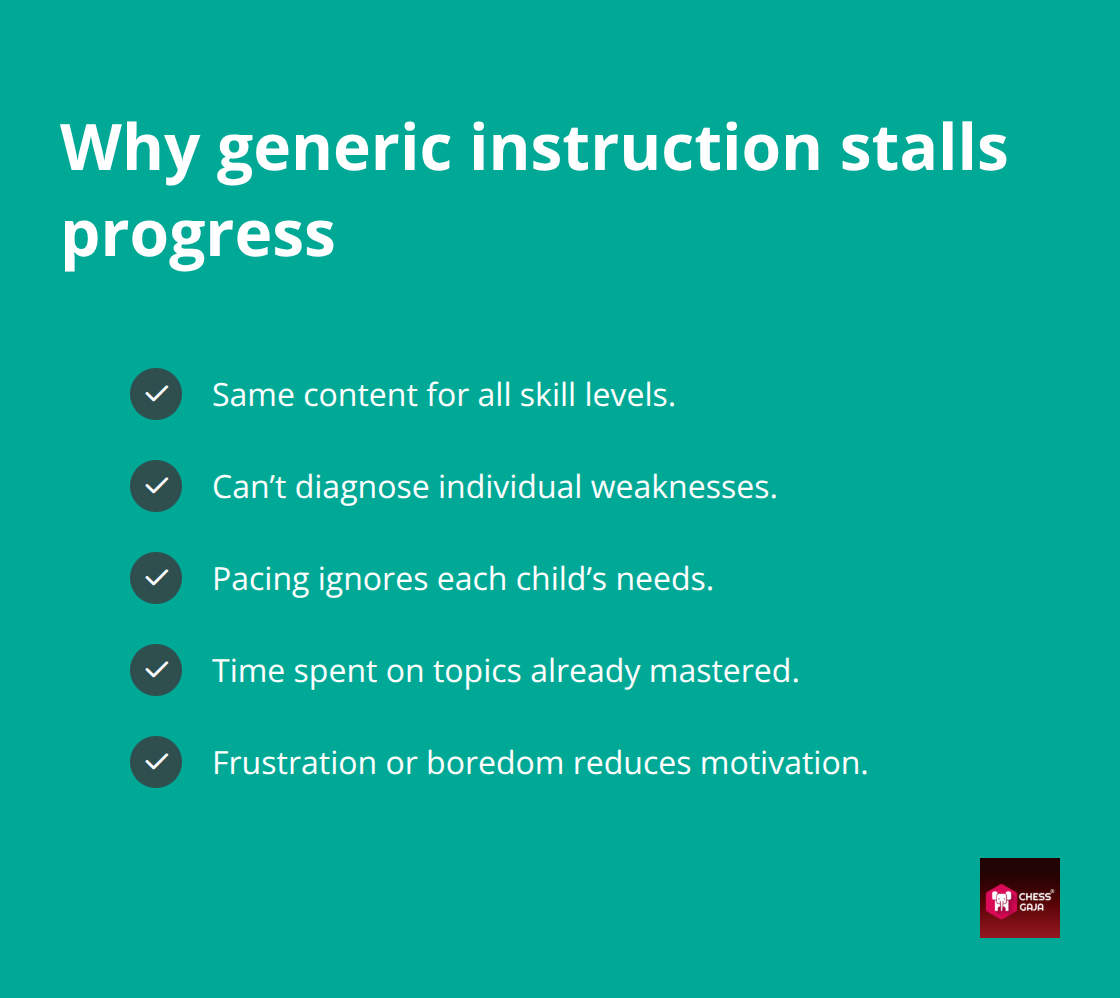
Your child’s chess rating tells you exactly where they stand and what they should learn next. A beginner with a 400 rating needs completely different instruction than an intermediate player rated 1200 FIDE. Yet most group programs ignore this reality. They teach the exact same opening principles, tactical patterns, and endgames to everyone in the room. This causes young players to plateau—they are either bored by basic material or frustrated by advanced concepts.
We’ve taught 5,000+ students across 40+ countries, and the pattern is unmistakable: students accelerate when instruction matches their actual skill level, not their age or how long they’ve been playing.
The Three Distinct Learning Phases Every Young Player Must Navigate
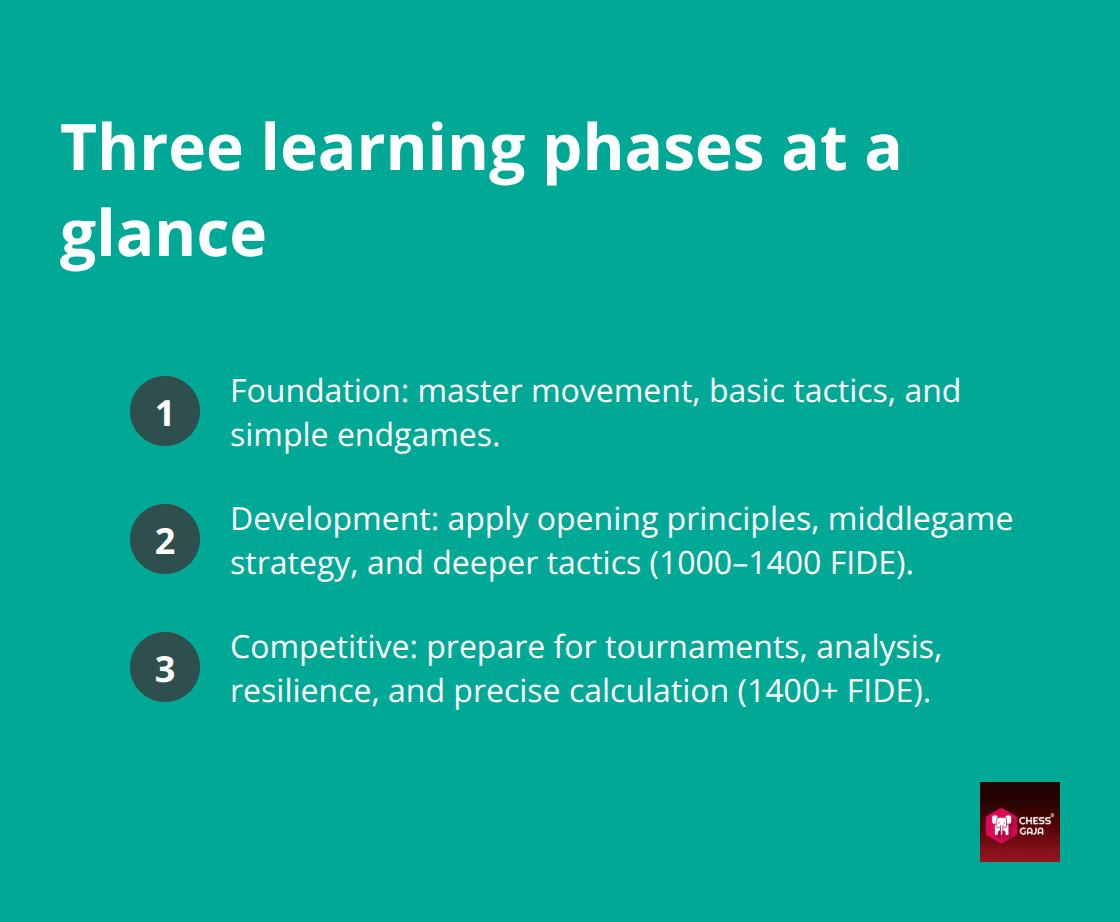
A 7-year-old with a 300 chess rating is not a beginner in the same way as a 12-year-old with a 300 rating, but they both need the foundation phase. This phase focuses on piece movement, basic tactics (forks, pins, skewers), and elementary endgames. Research from chess education shows that 70–90% of games at beginner to club level are decided by tactics alone. A young player who masters tactical pattern recognition will win far more games than one who memorizes opening lines.
The development phase introduces opening principles (control the center, develop pieces before attacking, king safety), middlegame strategy, and more complex tactical sequences. A student typically reaches this phase around 1000–1400 FIDE rating. The competitive phase demands tournament preparation and psychological resilience under time pressure. Students must also learn to execute precise calculations in critical positions. Students entering this phase are usually 1400+ FIDE and ready for serious competitive play.
Generic Instruction Creates Invisible Ceilings
Generic instruction fails because it cannot adapt when a student masters a concept faster than expected or struggles with a specific pattern. A coach with 12 students cannot pause the class for one child. If a student struggles with back-rank mates, the rest of the group moves on. More importantly, there’s no mechanism to identify which specific weaknesses are holding a student back. One young player might lose games because of weak calculation; another might have solid tactics but terrible opening knowledge. Without rating-based assessment and personalized study plans, both students waste time on areas where they’re already competent.
Chess Gaja takes a different approach. Every student receives a thorough skill assessment during their starter class to reveal precise skill gaps. We then build a personalized study schedule complete with rating-calibrated books, puzzle sets, and software. This ensures coaching time addresses exactly what each student needs, not what a standardized curriculum assumes they need. Students in rating-matched chess coaching programs improve faster because every hour of instruction builds on their actual foundation rather than a theoretical one.
What Separates Fast Improvers From Plateaued Players
The students who accelerate fastest have three things in common: they know their exact skill level, they receive instruction matched to that level, and they follow a personalized study plan between coaching sessions. A student rated 800 FIDE who spends 20 minutes daily on tactical puzzles calibrated to their rating will improve far faster than one who randomly solves puzzles from a general database. The same applies to opening study, endgame work, and game analysis. When every component of a student’s chess education aligns with their current rating and goals, progress becomes predictable and measurable.
This is why the next step in your child’s chess journey matters so much. The right coaching structure-one that assesses your child’s actual level, creates a personalized pathway, and maintains consistency-determines whether they plateau or accelerate toward competitive play.
Three Phases That Turn Raw Beginners Into Tournament Winners
Foundation Phase: Mastering Tactics and Pattern Recognition
Every strong chess player follows the same progression. The foundation phase teaches non-negotiable building blocks: piece movement, tactical dominance, and instant pattern recognition. Research from Silver Knights Chess Academy confirms that beginner and club games are decided by tactics alone. A young player who spends 20 minutes daily solving level-rated puzzles will easily outpace someone memorizing opening lines.
In this phase, a student rated 300–600 learns the core tactical patterns—forks, pins, skewers, and discovered attacks—through a framework called forcing moves. This framework trains players to evaluate candidate moves in strict order of priority: Checks, Captures, and Threats (CCT). This isn’t abstract theory; it’s the mental discipline that translates directly into faster, more accurate game decisions. Students receive personalized puzzle sheets calibrated to their exact rating, not generic puzzles that waste time on patterns they’ve already mastered or frustrate them with concepts beyond their reach.
Development Phase: Opening Principles and Strategic Thinking
The development phase, typically 1000–1400 FIDE, shifts focus to opening principles and middlegame strategy without abandoning tactics entirely. A young player now learns key strategic concepts: center control, piece development, and exploiting tactical opportunities from positional imbalances. This is where many generic programs fail: they teach opening principles as memorized lines rather than as decision-making frameworks.
At this stage, a student learns to analyze their own games, identifying not just where they lost but why the position became losing-was it a tactical miss, a strategic misjudgment, or poor time management? A coach reviewing games with a 1200 FIDE student provides exact clarity. They can pinpoint whether a winning tactic was missed on move 17 due to short calculation, or if an early opening flaw left the king exposed. This specificity is impossible in group settings with 12 students.
Competitive Phase: Tournament Readiness and Mental Resilience
The competitive phase, 1400+ FIDE, demands tournament preparation, psychological resilience under time pressure, and the ability to execute precise calculations when stakes are high. Students preparing for competitive play need coaching that addresses not just chess knowledge but competitive behavior: how to stay focused when trailing, how to convert small advantages into wins, and how to recover mentally from losses without losing confidence.
This phase includes structured tournament play that provides real competitive experience in a supportive environment, game analysis with a coach who identifies patterns in your losses, and study schedules that prioritize your specific weaknesses. A student entering this phase might discover through game review that they consistently blunder when entering severe time pressure, or that they play aggressively when ahead but passively when behind. A personalized study plan addresses these specific behavioral patterns, not theoretical chess knowledge everyone assumes they should know.
Why Grandmaster Coaching Transforms Student Progress Faster Than Group Instruction
Elite Competitive Experience Shapes Superior Instruction
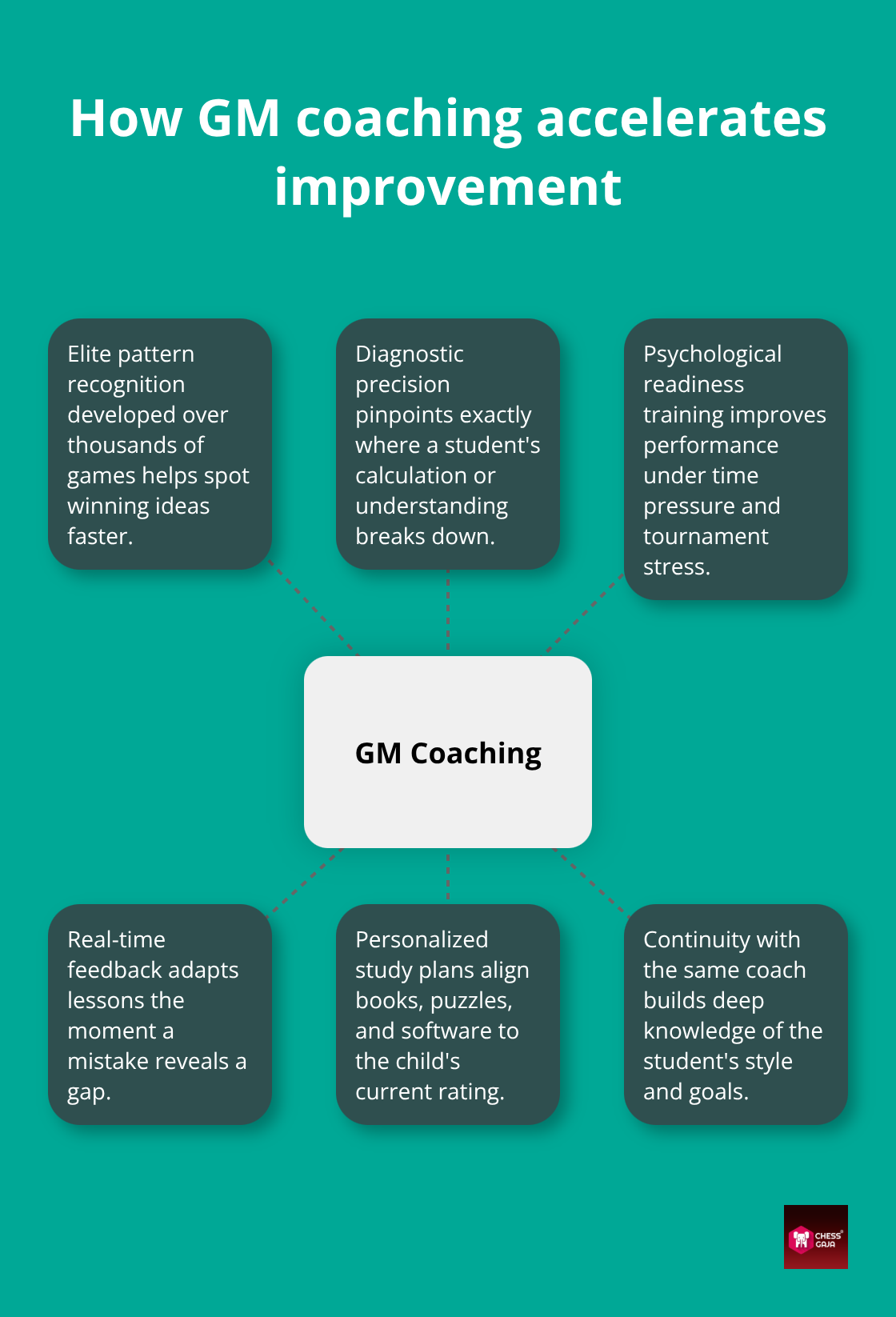
A Grandmaster’s knowledge comes from thousands of competitive games, not textbooks alone. GM Priyadharshan Kannappan achieved a 28-0 record in a simultaneous exhibition in February 2026. He understands the exact mental and technical pressures young players face in competition. This differs fundamentally from a coach who learned chess primarily through study. When a GM coaches your child, they bring pattern recognition honed at the highest levels. They quickly spot calculation breakdowns and provide psychological insights to perform under severe time pressure.
A coach who has competed at high levels recognizes when a student repeats the same mistake not because they lack knowledge, but because they haven’t internalized the pattern yet. This distinction matters enormously. A student rated 1100 FIDE might understand weak squares intellectually, but a GM coach shows them exactly how to exploit weak squares in positions matching their current rating, then assigns specific games to study where this pattern appears repeatedly. This accelerates pattern recognition far faster than generic instruction.
Personalized Study Plans Match Your Child’s Exact Rating
After your child’s starter class, they receive a detailed study schedule that includes recommended chess books, software tools, and puzzle sets matched to their current level. Instead of following a one-size-fits-all curriculum, coaches analyze each student’s strengths, weaknesses, and chess habits. Precision matters. Daily 20-minute puzzle sessions calibrated to your child’s rating produce measurable growth. Conversely, random puzzles waste time on familiar patterns or overly complex concepts.
A good coach should tailor their lessons based on the student’s skill level and progress, not apply a rigid curriculum to every student. Chess Gaja tailors every study plan to your child’s exact rating and competitive goals, ensuring that every hour of instruction addresses actual weaknesses rather than assumed ones.
Real-Time Feedback Identifies Exactly What Holds Your Child Back
Real-time feedback during coaching sessions means a GM identifies exactly what’s holding your child back in the moment. If your child miscalculates a tactic during a lesson, the coach pauses and asks specific questions to reveal whether the problem is calculation speed, pattern recognition, or confidence. This adaptive approach means coaching time addresses actual weaknesses, not theoretical ones.
Progress is continuously tracked in our Learning Management System between sessions. Parents receive AI-powered class summaries showing what was covered, key improvements, and areas needing continued focus. This transparency ensures that coaching remains aligned with your child’s actual development.
Continuity of Coaching Builds Deeper Understanding
Continuity of coaching matters more than most parents realize. Your child works with the same coach throughout their journey. This allows the coach to build a deep understanding of your child’s strengths, learning style, and competitive temperament. A coach who has worked with your child for three months can design study plans with far greater precision than one meeting them for the first time.
This relationship-based approach delivers clear advantages. Your child’s coach recognizes subtle patterns in their play that emerge only over time. A coach might notice that your child plays aggressively when ahead but passively when behind, or that they consistently miscalculate under severe time pressure. These insights allow the coach to address behavioral patterns, not just chess knowledge. This is why students improve consistently rather than in sporadic jumps.
Final Thoughts
The students who reach national rankings and tournament podiums share one characteristic: they work with the same coach throughout their entire chess journey. This continuity accelerates player improvement. A long-term coach understands your child’s learning style, competitive temperament, and specific weaknesses in ways rotating instructors cannot match. Your child’s coach stays consistent from starter classes through competitive tournaments. They quickly spot long-term behavioral patterns—such as playing passively when ahead or miscalculating under severe time pressure.
Chess Gaja has produced 7 national champions and trained students who gained 400–900 rating points under GM guidance. These results stemmed from consistent long-term coaching. Students worked with FIDE-rated instructors from day one, avoiding rotating teachers and generic group instruction. Your child’s coach becomes a stable mentor who celebrates wins, analyzes losses, and designs personalized study plans that evolve as your child improves.
Online chess lessons for kids work best through a long-term coaching relationship. A dedicated coach knows your child, believes in their potential, and tailors instruction based on months of observation. Book a Paid Starter Class at Chess Gaja for a professional skill evaluation and personalized study plan designed specifically for your child’s rating and goals.