

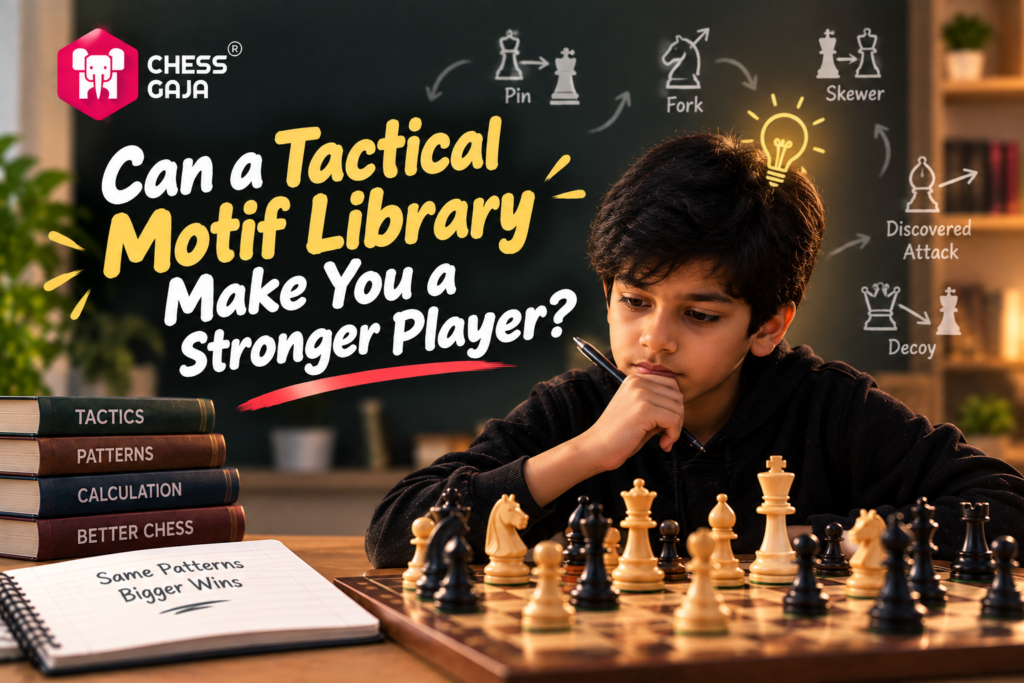
Most chess players waste hours solving random puzzles without building real pattern recognition skills. A tactical motif library changes that by organizing patterns into a system you can actually use in games.
At Chess Gaja, we’ve seen students jump 200+ rating points once they stop memorizing isolated tactics and start recognizing patterns across different positions. This blog post shows you exactly how to build that systematic approach.
Why Pattern Recognition Beats Random Puzzle Solving
Your chess improvement stalls when you treat tactics like isolated math problems. A student in Dubai solved 50 puzzles last week without recognizing a single pin in her tournament game the following day. Another player in Singapore memorized a classic back-rank mate pattern but failed to spot it in a game simply because a knight was blocking the rook’s entry line. This happens because random puzzle solving trains pattern fragmentation, not pattern recognition.
Building a tactical motif library changes this. It trains your brain to spot the same tactical idea across 100 different board positions. A pin looks like a pin whether the pieces sit on a4 and a7 or on e5 and e8. A fork remains a fork regardless of which pieces deliver it. Students who organize tactical training around core motifs show rapid improvement. Patterns like pins, skewers, forks, discovered attacks, and decoys lead to measurable rating gains within 4–6 weeks. The difference is simple: pattern recognition teaches your brain to extract the essential structure of a tactic, then recognize that structure instantly in any position.
Tournament results prove this works. A 14-year-old student in the UAE jumped from 1,400 to 1,650 rating in three months through systematic study of pins and forks across 200+ real tournament games rather than solving disconnected puzzles. Her calculation speed improved because her brain no longer had to analyze every variation from scratch; she recognized the pattern immediately and knew which moves to calculate.
The Cost of Memorization Without Understanding
Memorization without understanding wastes your study time and fails in real games. When you memorize that a specific sequence wins material in one position, you’ve learned nothing transferable. The moment the position shifts slightly, your memorized knowledge becomes useless. A player who understands why a pin works, however, can spot it in countless variations.
This distinction matters enormously at tournament pace. A beginner in New York had memorized 15 tactical combinations from a puzzle app but could not execute a single one during tournament play because the actual positions never matched his memorized sequences exactly. In contrast, a player who understands that a pin exploits a piece’s inability to move without exposing a more valuable piece behind it will recognize pins instantly, even in positions he has never seen before. Understanding transforms a tactic from a memorized trick into a permanent skill.
How Tournament Players Actually Win With Tactics
Tournament games are won by players who calculate faster and spot tactical opportunities earlier than their opponents. Speed comes from pattern recognition, not calculation volume. A player who sees a fork pattern instantly can calculate a 3-move forcing variation in seconds; a player who fails to recognize the underlying motif wastes several minutes just searching for candidate moves.
In the 2025 Asian Youth Chess Championships, the highest-rated players consistently won tactical positions not because they calculated deeper, but because they recognized tactical patterns 2-3 moves before their opponents. One winning player in Singapore could identify forcing tactics within five seconds. This was not supernatural talent, but the result of studying core motifs across hundreds of real games. This skill directly translates to rating gains. Players with organized motif libraries consistently outperform pure puzzle solvers. They make faster, more accurate decisions under tournament time pressure. The tactical library becomes your competitive edge because it compresses hours of calculation into seconds of recognition. This speed advantage is what separates tournament winners from puzzle solvers, and it’s what we’ll explore in the next section: how to actually construct your own pattern system.
How to Organize Your Tactical Training Around Five Core Patterns
Five of the most essential tactical motifs—pins, skewers, forks, discovered attacks, and decoys—form the core foundation of pattern recognition. pins restrict a piece’s movement because exposing the target behind it is catastrophic; skewers force a high-value piece to move, exposing a target lined up directly behind it; forks attack multiple targets simultaneously from a single square; discovered attacks unleash hidden threats when a masking piece moves away; decoys force an opponent’s piece onto an unfavorable square. These five patterns appear in the vast majority of tactical positions across all rating levels, according to analysis of games in the FIDE tournament database. Master these five, and you stop missing elementary tactics in your games.
The critical step is not studying textbook diagrams. You must recognize these patterns when irrelevant pieces surround them and distract your attention. A pin in a crowded position looks functionally identical to a pin on an open board. Yet, players trained on isolated puzzles often fail to spot it amidst board noise.
Progress From Simple to Complex Positions
Within each pattern type, organize your training progression by difficulty level rather than tackling random complexity. Start with positions containing the core tactical pieces plus 2–3 distractor pieces. Gradually add more distractor pieces until you spot the pattern in complex middlegame setups. A student in Abu Dhabi significantly improved her tactical accuracy over eight weeks, reviewing 15 positions per difficulty level before advancing. The progression matters more than the pattern itself because it trains pattern extraction under realistic conditions.
Collect Real Games Instead of Relying on Puzzle Apps
Puzzle apps feature isolated positions designed for quick solutions. This approach trains speed at the cost of real pattern transfer. Real tournament games teach pattern recognition in context. You see how tactics emerge from the opening, develop through the middlegame, and decide the outcome. Download PGN files directly from the FIDE tournament calendar or from Lichess, which hosts millions of games played by rated players at every level. Search for games featuring your target motif—for example, filter your database for games featuring royal fork tactics (attacking King and Queen), then review 20–30 complete games to see how those tactical setups were created from the opening.
A player in New Jersey built a fork library by studying 50 complete games from the World Chess Championship. Within three weeks, his fork recognition improved dramatically. He finally understood how those positions arose and why the fork decided the game. Real games also show you what happens when you miss a tactic, reinforcing the cost of inattention. Organize games by your rating plus one level above. Studying games from players 200–300 points stronger exposes you to sophisticated tactics without overwhelming your calculation ability.
Store and Review Games With a Single Database Tool
Use one chess database tool to store and review your collected games rather than scattering them across multiple apps and files. Lichess studies allow you to organize games into folders by pattern type and difficulty, add annotations explaining why the tactic works, and review them repeatedly with spaced repetition built in. Alternatively, use ChessTempo, SCID vs PC, or ChessBase Reader to maintain your personal database. The storage tool matters far less than consistency-choose one and stick with it.
Review your collected games on a fixed schedule: study one new game per day, then revisit annotated positions from two weeks ago, one month ago, and three months ago. A player in Singapore followed this schedule for 90 days. She reduced her pattern recognition time from 15–20 seconds down to just 3–5 seconds per position. This speed directly translated to faster tournament decision-making under time pressure.
Prioritize Patterns by Frequency in Your Rating Range
Track which patterns appear most frequently in games at your rating level, then prioritize collecting and reviewing those patterns first. If your game reviews show that you miss forks far more frequently than decoys, adjust your study routine to spend proportionally more time mastering fork setups before moving to rarer motifs. This frequency-based approach (rather than studying all five patterns equally) accelerates your tactical improvement because you train your brain to recognize the patterns you’ll actually encounter in tournament play.
Once you’ve built this organized system and trained your pattern recognition through real games, the next step is translating that recognition into faster calculation and stronger tournament performance-which is where consistent tactical training begins to compound into measurable rating gains.
How Pattern Recognition Speed Wins Tournament Games
A player in Dubai studied pins systematically for six weeks, building her library from 40 real games to 120, then spotted a pin in a middlegame position within 3 seconds instead of the 12-15 seconds required before her training. Saving 10 to 12 seconds on pattern recognition across multiple critical moments each round gave her several extra minutes of deep calculation time when complex positions arose. She won two additional games that tournament purely because faster pattern recognition allowed her to calculate variations she previously missed due to time constraints. This is how tactical libraries convert to rating gains in practice.
Recognition Speed Determines Tournament Outcomes
Recognizing a fork instantly frees up time to calculate deeper variations or alternative moves. In contrast, searching for basic tactics wastes precious time and leads to weaker decisions. Tournament data and coaching observations consistently show that players who maintain organized tactical libraries experience significantly higher rating gains over a 12-week period compared to players solving random puzzles. The difference compounds quickly. Faster recognition reduces time pressure and limits calculation errors, elevating decision quality across the entire game.
Daily Review Builds Speed Faster Than Cramped Sessions
A player reviewing 10 positions daily for 60 days saw a major jump in tactical accuracy. In contrast, a player reviewing 70 positions once weekly showed only marginal improvement despite identical total volume. Spaced repetition builds neural pathways that activate faster under time pressure; cramped review sessions build knowledge that evaporates when tournament stress arrives. The schedule matters more than the volume because consistency trains your brain to recognize patterns automatically.
Time-Constrained Training Mirrors Tournament Conditions
Train your pattern intuition by using a 5–8 second limit to spot the key motif. Look for unprotected pieces or aligned targets before diving into full calculation. This constraint forces your brain to extract pattern essentials rather than guessing variations, which is exactly what tournament play demands. A coach in the UAE implemented this motif-spotting rule with great success. Students improved their pattern recognition within four weeks. The process became automatic, freeing their minds to evaluate moves instead of hunting for patterns.
Track Accuracy by Pattern Type to Eliminate Weak Spots
A player who spots forks consistently but struggles with pins should prioritize pin training. Tournament performance depends on consistent accuracy across all five core motifs. This data-driven prioritization prevents the common mistake of practicing patterns you already recognize while neglecting your weaknesses.
Execute these three actions consistently: daily review, time-constrained identification, and accuracy tracking. Your pattern library will become a competitive weapon against opponents relying solely on brute-force calculation.
Final Thoughts
Structured tactical training beats random puzzle solving because it trains your brain to extract pattern essentials, not memorize isolated positions. A player with a tactical motif library recognizes pins, forks, and discovered attacks instantly on any board setup. A player solving disconnected puzzles remains dependent on brute calculation and wastes time searching for tactics. The evidence from our coaching experience is clear: students who organize their tactical training around core patterns achieve consistent rating gains within weeks, while random puzzle solvers often plateau.
Your next step is straightforward. Start collecting real games from the FIDE tournament calendar or Lichess in your rating range, organize them by the five core tactical motifs, and review 10 positions daily using the 5-second motif-spotting rule. Track your accuracy by pattern type, prioritize your weakest motifs, and stick to your review schedule. Stick to your review schedule for 60 days of consistent practice. Your pattern recognition will become automatic, freeing your mind to evaluate strategy rather than hunting for tactics.
We at Chess Gaja guide students through this exact systematic approach using our GM-led curriculum, which operates across 40+ countries and teaches students to build their tactical motif library from real tournament games.
A Paid Starter Class at Chess Gaja includes a professional skill evaluation and a personalized training plan. You also get access to our exclusive puzzle library organized by pattern type and difficulty. Book your evaluation today and start building the systematic tactical approach that separates tournament winners from puzzle solvers.