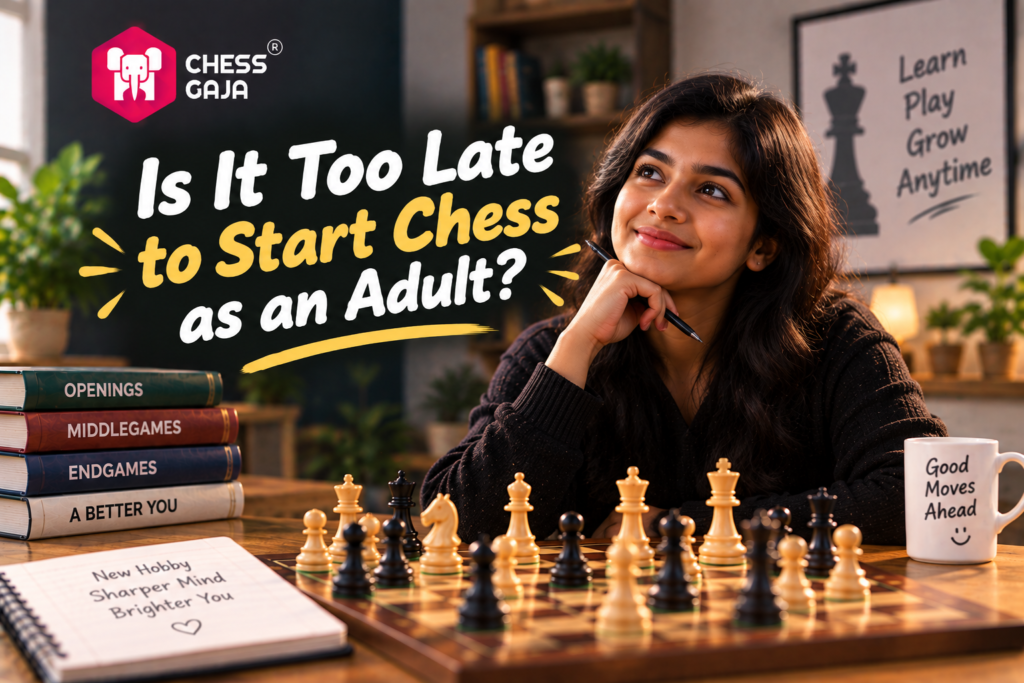
You picked up chess as an adult and wonder if you’re starting too late. The truth is, thousands of adults in the USA, UAE, and Singapore are beginning their chess journey right now-and many are progressing faster than they expected.
At Chess Gaja, we’ve coached adult beginners through this exact path. This guide shows you how to move from your first game to confident play without the frustration of trial and error.
Why Adults Are Learning Chess Today
The Science Behind Adult Chess Learning
Adult learners pick up chess at unprecedented rates today. This trend is driven by clear cognitive benefits rather than nostalgia.
Chess strengthens pattern recognition, decision-making under pressure, and long-term planning. These skills transfer directly to work and daily life. In fact, a 2024 study showed that regular adult players make measurable improvements in working memory compared to non-players.
In the UAE and Singapore, corporate professionals use chess for leadership development. Business leaders recognize how on-board discipline sharpens real-world strategy. Companies in Dubai and Abu Dhabi even sponsor internal chess clubs to build manager analytical skills.
How Online Access Changed Everything
The barrier to entry has collapsed entirely. Twenty years ago, adult beginners needed to find a local club, commit to in-person meetings, and accept instruction from whoever was available. Today, you can access world-class coaching from your home at any time that fits your schedule. Online platforms make it possible to play thousands of opponents, study from Grandmaster-led curricula, and receive personalized feedback without leaving your living room.
Time-zone-flexible coaching means a working parent in New York can take a class at 6 AM, a professional in Dubai at 7 PM, and a student in Singapore at 9 PM-all from the same academy with the same coach. Chess Gaja serves 5,000+ students across 40+ countries with this exact model, meaning you learn as part of a global community rather than in isolation.
Building Real Connection in a Virtual Space
The social element matters too: adult learners report that joining an online chess community removes the intimidation factor of walking into a club where everyone else seems to have played for years. Monthly academy tournaments, student spotlights, and group study sessions create genuine connection without the friction of geographic location. Adults are learning chess now because the path is finally accessible, the benefits are scientifically documented, and the community is global and welcoming-yet the real question becomes how to structure your first steps so you progress efficiently rather than waste months on ineffective practice.
How to Play Your First Games Without Memorizing Opening Lines
Your first instinct as an adult beginner is often to memorize opening moves. This is a mistake. Most adult beginners waste weeks memorizing sequences they will forget under tournament pressure, when a single principle-based decision would have served them better. The real path forward is learning the three to four core ideas that govern every opening, then playing immediately. A player rated 1200 who understands why pieces belong on certain squares will beat a player rated 1200 who has memorized 20 moves of theory but does not understand the reasoning. Adult students who focus on principles rather than memorization typically break past intermediate plateaus much faster, while those chasing memorized lines stall early trying to recall heavy theory.
The Three Opening Principles That Matter
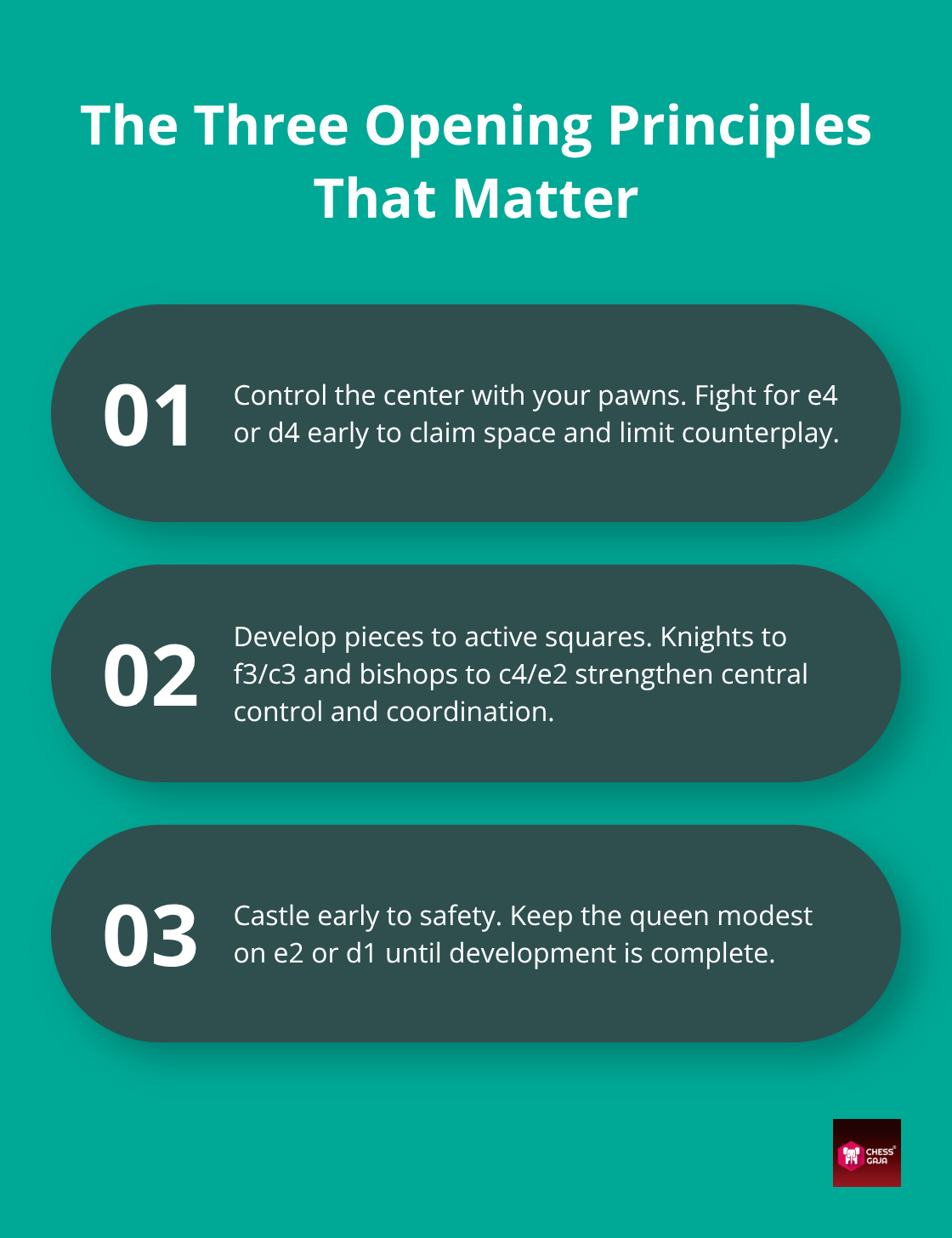
Control the center with pawns, develop pieces to active squares, and castle early for safety. These three rules solve most opening decisions for beginners.
When you claim the center, you fight for space immediately. Do not try to recall memorized lines when your opponent responds. Instead, ask yourself which piece can move to an active square right now. Developing knights and bishops toward the center controls key squares naturally. A bishop on c4 or f4 supports your center aggressively.
Keep your queen safe early on. Avoid wandering the board to create cheap threats that opponents easily punish.
Finally, castle kingside by move 10 unless the position demands otherwise. This simple framework eliminates early-game paralysis. You will still make mistakes, but you will learn game logic rather than cramming variations.
Where Adult Beginners Actually Lose Games
Adult beginners rarely lose due to opening knowledge. Instead, they lose by hanging pieces in the first 15 moves. A hung piece is simply left undefended for easy capture. Beginners often focus so hard on their own plans that they forget to ask what the opponent threatens. Always pause to check for threats before completing your turn.
Uneven trades are another common mistake. A queen is worth nine points, a rook five, a bishop or knight three, and a pawn one. Trading a bishop for a pawn creates a heavy material disadvantage that makes winning far harder.
Finally, beginners leave their king exposed by delaying castling or pushing defensive pawns. A exposed king under attack often loses within five moves. These three habits account for most losses between 1000 and 1400 rating points. Fixing them takes discipline early in the game, not complex theory.
Building Confidence Through Real Games, Not Theory
Play 15 to 30-minute rapid games instead of blitz. Blitz forces speed over calculation, training panic rather than deep thinking. Rapid gives you time to pause, spot threats, and execute plans.
After each game, spend 15 minutes reviewing your biggest mistake without using an engine first. Write down your goals, your opponent’s threats, and your alternate moves. Afterwards, check your analysis against Stockfish or Chess.com tools. This self-analysis habit quickly internalizes chess logic.
Aim for two to three games per week and review each one. This rhythm builds pattern recognition faster than solving 100 isolated puzzles.
Your first 20 games will feel chaotic. By 50 games, you will recognize familiar positions and decide faster automatically. Confidence comes from repetition, not memorization.
Moving From Solo Practice to Structured Instruction
Self-directed practice works, but it works slowly. Adult learners who add professional coaching to their game review and puzzle training accelerate their progress significantly. A coach identifies the specific weaknesses in your position-handling that hold you back, then structures your study plan to address them systematically. Rather than spending months on random tactics puzzles, you work on the exact patterns that appear in your games. Rather than guessing which openings suit your style, you receive a personalized opening repertoire built around your strengths. This targeted approach cuts months off your journey from beginner to confident player, and it transforms the frustration of slow progress into measurable improvement week after week.
Why Coaching Accelerates Adult Progress Faster Than Solo Study
Professional instruction cuts your learning timeline by months. A self-taught beginner often takes 12 to 18 months to reach a 1500 rating. With structured coaching, that same goal takes four to six months.
The main difference isn’t talent—it’s specificity. A coach finds the exact weaknesses in your games and builds a targeted study plan around them.
Solo learners waste time on generic puzzles and unnecessary openings. They repeat the same tactical errors because no one points out the pattern.
In contrast, a coach reviews your games quickly and flags critical turning points. They assign specific puzzles for your exact patterns, guide your repertoire, and track your progress over your next ten games.
This feedback loop is impossible to replicate alone. Rather than guessing whether to focus on endgames or tactics, your coach determines that you lose games in the middlegame because you miss tactical shots under time pressure, so your first four weeks emphasize calculation speed and pattern recognition.
Your opening repertoire gets simplified to three reliable systems instead of the ten half-learned variations scattered across your preparation. Within six weeks, you notice the difference: you spot winning moves faster, you hang fewer pieces, and your rating climbs predictably because you solve the actual problems in your games, not theoretical problems that sound important.
Personalized Plans Match Your Schedule and Goals
An adult beginner in Singapore juggling work and family needs a different study approach than a retired professional in Abu Dhabi. Structured coaching plans fit your reality, not some generic template.
If you have ninety minutes per week, your coach allocates time to game play, post-game analysis, and focused puzzle training. If you have five hours weekly, that stretches to deeper opening study and endgame practice.
The plan evolves as you progress: a player reaching 1200 needs different resources than one climbing toward 1500. Your coach recommends specific chess books—such as Irving Chernev’s Logical Chess: Move by Move for positional understanding or Bruce Pandolfini’s Weapons of Chess for fundamental patterns—calibrated strictly to your current rating.
You receive puzzle sets matched to your level through platforms like Chessable, not random collections that frustrate you.
Your opening repertoire matches your playing style. If you prefer solid positions and patient maneuvering, your coach will recommend reliable systems. Popular options include the Queen’s Gambit and the Caro-Kann Defense.
You can avoid hyper-sharp openings like the Sicilian Defense. This personalization matters. Adult learners have limited time and zero tolerance for wasted effort.
Tracking Progress Beyond Rating Numbers
Rating alone is a misleading progress metric. A player might jump 150 rating points in three months, then plateau for six weeks because they hit a new skill ceiling.
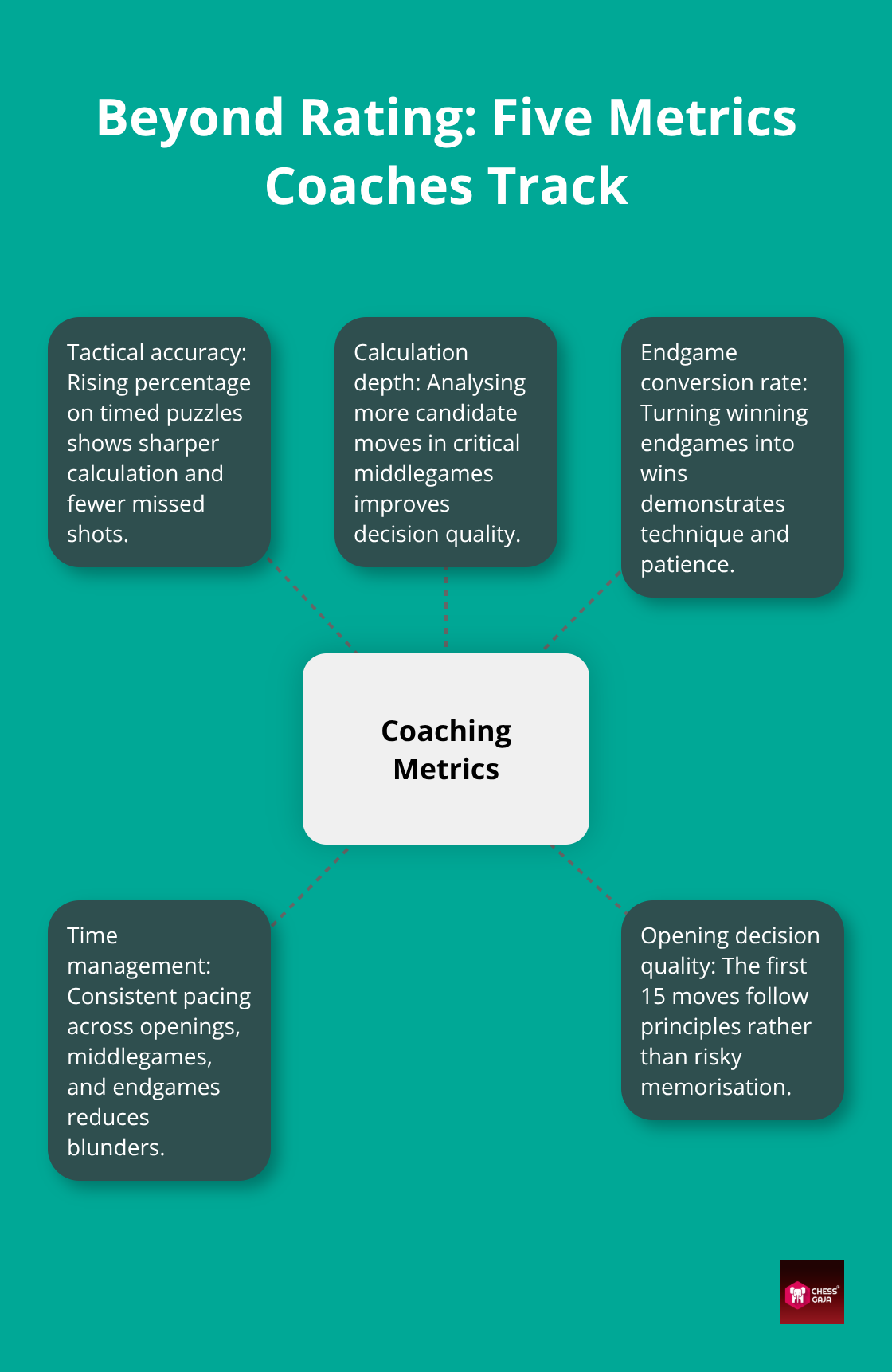
A coach tracks five key improvements that rating numbers miss:
- Tactical accuracy on puzzles
- Calculation depth in critical middlegame positions
- Conversion technique when ahead in material
- Time management consistency across game formats
- Opening decision quality in the first 15 moves
Your tactical accuracy jumped significantly in four weeks. That is real progress, and it predicts rating gains. You notice your endgame conversions improved notably. You now win games you previously drew or lost.
Monthly academy tournaments provide concrete feedback. These milestone celebrations matter for adult motivation. A coach who tracks your growth keeps you engaged far longer than watching a rating number creep upward unpredictably.
Final Thoughts
Your adult beginners chess journey starts with a single decision to play your first game, not with perfect opening knowledge or years of study. You now understand that opening principles matter far more than memorization, that identifying threats prevents most losses, and that structured practice beats random effort. The path from your first move to confident play is clear: play games, review them honestly, and fix the patterns that repeat.
Finding the right learning environment determines your progress speed. A global community in the USA, UAE, and Singapore proves that age is irrelevant. You only need world-class instruction and peers at your level.
Online coaching removes intimidation. You do not have to walk into a club where everyone seems stronger.
Additionally, personalized study plans protect your time. Your effort produces measurable results rather than wasted time on generic tactics puzzles.
Book a Paid Starter Class with Chess Gaja, where a FIDE-rated coach will evaluate your current level, identify your specific weaknesses, and build a personalized study plan tailored to your goals and schedule. Within four to six months of consistent practice and professional guidance, you will shatter your early plateaus and play with genuine confidence. Your adult beginners chess journey starts today.