

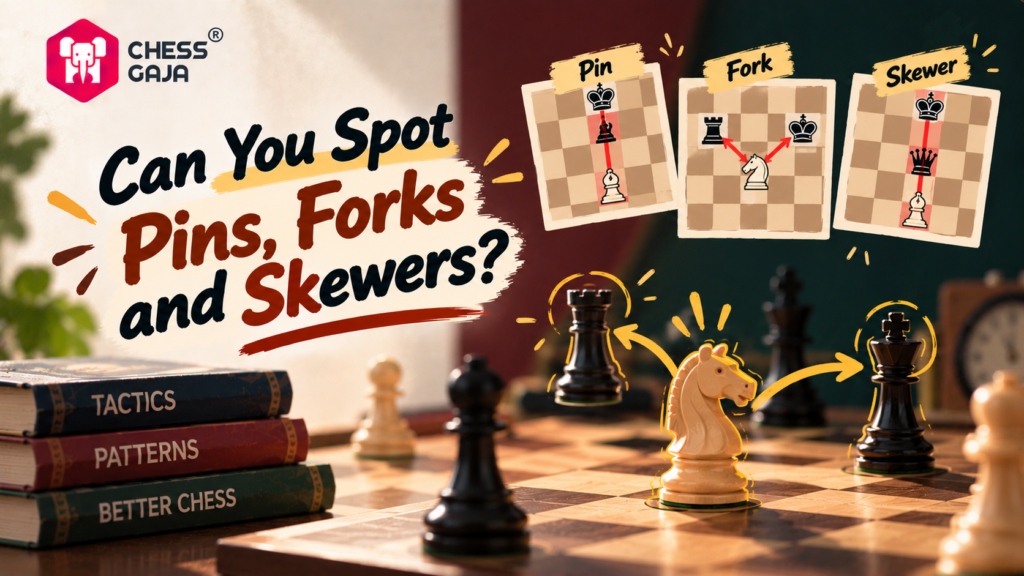
Tactical patterns are the difference between players who win games and those who lose them. A student in Singapore who masters pins, forks, and skewers can jump two rating categories in months.
At Chess Gaja, we’ve coached thousands of young players through advanced chess tactics patterns, and we’ve seen firsthand how pattern recognition transforms tournament results. This guide breaks down exactly how to spot these patterns under pressure and build the tactical vision that separates competitive players from casual ones.
The Three Patterns That Win Games
Why These Three Patterns Matter Most
Tactical patterns are not theoretical concepts-they are weapons. A player in Dubai who spots a pin under time pressure gains an immediate material advantage. A student in the USA who recognizes a fork wins the game before the opponent realizes what happened.
The pin, fork, and skewer drive most tactical wins in tournament play. This is especially true at the beginner and intermediate levels. Most players waste months studying openings while their tactical vision stays weak. We recommend the opposite approach. Focus exclusively on pins for your first 30 days, forks for the next 30, and skewers for the final 30.
The Pin: Freezing Your Opponent’s Pieces
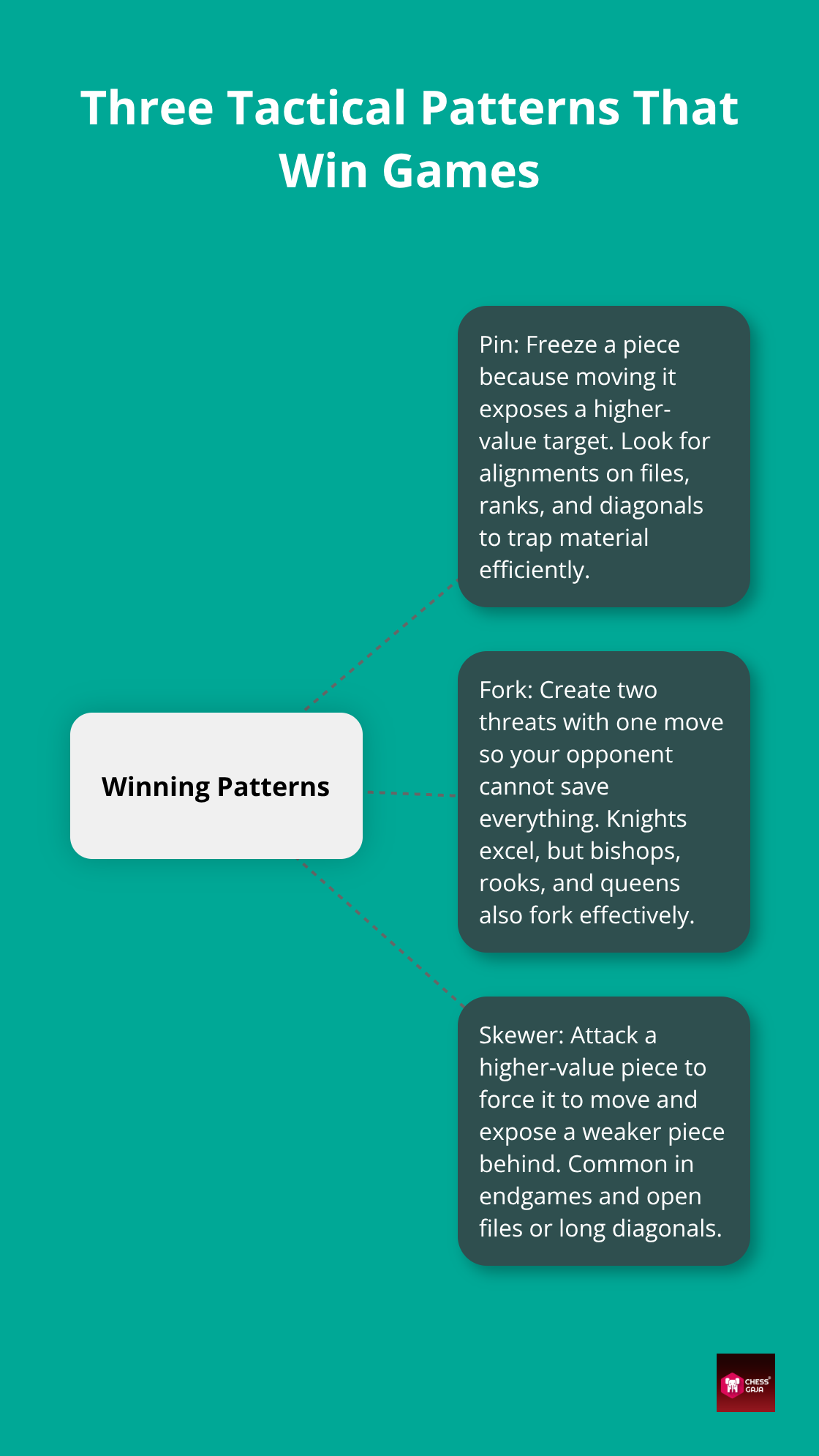
The pin freezes a piece in place because moving it exposes something more valuable behind it. A bishop pinning a queen to its king creates an absolute pin. The queen cannot legally leave that diagonal because it would place the king in check. In tournament play, pinned pieces become targets. Your opponent faces a brutal dilemma: leave the piece trapped under the pin and lose material slowly, or sacrifice surrounding resources to try to unpin it. This pattern teaches you to spot alignment. Whenever two pieces of different values sit on the same line, a pin exists. Solve 5–10 pin puzzles daily for 30 days, and you will spot this pattern instantly in real games.
The Fork: Creating Two Threats at Once
The fork creates two simultaneous threats that cannot both be defended. A knight leaping to c7 attacks both the e8-king and the a8-rook simultaneously. Your opponent must move their king. This leaves the trapped rook open for capture on your next move. Forks are devastating because they exploit your opponent’s inability to defend everything at once. Knights excel at forks due to their unique movement pattern, but bishops, rooks, and queens can fork too. The key is recognizing positions where one move attacks two or more pieces of value. Train fork puzzles for 30 days. You will automatically scan the board for double-attack opportunities before every move.
The Skewer: The Pin’s Devastating Cousin
The skewer reverses the pin’s logic: the high-value piece stands in front, and moving it reveals the capture of a lower-value piece behind. Where a pin paralyzes a piece, a skewer forces it to move and lose material. For example, a king placed in check by a bishop on an open diagonal must move, exposing an undefended rook directly behind it for capture. Skewers often appear in endgames and positions with exposed kings. Look for positions where a high-value piece blocks a weaker one. Attack the stronger piece first to win the weaker target behind it.
Building Pattern Recognition Through Structured Practice
These three patterns overlap in real games, and mastering them means you stop missing free material. Solve at least 5–10 puzzles per day on each motif before mixing them together. High volume repetition with good focus reinforces pattern recognition deeply, so you spot these tactics instantly in tournament games. Players who follow this method develop competitive advantage because tactics are not luck-they are pattern recognition, and pattern recognition is learnable through deliberate, focused practice. The difference between a casual player and a competitive one is not talent. It is whether they trained their eyes to see what is already there on the board.
Once you master these three foundational patterns, intermediate tactics become accessible. Removing the defender, discovered attacks, and deflection all build on the foundation you establish with pins, forks, and skewers.
Intermediate Tactics: Building Winning Combinations
Foundational patterns alone do not win tournaments. A player in the UAE who spots a pin feels confident, but intermediate players exploit this confidence by layering multiple patterns into one devastating combination. Removing the defender teaches you to eliminate the piece protecting your opponent’s weakness, discovered attacks force your opponent to react to a threat they cannot see coming, and deflection pulls key defensive pieces away from critical squares. These three tactics are where pattern recognition becomes lethal because they force opponents into positions where they must choose between two losing options.
A student in Singapore who masters these intermediate patterns gains a concrete advantage: they stop missing winning sequences that require two or three moves to execute. Most beginner players see only one move ahead and miss the second move that wins material or delivers checkmate. Intermediate players calculate one move deeper, and that single extra layer of vision transforms tournament results.
Removing the Defender: Eliminating Protection
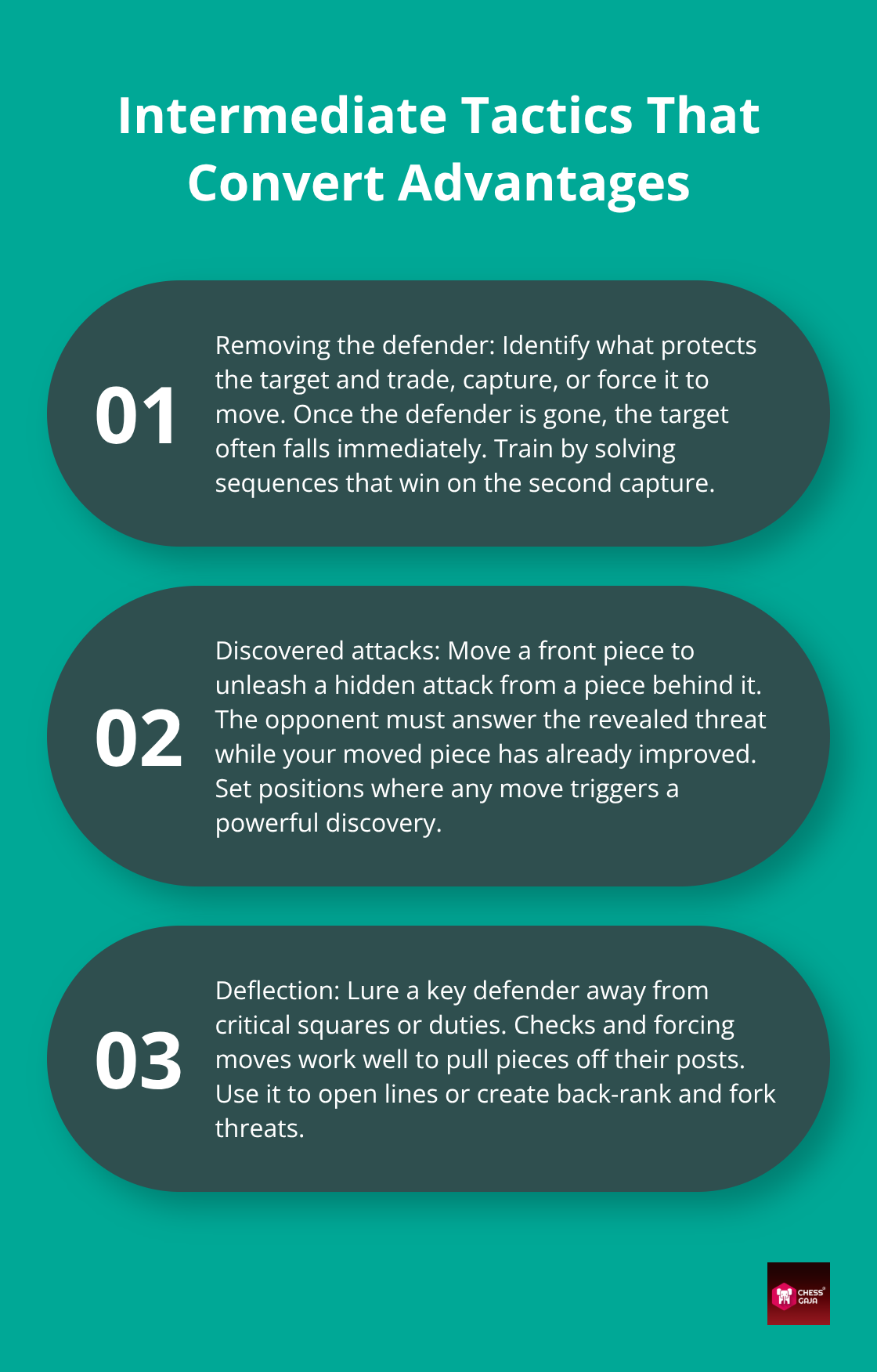
Removing the defender works because every piece protecting something valuable can be traded away, captured, or forced to move. For instance, if a knight on f6 protects a bishop on e4, capturing that knight with your bishop forces the opponent to recapture, leaving their bishop on e4 unprotected for your next move. The moment the defender disappears, the target falls. Tournament players use this tactic constantly because it converts defended material into free material.
Practice driving away or capturing the defender first. Then, take the unprotected target piece on your follow-up move. This teaches your brain to look past the first capture and see the second one that wins material. A player in the USA who practices this pattern will develop the habit of asking: what is defending this piece, and can I remove it? That question alone wins dozens of games per season because most opponents never expect the two-move sequence.
Discovered Attacks: Revealing Hidden Threats
Discovered attacks operate on the opposite principle: you move one piece and reveal a devastating threat from a piece behind it. Your knight moves and uncovers a rook attack on the queen. Your pawn advances and exposes a bishop that attacks the king. Discovered attacks are particularly powerful because your opponent must respond to the newly revealed threat, and the moved piece has already accomplished its purpose. Train discovered attacks by calculating forcing moves for the front piece—such as a check or an attack on an undefended piece—so your opponent is forced to respond while your uncovered piece delivers its hidden strike. This pattern teaches you to see the board in layers-the piece you move matters less than the piece you uncover.
Deflection and Decoy: Pulling Pieces Away
Deflection forces a defensive piece away from a critical square, while a decoy lures an enemy piece onto an unfavorable square to set up a follow-up tactic like a fork or checkmate. A knight on d4 defending a critical back-rank square can be deflected by a tactical sacrifice elsewhere that the opponent is forced to accept, instantly leaving those key squares vulnerable. A queen protecting the back rank can be lured away by a forcing check that only the queen can capture, instantly leaving the back rank exposed to a checkmate. These tactics exploit your opponent’s defensive setup by stripping away key defenders or forcing high-value pieces onto vulnerable squares. Deflecting a defender creates a lose-lose choice. Your opponent must either ignore the threat and lose material, or take the bait and leave their critical square exposed.
Combining Patterns Into Tournament-Winning Sequences
Real games do not present these patterns in isolation. A single move often combines removing the defender with a discovered attack, or uses deflection to set up a fork three moves later. A player who trains these patterns separately will eventually see them blend together naturally during tournament play. The key is training volume and focus. Solve at least 10–15 puzzles daily on intermediate patterns, mixing them randomly so your brain learns to recognize which pattern applies in unfamiliar positions. After 60 days of consistent practice, you will notice a dramatic shift: positions that once confused you become obvious, and your calculation speed accelerates. Intermediate tactics are where the gap between casual and competitive widens permanently.
These three intermediate patterns form the bridge between seeing single-move tactics and executing multi-move combinations that dominate tournament play. Once you combine removing the defender, discovered attacks, and deflection into your tactical arsenal, you are ready to apply these patterns across different opening systems and time controls-the final step toward competitive mastery.
Tactics Under Time Pressure
Tournament chess forces you to execute patterns in seconds, not minutes. A student in Singapore competing in a rapid tournament with a 15-minute clock has mere seconds per move—far too little time to calculate every variation deeply. The difference between winning and losing hinges on whether you trained your pattern recognition to operate automatically. Your opponent will not wait while you analyze. The solution is simple: train your eyes to recognize patterns so deeply that spotting a fork feels as natural as seeing a piece on the board.
Building Speed Through High-Volume Pattern Training
Train pattern recognition through structured daily repetition, and your brain will flag tactical opportunities automatically. A player in Dubai who follows this regimen will notice a concrete shift: positions that once required 30 seconds of calculation now take seconds because the pattern recognition is deeply ingrained. The key is volume with variety. Solve focused sets of 10–15 puzzles per motif to lock in the visual pattern, then immediately transition to randomized puzzle sets to build dynamic recognition speed. This forces your brain to recognize patterns across different board configurations, not just memorized positions. Competitive players train this way because tournaments demand speed and accuracy simultaneously.
Recognizing Patterns Across Opening Systems
Applying patterns across different opening systems requires understanding that tactics emerge from structural weaknesses, not opening theory. A student in the USA who masters pins in the Sicilian Defense will recognize the same pin in the French Defense because the pattern is universal.
Your opening choice influences which squares become vulnerable, but the tactical motifs remain constant. Train by studying real tournament games in your preferred openings, then solve puzzles extracted directly from those games. This teaches you how patterns actually appear in competitive play rather than in artificially constructed puzzle positions.
Study 20 to 30 annotated master games. You will quickly build intuition for the tactics that arise in your opening choices. An open file leading to a back-rank vulnerability can be exploited across many opening setups once pieces begin to trade off. A centralized knight on a key outpost like d5/e5 (or d4/e4 for Black) often sets up tactical forks or discovered attacks.
A bishop pair in open positions frequently generates powerful pins along open diagonals, freezing enemy pieces against high-value targets. These are not theoretical concepts-they are predictable consequences of opening structures. Players who recognize these tendencies gain enormous practical advantage because they anticipate tactical opportunities before opponents create them.
Tournament Simulation Under Match Conditions
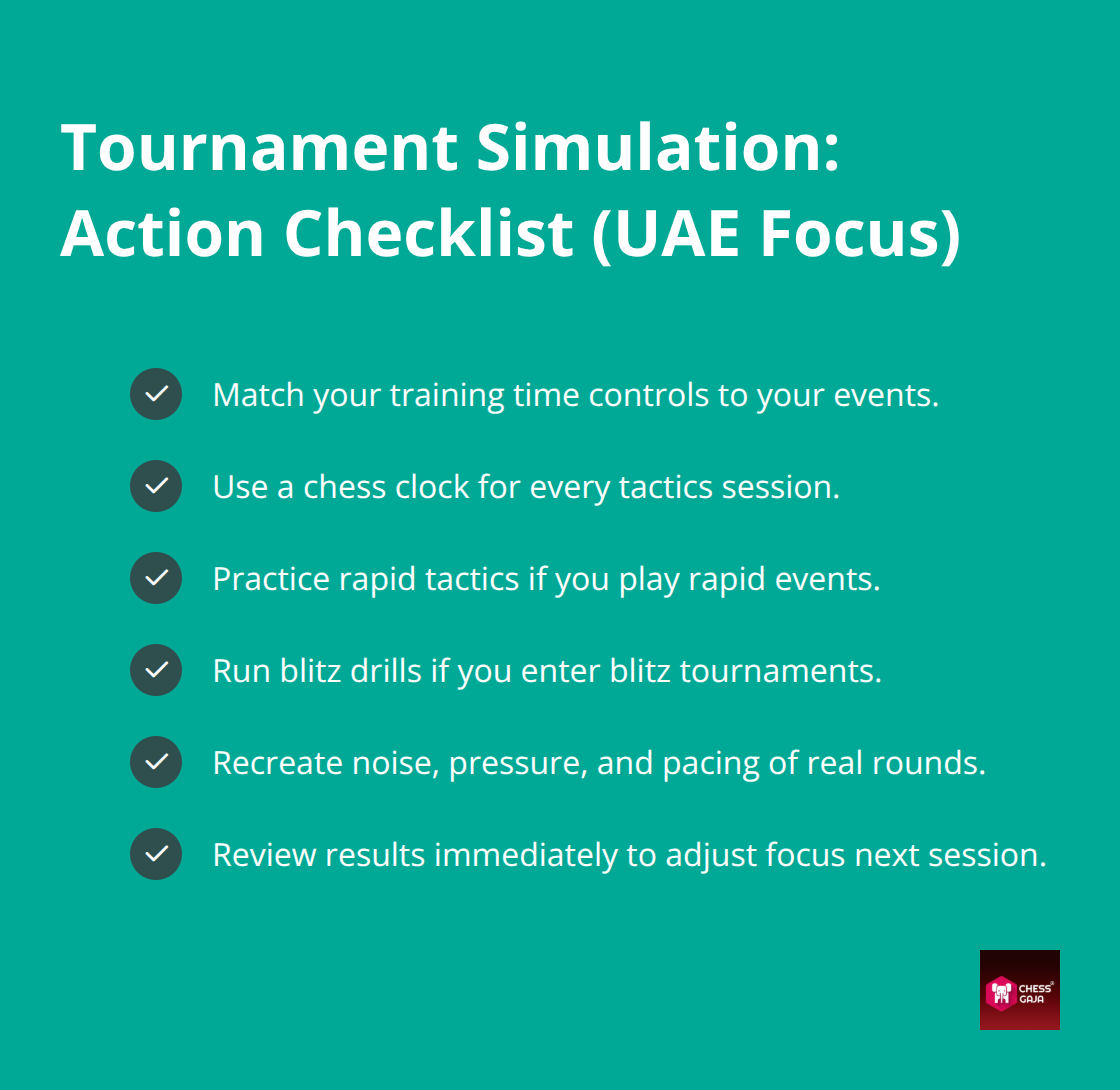
The final step is tournament simulation: solve puzzles on your chosen opening systems while using a chess clock set to your tournament time control. This trains your brain to operate under the exact conditions you will face. Taking 10 minutes per puzzle will hurt your rapid tournament preparation. Real matches demand much faster mental processing speed. Train under the conditions you will compete in, and your pattern recognition will transfer directly to tournament results.
A student in the UAE who solves puzzles at classical pace but never practices rapid will find that rapid tournaments expose gaps in their speed. The solution is straightforward: match your training environment to your tournament environment. If you compete in rapid (15 minutes per side), practice tactics under rapid time pressure. If you compete in blitz (3 minutes per side), practice high-speed tactical drills with strict 5-to-10-second limits per puzzle to train instant visual intuition.
Your brain adapts to the conditions you expose it to, so create conditions that mirror the tournaments you will enter.
Final Thoughts
Tactical mastery separates players who win consistently from those who lose repeatedly. A student in Singapore who masters pins, forks, and skewers gains an immediate advantage in tournament play, while a player in Dubai who recognizes removed defenders and discovered attacks calculates faster than opponents. A competitor in the USA who trains advanced chess tactics patterns under time pressure executes combinations that opponents cannot defend.
Your daily practice must mirror tournament conditions. Solve focused puzzle sets daily, transitioning to mixed sets only after single-pattern motifs are fully mastered. Train under time pressure that mirrors your upcoming events so your tactical vision translates seamlessly to actual tournament games.
Most players waste months memorizing openings while their tactical vision stays weak. We recommend the opposite strategy. Spend your first 90 days mastering pins, forks, and skewers. Once your tactical foundation is solid, layer opening knowledge on top.
At Chess Gaja, we serve 5,000+ students across 40+ countries with GM-led coaching from FIDE-rated instructors, and our Paid Starter Class includes a professional skill evaluation where a coach assesses your current tactical level, identifies your pattern recognition gaps, and builds a personalized study plan tailored to your rating and tournament goals.