


Your first tournament is coming up, and you realize your openings feel scattered. You’re playing different moves each game without a real plan.
We at Chess Gaja have coached thousands of junior players through this exact moment. The opening ideas for juniors that work best aren’t complicated-they’re systematic. This guide shows you how to build openings that grow with your rating.
The Three Rules That Stop Scattered Opening Play
Rule One: Control the Center with Purpose
Your first tournament game starts, and you’ve played 1.e4 in practice all week. Then your opponent plays 1…c5, and suddenly you’re unsure whether to memorize lines or trust your instincts. This moment stops most juniors cold. Opening play feels disconnected from the rest of the game. Center control doesn’t mean planting pawns on d4 and e4 and defending them endlessly. It means placing pieces where they accomplish two jobs at once: they control central squares while developing toward an active position.
When you play 1.e4 e5 2.Nf3, your knight directly attacks the e5-pawn while controlling the key central d4 square and preparing further development. That’s purposeful center control. Compare this to a beginner who pushes pawns forward recklessly-they occupy space but create weaknesses. In junior tournaments, players rated 1200–1600 improve fastest when they rethink piece placement. Stop asking where pieces go, and start asking what each piece accomplishes.
Rule Two: Develop Pieces Before Moving the Same Piece Twice
This rule saves you from wasting critical opening moves. Each piece move in the opening should bring a piece from its starting square toward an active role. If you move your knight from g1 to f3 to e5 to d3, you’ve used four moves to position one piece. Your opponent has developed three pieces in the same time.
Tournaments show that juniors who develop four or five pieces in the first 10–12 moves gain a real advantage over players who move the same piece multiple times. The math is simple: more pieces active means more control, more threats, and more winning chances before the middlegame even starts.
Many players abandon an opening after a few losses because they assume it’s weak, when in reality they’ve only scratched the surface of how to study chess openings the right way.
Rule Three: Castle Early to Secure Your King
Many juniors wait too long, thinking they’ll launch an attack first. In practice games, this costs them. Castling early—ideally by move 5 to 8 for both White and Black—removes your king from the center where it’s exposed to checks and tactics. Once your king is safe, your remaining pieces can attack with full confidence.
These three rules work at every rating level because they’re not about memorizing specific defenses-they’re about building positions where your pieces work together and your king stays safe. The next step is learning which opening systems let you apply these rules most naturally.
Common Opening Systems That Work at Every Level
The Italian Game, Sicilian Defense, and French Defense aren’t just names in a textbook-they’re three distinct pathways that junior players in the USA, UAE, and Singapore use to apply the three foundational rules you just learned. Each system works differently. Choosing the right one depends on your playing style and study time. The Italian Game rewards aggressive, tactical players who want quick piece activity. The Sicilian Defense suits competitive juniors who expect tough opposition and want counterplay. The French Defense appeals to positional players who prefer solid structures and long-term plans.
What matters most is that you pick one system for White and one for Black, then study it deeply rather than jumping between different openings every month.
The Italian Game: Speed and Tactics
The Italian Game (1.e4 e5 2.Nf3 Nc6 3.Bc4) follows Rule One perfectly-your bishop on c4 controls the center while attacking f7, one of Black’s weakest squares. You develop quickly, often castling by move 4 to 7, and the positions remain tactical and sharp. Juniors who play the Italian Game typically see faster rating gains in the first year because the opening naturally forces you to calculate tactics and spot weaknesses.
The downside is that Black has solid defensive resources if they know the main lines, so you need to study model games from strong players like Fabiano Caruana and Veselin Topalov, both of whom have mastered the Italian Game at the highest levels. Their games show you how to maintain pressure without overextending.
The Sicilian Defense: Counterplay and Complexity
For Black, the Sicilian Defense (1.e4 c5) is the most popular weapon in junior tournaments. It avoids symmetrical positions and gives you immediate counterplay. Black’s c-pawn controls the central d4 square. When White plays d4, Black trades their c-pawn for White’s d-pawn. This trade grants Black a superior central pawn majority for the middlegame.
However, the Sicilian demands serious study. White has many different systems, such as the Open and Closed lines. You must know how to respond to each. Juniors who commit to the Sicilian often see their rating plateau until they deepen their opening knowledge. The investment pays off once you master the key positions.
The French Defense: Solid Structures
The French Defense (1.e4 e6) is the third option. It differs from the others by focusing on a solid, positional foundation rather than immediate tactics. Black accepts a space disadvantage in the early game. In return, Black gains a strong pawn structure and solid counterplay.
The French Defense works exceptionally well for junior players who think two or three moves ahead and dislike chaotic positions. Players using the French Defense as Black tend to have more consistent results because the opening reduces blunders-you’re playing a known, tested structure rather than improvising against tactical threats. This consistency matters when you’re building your rating over months and years.
Moving Forward with Your Choice
Once you select your opening systems, the real work begins. You’ll study model games, practice against different opponents, and refine your understanding of the positions that arise. The next section shows you how to build a long-term opening repertoire that grows stronger as your rating climbs.
Building Your First Opening Repertoire
Commit to Two or Three Openings
Limiting yourself to two or three openings feels restrictive when you’re starting out, but it’s the fastest path to rating growth. Juniors who bounce between five or six openings waste energy. They constantly relearn positions instead of deepening their understanding. When you commit to the Italian Game as White and the Sicilian Defense as Black, you play the same types of positions repeatedly. After 15–20 games with each opening, patterns emerge. You recognize when your opponent deviates from standard moves. You spot tactical themes faster because you’ve seen them before. Your rating climbs not because you memorized theory, but because familiarity breeds accuracy. This focus matters most in your first 12 months of serious tournament play-lock in your systems now, and you’ll build a foundation that holds at 1400, 1600, and 1800 ratings.
Study Model Games from Players Near Your Level
You should study model games from players near your level, not 2700+ supergrandmasters. When you watch Fabiano Caruana’s Italian Game masterpieces, you see brilliant sacrifices and deep preparation that don’t apply to your 1200-rated opponents. Avoid memorizing complex GM lines. Instead, study classic games by legends like Paul Morphy or José Raúl Capablanca. Clear model games by strong Masters (2000–2200 rating) are also ideal. Chess.com, Lichess, and the ChessTempo database let you filter games by opening and rating range. Pick three to five games where your opening creates a middlegame advantage. Study them without a computer first. Ask yourself why each move happened.
What was the player attacking or defending? Where did Black go wrong? Only after you’ve thought through the position yourself should you check engine analysis. This approach teaches you the logic behind moves, not just the moves themselves. Many juniors skip this step and memorize 15 moves of theory. Then, they panic when an opponent plays an unexpected 12th move. Model games teach you principles that adapt to any opponent’s response.
Practice in Rapid Games with Purpose
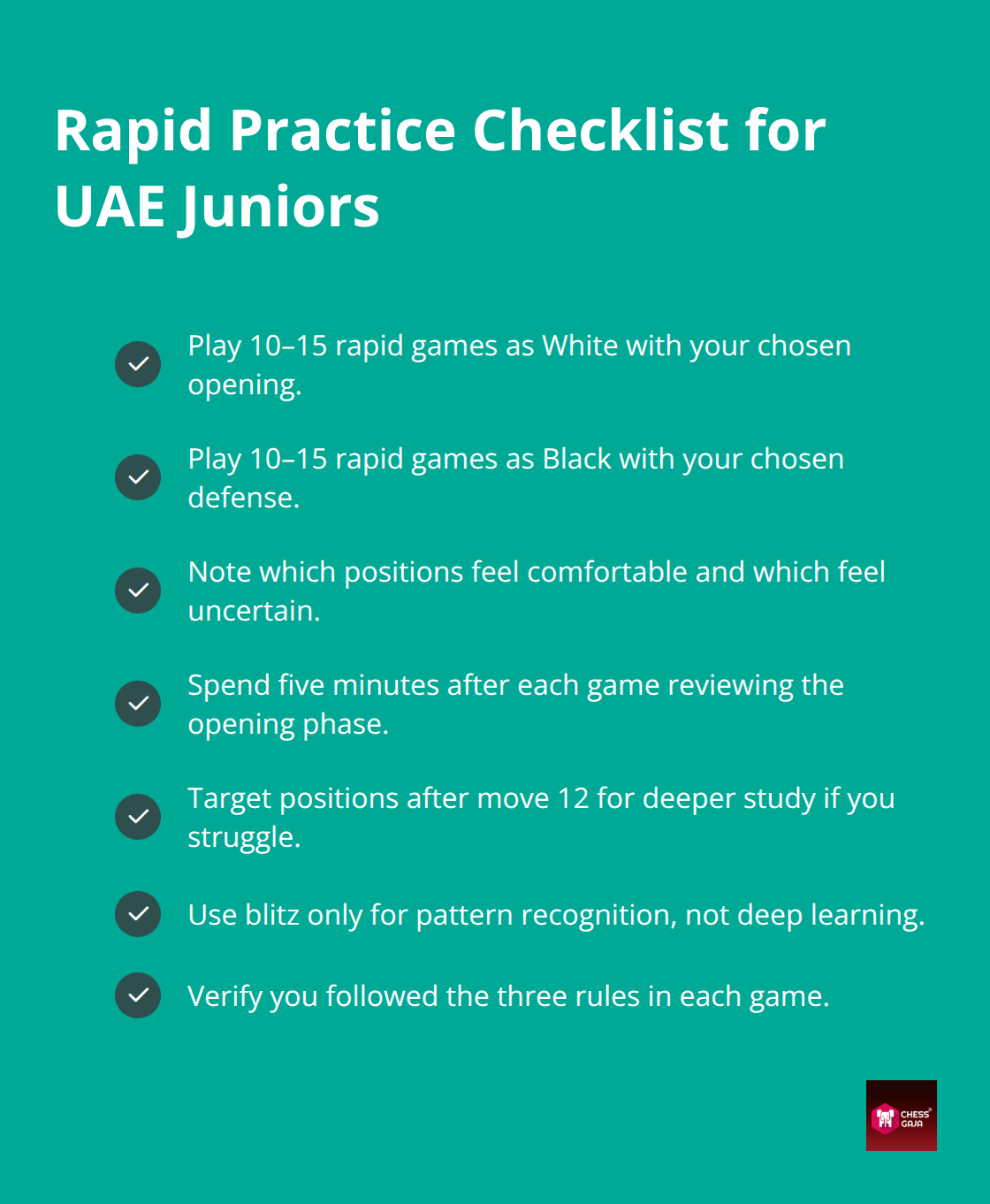
You should practice your openings in rapid games before tournaments, but with a specific purpose. Play 10–15 rapid games (10-minute time controls) with your chosen opening as White, then 10–15 more as Black. Note which positions feel comfortable and which ones leave you uncertain.
If you consistently struggle in a particular position after move 12, that’s a signal to study more model games or adjust your opening choice. Blitz games (3–5 minutes) are useful for pattern recognition but not for serious opening study-you won’t have time to think deeply, and you’ll reinforce bad habits if you’re guessing. After each rapid game, spend five minutes reviewing your opening phase. Did you follow the three rules from the previous section? Did you develop pieces efficiently, or did you move the same piece twice? This discipline separates juniors who improve steadily from those who plateau.
Track Your Results and Identify Patterns
You should track your results in a simple spreadsheet: opening played, opponent rating, result, and a one-sentence note on what you learned. Over 30–40 games, patterns will emerge about which openings suit your style and which ones need adjustment. This data reveals whether your struggles stem from weak opening knowledge or poor middlegame execution. If you score well in the opening but lose games after move 20, your opening choice is sound-you need to strengthen your middlegame play instead. If you consistently find yourself in worse positions by move 15, your opening system doesn’t match your playing style or preparation level. These insights guide your next steps without wasting months on the wrong path.
Final Thoughts
The opening ideas for juniors you’ve learned in this guide work because they rest on principles, not memorization. Control the center with purpose, develop pieces before moving the same piece twice, and castle early to secure your king. These three rules apply whether you play the Italian Game, Sicilian Defense, or French Defense-and they apply at 1200 rating and at 1800 rating.
Juniors who commit to two or three openings and study model games from players near their level see measurable rating growth within 6–12 months. Each tournament game teaches you something about the positions you’re building, and each loss reveals where your understanding breaks down. This feedback loop accelerates your development in ways that solo study cannot.
We at Chess Gaja have coached thousands of students across 40+ countries through this exact progression. Our FIDE-rated coaches work with you to select opening systems that match your playing style, then guide you through model games and tournament preparation. Book a Paid Starter Class with Chess Gaja for a professional skill evaluation, and your coach will assess your current opening knowledge, identify which systems suit you best, and create a personalized study plan that grows with your rating.